

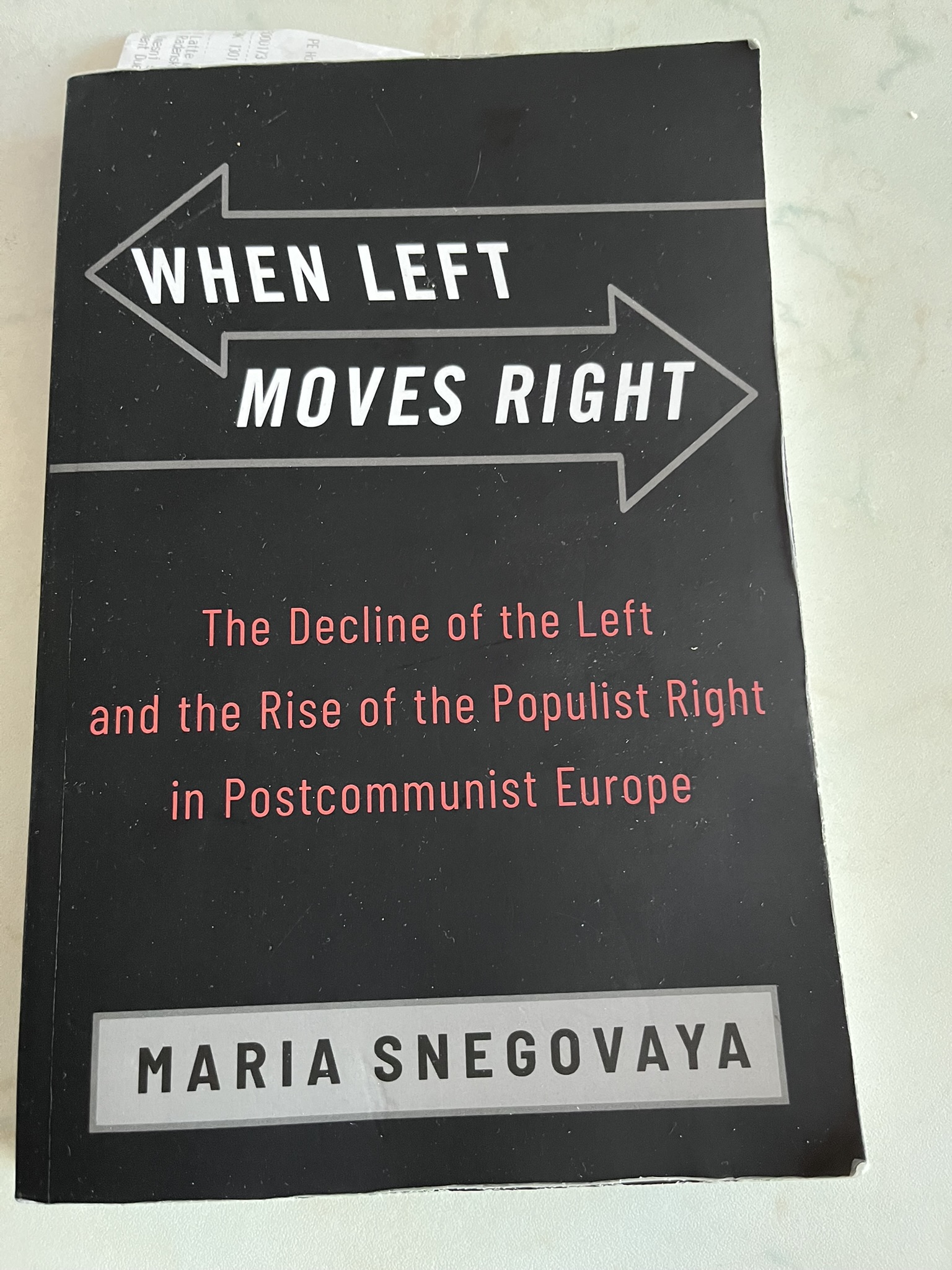
What Happens when Left Moves Right
Right-wing populism is strong in Eastern Europe.
Throughout the 1990s many leftist parties in Central and Eastern Europe defied predictions that they would sink into oblivion.
Starting in the mid-2000s left-wing parties began to suffer major electoral defeats. Even in former social democratic strongholds such as Germany and Scandinavia the left’s vote shares saw a striking drop in the twenty-first century.
The number of Europeans voting for populist parties in national elections has surged from an average of 7% in 1998 to more than 25% in 2018.
The embrace of pro-market policies and the implementation of painful and unpopular reforms contributed to the electoral demise of left-wing parties in the region. Populist parties on the right turned out to be unlikely beneficiaries of the left’s policy miscalculations.
Scholars did not expect policy reversals to constitute a major threat to the stability of left-wing parties’ electoral base, for three reasons:
- First, left-wing parties in the region were able to build considerably stronger and more extensive organizations than their right-wing competitors partly as a legacy of the communist period.
- Second, the traditional pro-welfare image of leftist parties was expected to provide a safeguard against voter punishment because budget cuts introduced by left-wing parties, unlike those introduced by right-wing parties, could be interpreted as being absolutely essential rather than ideologically motivated.
- Third, scholars expected that the existence of lingering social constituencies (older people, former members of communist parties, etc.) would facilitate the programmatic turnaround of successor parties.
Experts overestimated the level of loyalty for the reformist left.
Party competitions is a strategic contest among parties as political actors to gain political power by positioning themselves on different policy dimensions.
Studies have demonstrated that party competition in Western Europe unfolded primarily along two dimensions: an economic axis and a socio-cultural axis. The economic dimension refers to a conflict about levels of economic regulation and redistribution that occurs between supporters of more stringent socialist and capitalist policies. The sociocultural dimension usually describes a conflict that occurs between supporters of more traditional and more multi-cultural, postmaterialist values and issues.
Dealignment is when a large swath of voters leaves their party without switching to another. Realignment is when a large swath of voters switches to another party.
Following the collapse of communism, countries underwent the process of a triple transition. Political transition refers to democratization. The process of national transition led to defining the territorial and cultural boundaries of the nation-state in respective societies. Economic transition refers to marketization.
Social class is conceptualized as an interrelated set of occupational characteristics, which give rise to differentiated economy strategies and link workers from various sectors of the economy.
Author use the terms neoliberalism, neoliberal politics, and pro-market reforms interchangeably to refer to the embrace of three elements: economic privatization, deregulation and liberalization, and work-centric welfare reforms.
During the 1990s and 2000s postcommunist countries became global leaders in the adoption of neoliberal ideas and policies at a dramatic rate.
Welfare chauvinism refers to protecting the welfare state from the external threat of immigrants by restricting specific benefit to citizens or natives.
A combination of support for domestic free-market policies with strong anti-free-trade positions and welfare chauvinism is often referred to as economic nationalism.
Author defined parties as the traditional left if they constituted the part of the unreformed communist party that refused to break away with its communist past and largely preserved its Marxist agenda.
Author uses the terms nationalist-populist, right-wing populist, and populist right parties interchangeably.
It remains unclear why the left’s supporters waited many years to punish leftist parties.
The rise of populism across Western Europe as a reaction to failures of traditional parties to adequately respond to existing societal problems and public opinion in the eyes of their electorates.
Pro-market reforms tended to undermine worker sodalities and dramatically shrink their power, prestige, and opportunities.
In an effort to attract voters dissatisfied with the left’s policies, right-wing challengers commonly adopted more left-leaning economic platforms than other parties in their respective political systems.
The cultural backlash theories link the success of right-wing populist parties to their ability to politicize issues on the sociocultural dimension.
The populist phenomenon needs to be understood in combination with leftist parties’ policy choices on the economic dimension. Focusing on the sociocultural dimension alone does not fully explain the variation in right-wing populist parties’ fortunes.
Empirical evidence does not back the claim that party competition in European party systems occurs primarily because along the sociocultural dimensions.
Another popular explanation for the success of the populist right – the role of the migrant crisis and anti-immigration sentiment.
The formula for success of the populist right is clear: and it tends to follow the preferences of the working-class electorates combining nativism on the sociocultural dimension with redistribution positions on the economic dimension.
Postcommunist countries embraced pro-market economic policies more strongly than any other developing world region after 1989. These reforms known as “shock therapy” or the Washington Consensus, included the immediate liberalization of prices, the liberalization of trade, the introduction of convertible currencies, the lifting of capital controls, the elimination of state subsidies to firms, the privatization of pensions, and the introduction of the fiat tax.
Citizens of postcommunist countries were substantially more likely to agree that it is the state’s responsibility to provide for the social welfare of its citizens, as compared to the citizens of other European countries. The backlash against welfare retrenchment in this region was more pronounced than in Western Europe, which lacked such a legacy.
Postcommunist workers display a particular set of political attitudes that combine pro-redistributive preferences on economic policies with anti-immigration preferences on the sociocultural dimension.
How the Left Moved Right
Following the Third Way rebranding of leftist parties in countries such as the UK, Germany, and Sweden, their Eastern European counterparts tended to copy this behavior and adopt similar platforms.
Pro-market reforms in postcommunist Europe launched a socioeconomic cleavage between the economic “winners” and “losers” of the transition.
Since the 1950s, the Western left had come to be dominated by Keynesian economic policies, which included a focus on public spending and income redistribution, an interventionists role of the state in the economy, and stronger regulation. By the late 1970s, the structural context of social policy had changed dramatically. The welfare state was strained by slowing economic growth and deindustrialization, rising structural unemployment, demographic aging, and declining birth rates. The share of blue-collar workers that made up to voter population was halved.
Third Way parties promoted market-friendliness. Such parties accepted and often pioneered policies like partial privatization of the welfare state and government-run services and enterprises, taxation reforms, and heavy restrictions on trade tariffs that, in an earlier era, would have been unthinkable. Instead of redistributing incomes, they emphasized equal opportunities. They transformed from hybrid working-class parties into “catch-all” parties.
The disassociation of working-class interests from center-left parties has become a chief feature of social democratic parties since the 1990s.
Since the 1990s, working-class constituencies that had supported left parties gradually became the core support groups of many populist right parties.
In Britain after the Third Way period, the Labour Party attempted some rebranding, by appointing far-left socialist Jeremy Corbyn in 2015.
In Germany after Schroder period in the SPD the AfD, that was founded in 2012 received 11,5 % in 2017 federal elections. They drew significant shares of its support from former SPD voters.
In Sweden SAP (Social Democratic Party) introduced some liberal reforms in 1990s. This provided some political openings for other parties. Since 2010, the nationalist populist Sweden Democrats party (SD) has emerged from obscurity.
In Eastern Europe, the postcommunist governments in Hungary and Poland were in debt from the communist period and thus dependent on the IMFs continuous debt restructuring and aid.
Many left communist and socialist parties rebranded them into social democrats with more liberal stance in economic matters. This rebranding cost them in long run.
Liberal transition was additionally pushed by EU. The Maastricht convergence criteria needed to join EU proved particularly consequential.
As Rupnik has observed, it was “striking that most of the pro-European coalitions that dominated CEE politics over the last decade or so felt apart as soon as they had accomplished the historic task of achieving EU membership.”[1]
The 2008 financial crisis further accelerated these trends by deepening accumulated disappointment in neoliberalism. The average vote share of right-wing populists across Europe, which was about 5 % prior to crisis, climbed to double-digit levels two elections after the crisis.
The right-wing parties stated to offer the alternatives to neoliberalism. As an alternative to marketization, they started offering economic nationalist policies. While presenting “the people” as morally decent, economically struggling, hard-working, and family-oriented, right-wing populists contrasted them to “the elite”, which was seen as living in a different world, playing by different rules, insulated from economic hardships, corrupt, out of touch with the concerns and problems of ordinary people, and condescending toward ordinary people’s values, habits and lifestyles.
The populist right parties eventually shifted further to the left on the economic dimension, away from centrist or blurred economic positions towards more decidedly protectionist economic positions.
In Hungary and Poland, populist right parties Fidesz and PiS, respectively, adopted economic nationalism.
The Class Politics in Postcommunist Europe
Where ex-communist left parties look much like traditional left-wing parties, working-class support is more likely to be associated with them. Where these parties are adopt more pro-market positions, working-class groups are less likely to vote for them.
Today in Western Europe, production workers no longer represent a majority of the population. Political scientist Line Renwald estimates that the share of production workers in the Western European workforce declined from 31 % to 16%.
The postcommunist working class in Eastern Europe has always been weak. This is because communist rulers manipulated trade unions and replaced them with fictious structures.
Studies of Western Europe have demonstrated that working-class voters tend to hold a particular combination of political attitudes. They have stronger support for redistribution and more pronounced anti-immigration sentiments. The anti-immigration stance is connected to working-class having bigger labor market competition from immigrants. Due to lower education levels and a lack of material resources they are more likely to view immigration as a cultural threat.
The preferences of postcommunist working-class electorates tend to follow the patterns prevalent in Western European polities.
In postcommunist Europe working-class groups still represent a majority (up to 60%) of electorates.
How the Postcommunist Left Reformed and Lost
Author conducted a research of left parties according to their stances on economic issues. They placed the parties on a scale from 0 – left economic side with high redistribution and 10 – pro-market side. The period was from 2000 to 2014. Slovenia came from 4 to 3. Hungary was the most pro-market with 7 in 2006.
Similar analysis was done for sociocultural dimension. 0 represents extreme traditional/authoritarian position and 10 represents libertarian/postmaterialist position.
When left parties have increasingly pro-market positions on the economic policy dimension, there is a significant negative correlation to the level of political support for those parties.
Groups in precarious jobs are particularly unlikely to back left parties with more pro-market policy stances.
As left parties vacated redistributionist positions, right-populist parties shifted leftward on the economic axis. Such parties then successfully attracted support from working-class electorates, a phenomenon that became known in the Western European context as “proletarization” of the populist right.
When Left Moves Right, Right Wins
Hungary and Poland were countries where we could follow the pattern of left moving to right and right winning.
Hungary have two populist right parties: Fidesz and Jobbik. Large share of working-class voters who had traditionally voted for the Hungarian Socialist Party (MSZP) moved to right parties.
In Poland the right party the Polish populist right party (PiS) got votes from a center-left ex-communist party SLD.
Hungary
The MSZP strongly emphasized social tolerance, human rights, and multiculturalism. They joined the coalition with Alliance of Free Democrats further reinforcing their liberal, free-market-oriented image.
In 1994 MSZP established a formal alliance based on common “leftist values” with the National Confederation of Hungarian Trade Unions (MSZOSZ). MSZP won 33 % of the vote and 54 % of the seats in 1994.
The key element of the pro-market reform was the so-called Bokros Package. The package improved Hungary’s economic situation but the costs were huge.
MSZP was defeated at 1998 elections. Fidesz won 26 % of votes in 1998. Their stance changed from liberal (from 1990 to 1994) to state-led economici development and protection of domestic employers.
In 2002 MSZP get back to left economic stance and won. Spending programs boost the economy and increase public debt. And the MSZP re-election in 2006 was based on that public spending. And the national debt kept rising. That led to new austerity policies called New Balance Program that started after the election in 2006. Prime Minister Gyurcsany resigned in 2009 and Gordon Bajnai the new PM continued with austerity measures.
The 2010 elections were again the turning point Fidesz and Jobbik contested them on nationalist-populist platform. Fidesz won the elections with 52,7 % of votes. Many blamed the MSZP for abandoning the working class.
In its economic approach Fidesz pursued the policy of economic nationalism, offering to bring the interventionist nation-state back into the economy.
Poland
Lech Wales and his Solidarity movement won the first free elections in 1990. But the break-up of the Solidarity movement in 1991, opened the door to the formation of political parties that identified themselves as right-wing or center right. That led to formation of a center-right coalition government in 1991.
They introduced the economic reforms called the shock therapy. The Balcerowicz Plan aimed to curtail hyperinflation, reduce government spending, liberalize trade, and privatize state-owned companies. Country went into recession. That led to success of the left on 1993 elections.
Former activists of the communist Polish United Workers? Party opted to dissolve it and establish the Social Democracy of Republic of Poland (SdRP). They formed Democratic Left Alliance with other left parties.
There was also the agrarian Polish Peasant Party (PSL).
After the 1993 election, the SLD and the PSL together controlled nearly two-thirds of the seats. The new government announced that they will continue with the Balcerowicz Plan. The SLD lost 1997 elections to the Solidarity Election Action (AWS), a right-wing coalition of Solidarity trade unions and Catholic Parties.
The winning coalition broke in 2000. The SLD returned to its redistribution rhetoric and won the 2001 election with 41 % in a coalition with the Labor Union Party.
But again the left government was not in a position to cater to social demand – EU conditionally constrained the ruling parties’ policy choices. The voters did not appreciate the new government’s policies.
The party lost 2005 elections with only 11 % of the vote. The main contest on the Polish political scene occurred between two right-wing parties: the populist, PiS and the center-right Civic Platform (PO).
PiS was formed by Kaczynski brothers. They won 2005 election with 27 % of the vote, luring away between 13% and 17% of SLD supporters. The party decided to delay Eurozone entry. They eliminated inheritance tax, cut payroll taxes.
An earlier election was in 2007 and PO won that time with 41.5 % of vote. PiS was able to return to power in 2015 with 37.6 %. While preserving its nationalist focus, PiS presented itself as a protector of those who had not benefited from the transition to capitalism. Both anti-immigration and pro-distribution economic platform contributed to PiS victory. They reverse the increase in retirement age, they offer 500+ program for every family with a child. 500 zlot per month for every child.
When Left Stays Left, Right Stays Small
Communist Party elites in Czechoslovakia were more orthodox and traditional due to the legacy of the post-Prague Spring normalization. As a result, communist successor parties in both the Czech Republic and Slovakia took a more orthodox stance on political and economic transitions. This might be one reason why in both countries major leftist parties remained generally faithful to their traditional economic positions throughout the analyzed period.
Czech Repulic
KSČM was the direct heir to the Communist Party of Czechoslovakia. They did not embark on democratic reforms during the democratization period. They adopted a platform reminiscent of those used by populists right parties in other countries. Euroskeptic and nationalist on the sociocultural dimension. KSČM’s Party Manifesto combined redistribution and nationalist approach.
Another left party the Czech Social Democratic Party (ČSSD) also stayed close to leftist economic policies.
In 1992, the right wing alliance between the Civic Democratic Party (ODS), led by Vaclav Klaus and the Christian Democratic Party gained the majority of votes. They started to cut down welfare provisions.
ČSSD benefited the most from voters leaving ODS.
Class-based voting remained stable in the Czech Republic for almost two decades.
The Republican Party of Czechoslovakia (SPR-RSČ) was the right-wing party oriented toward redistribution. They made it to parliament in 1998 with 8% of vote.
In 2002 election KSČM won 18.5 % of vote.
In 2002 the populist right Czech Workers’ Party (DSSS) was founded by Tomaš Vandas. They adopted pro-distribution stance.
Between 1998 and 2010 the Czech electoral competition was characterized by the classic left-right model of political competition, with two main parties on the right (ODS) and on the left (ČSSD) rotating in power.
Slovakia
The People’s Party-Movement for a Democratic Slovakia ruled the country until 1998. It was led by Vladimir Mečiar.
The second-largest party at that time was Party of the Democratic Left (SDL). It was the successor of the communist party, but not the hard communist, that had their own party. They emphasized solidarity, social justice, and the promotion of the health and economic well-being of working people.
During the government of Mikulaš Dzurinda (1998-2002) a series of public-sector reforms and wide-scale economic restructuring took place. His government dismissed the unions as reform partners.
The SDL found itself in the position of being a left-wing party in a largely center-right government. They lost 2002 elections by gaining only 1.4 % of the vote. And they ended up merging with the splinter party Smer-SD in January 2005.
The hardline KSS gained parliamentary representation with 6.3 % of vote.
Smer-SD was created by Robert Fico, the SDL member at the time. In its platform they combined redistribution economic policies with some nationalistic overtones. Smer-SD won 2006 election and the next three 2010, 2012, 2016.
Decisions on the Ground
Experiment on the ground was run in Hungary in March 2018. In 2018 the MSZP adopted a program with the central slogan Let the rich pay.
Author used a 4-point Likert-type scale question:
- Not likely
- Probably not likely
- Probably likely
- Very likely
Results were in line with hypothesis.
When left parties adopt pro-market positions, support for populist right parties increases as long as the populist right parties adopt protectionist economic positions.
Conclusion
The effects of the pro-market shift by center-left parties in the postcommunist region have direct parallels to Western Europe. In both regions the process was launched by the rebranding of left parties. In both regions the Third Way policies eventually proved to be incapable of reconciling these newly adopted platforms with the domestic demands of their traditional constituents. With left parties no longer able to capture the support of economically vulnerable groups, in both regions and opportunity emerged on the opposite side of the political spectrum. Populist right parties tended to add more leftist economic positions to their traditional nativist stances on the sociocultural dimension.
The differences were that in Western Europe left parties moved to center due to the changes in electorate, in postcommunist countries they wanted to distance themselves from the communist past. In the postcommunist region the economic transition created sharper division between reform winners and losers. In this region the challenger parties gain more by attacking reformist left-wing incumbents. It was also more beneficiary due to the sheer size of these constituencies. Young democracies in the region were more vulnerable, more volatile than in the West.
In the future, new political openings allowing left parties to regain some working-class constituencies will most likely emerge when right-wing populist parties switch their economic platforms.
Social democratic parties will have to figure out ways to make their commitment to European integration compatible with their ideological goals of catering to the needs of economically vulnerable groups.
[1] In the book on page 59


