

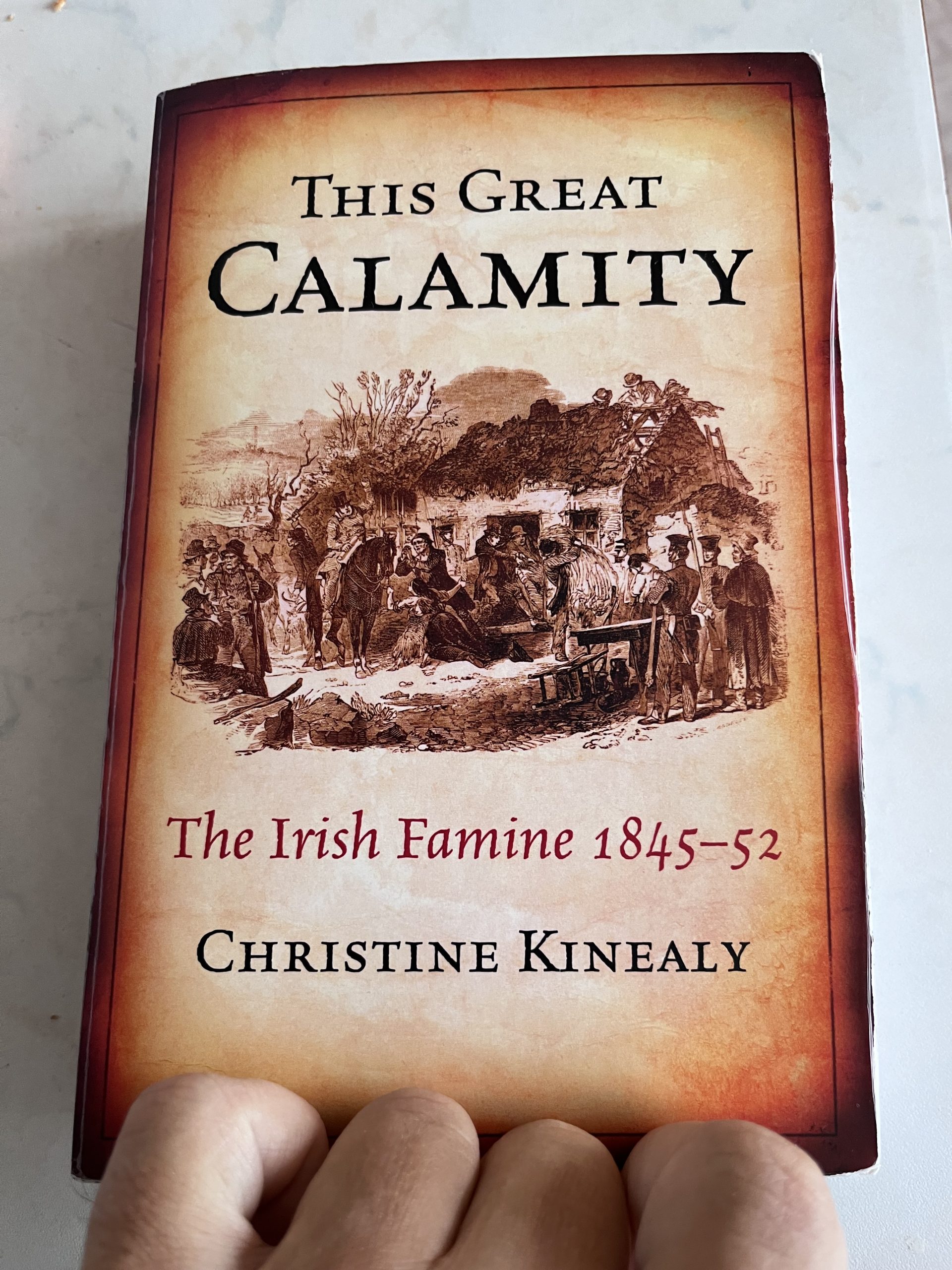
The Irish Famine
The impact of the Great Famine in Ireland remains unsurpassed in terms of demographic decline, with the Irish population falling by approximately 25 per cent in just six years, due to a combination of excess morality and mass emigration.
There was the marginalization of the Famine as an event of consequence within the development of modern Ireland by a group of historians known as revisionists. Collectively, they dominated Irish history discourse between the 1930s and 1990s.
Tony Blair. Although not directly offering an apology for the actions of the British government 150 years earlier, Blair acknowledged that, ‘Those who governed in London at the time failed their people through standing by while a crop failure turned into a massive human tragedy.’
Since the late nineteenth century, historians of the Famine have tended to portray it as a Catholic tragedy predominantly located in the south and west of the country. Pioneering research by James Grant and Gerard MacAtasney has shown that even east Ulster was affected by the Famine.
Background: The Rags and Wretched Cabins of Ireland 1845
The populist model of political economy produced an interpretation of Ireland as an over-populated country where sub-division of land and dependence on the potato left an excessive amount of idle time to peasant and landlord alike. The lack of economic progress was interpreted as a failure by landlords to undertake their responsibilities properly.
The introduction of a Poor Law to Ireland is significant. Its development highlighted attitudes within Westminster to the problem of poverty in Ireland. The 1838 Poor Law itself proved to be hopelessly inadequate in meeting the challenge of the Famine years.
The potato is believed to have reached Ireland in the late sixteenth century. By the 1840s, approximately two-fifths of the Irish population, that is over three million people, were relying on the potato as their staple food. The extent of land under the potato crop reached a peak in 1845, when 2.516.000 acres of land, approximately one-third of the total acreage tilled, was for the use of this crop.
Since 1801, Ireland had been part of the UK. Economically it was an unequal union.
During the Famine, the ideas of political economy were invoked to justify non-interference in the grain trade, following the disastrous blight of 1846.
Thomas Malthaus was one of the most influential disciplines of Adam Smith. He predicted that if the population was allowed to grow unchecked, it would increase more rapidly than food supplies. He alleged that poor relief, in fact, exacerbated the problem of population growth by encouraging the poor to breed recklessly.
The Royal Commission on Poor Law in England sat between 1832 and 1834. The Report of the Commission formed the basic of the new Poor Law in 1834. One of the most vociferous critics of the Poor Inquiry was the Home Secretary, Lord John Russell. He would replace Peel in 1846 and remain Prime Minister for the rest of the Famine.
Prior to 1838, the poor in Ireland were assisted almost totally by private charity.
In June 1838, a Poor Law closely based on the recommendations of George Nicholls was introduced to Ireland. It was modeled on the new English Poor Law of 1834.
Before the Poor Law could be implemented, Ireland was divided into 130 new administrative units known as unions.
Nicholls recommended that the workhouse should be able to hold approximately 1 per cent of the total Irish population, or an estimated 100.000 paupers.
By the beginning of 1845, only twelve of the 130 workhouses remained unopened.
A Blight of Unusual Character 1845-6
In August 1845, there were reports of the appearance of the mysterious disease in parts of England, notably on the Isle of Wright and in the vicinity of Kent.
The unknown blight was caused by a fungus ‘phytophtora infestans’. The disease was thought to have originated in South America.
The Corn Laws restricted the importation of corn into the UK until the price of grain in the home market had reached a fixed price. In June 1846, when the Corn Laws were repealed this resulted in the fall of Peel’s government. The Tory party was replaced by a Whig government led by Lord John Russell.
Charles Trevelyan was Permanent Secretary at the Treasury during the whole of the Famine period. He warned the officers involved in providing relief of the dangers of allowing Irish landlords and large farmers to abdicate from their duty and instead throw the burden on the ‘public purse’.
The Temporary Relief Commission was established by Sir Robert Peel on the 20 November 1845. During the summer of 1846, almost 700 relief committees were established according to the instruction of the government.
One of the first actions of Peel, acting with the Chancellor of the Exchequer, Golburn, had been to arrange for 100.000 worth of Indian corn and corn meal to be secretly purchased in America and shipped to Ireland at the beginning of 1846. The government decided to postpone making the corn available until the last possible moment in order to conserve the limited supplies which they had. The date for the opening of the food depots was 15 may 1846. They were closed on 15 August.
One of the less satisfactory elements of the government’s relief policies was the fact that some Irish merchants were dissatisfied with them. They could not get a sufficiently high price for their goods. Charles Trevelyan was sympathetic to the situation of the Irish traders. In the spring of 1846, he sent copies of a book by Edmund Burke, Thoughts on Scarcity, to various relief officers.
The Irish Board of Works did not become involved in the actual provision of relief until December 1845. Even before the public works commenced, Trevelyan expressed reservations about the wisdom of making the public works so attractive through the introduction of the ‘half-grant’ system.
A Poor Law had been introduced into Ireland in 1838. Immediately following its introduction, there was distress in Ireland in 1839 and again in 1842. The government made a clear distinction between the temporary measures that were necessary to meet the additional distress.
On 24 March 1846, a Fever Act was introduced which established a temporary Board of Health in Dublin. Its remit was ‘to make temporary provision for the treatment of destitute poor persons afflicted with fever in Ireland. This act was to expire on 1 September 1847.
As both the government meal and the public works became available, however, they tended to dissipate and were not revived until August 1846, when the government attempted to reduce wages on the public works.
In July 1846, there were increasing sightings of potato blight in various parts of the country.
We Cannot Feed the People
During the winter of 1846-7, the localized food shortage that had been a characteristic of the previous year gave way to widespread distress on a major scale.
In 1846, the destruction of the potato crop was as rapid as it was comprehensive.
Russell confirmed the allegiance of the Whig government to a policy of non-interference as far as possible.
There were three components to the relief policies of the government following the second year of crop failure: public work, relief committees and the local workhouses.
In the early months of 1847, there were increasing reports of deaths caused by disease and starvation in all parts of Ireland.
Regardless of the fact that the policies being pursued by the government were inadequate, the government refused to deviate from its chosen course. The promise made to a small but powerful group of merchants and traders were put above the need of many Irish people to obtain food.
The new public works legislation which was passed in August 1846 was popularly known as the ‘Labour Rate Act’. After August 1846, a system of task work – that is, payment by results – was introduced.
Although many aspects of the public works were disliked, the number of people engaged on them continued to grow, not peaking until March 1847. In March 1847 714.000 persons were employed on the works.
At the beginning of 1847, the government announced a major change of policy. It had two basic components. In the short term, people in the western counties of Ireland need food. This was to be provided through soup kitchens which were to be introduced in the spring and summer of 1847. The permanent system of poor relief in Ireland, the Poor Law, was to be extended to meet any future demand.
By Christmas 1846, over half of the 130 workhouses were full.
Outdoor relief provided by the Poor Law guardians, therefore, was widely resorted to in the winter of 1846-7 as a way of compensating inadequacies of government’s temporary relief measures.
By the end of 1846, it was obvious that the temporary relief policies introduced by the government in the autumn of 1846 were not succeeding.
By the beginning of 1847, several Poor Law unions were without funds. The amount of poor rates collected rose sharply in 1847 and 1848, but it remained insufficient to meet increased union expenditure.
Increasingly, a gulf between how the Famine was viewed by the relief officials in Dublin and how it was viewed in England was opening. The general consensus within Britain was that the Irish people must be made to learn to depend on their own resources, despite the problems that had become apparent.
One change which was to have long term implications for the government’s relief policy was the official sanction given to the establishment of soup kitchens. It formed a major part of the government’s relief policies in 1847. The legislation was known as the Temporary Relief Act.
At the beginning of 1847, deaths in the Irish workhouses reached approximately 2.700 per week. The same number was reached in the early months of 1849.
The impact of the potato blight of 1845.6 on Belfast had been limited. The impact of the second blight was both immediate and unrelenting.
A small clique within the Whig administration had decided that local resources were to bear the responsibility for financing local poverty, regardless of the ability of these resources to meet the new demands.
The Deplorable Consequences of This Great Calamity (1846-7)
By the beginning of 1847, it was obvious that the temporary relief measures introduced only a few months previously had failed.
Some members of the government believed that the salvation of Ireland depended on a transfer to local interest and accountability. In his book of the Irish Famine, written in 1848, Trevelyan repeated many of the arguments made by Edmund Burke half a century earlier.
Routh was replaced as the chairman of the new Temporary Relief Commission. He was replaced by Major-General Sir John Burgoyne.
On 20 March 1847, the Treasury ordered a 20 per cent reduction in the numbers employed on the relief works. A second reduction of 10 per cent was to take place on 24 April. The contraction of the public works was sometimes enforced without any due regard to the availability of other forms of relief.
The Temporary Relief Act was undoubtedly the most liberal and extensive form of relief used at any time during the Famine.
The number of people in receipt of soup continued to rise throughout May and June 1847.
The Temporary Fever Act of 1846 had made the local boards of guardians responsible for establishing additional fever hospitals, but the guardians had been hamstrung by the general lack of funds. The government established a Central Board of Health at the beginning of 1847.
One of the most important and highly regarded charitable organizations was the Society of Friends or Quakers. They first became involved in Irish Famine relief in November 1846.
A large proportions of private donations came from North America which have been a favorite destination for migrants in the century prior to the Famine.
The exact number of people who died during the Famine years (1845-51) is not known. In 1851, the Census Commissioners attempted to produce a table of mortality for each year since 1841, the date of the previous census. The correct number probably lies between half a million and one and a half million.
Expedients Well Nigh Exhausted 1847-48
The third consecutive year of Famine distress in Ireland coincided with an extension of Treasury control over the mechanism as well as finances of social policy. A strengthen position of Wood and Trevelyan in the Treasury, and a general lack of sympathy in Britain for Irish distress, facilitated the enactment of significantly more rigorous approach to relief policy.
The results of the 1847 General Election were to have important implications for subsequent relief policies in Ireland.
British public opinion and short-term financial crisis in 1847 contributed to a determination that Ireland should not be allowed to make further demands on an already hard-pressed Treasury.
The transfer to Poor Law relief was achieved through the introduction of three new pieces of legislation in June and July 1847. The Poor Law Amendment Act of 1847 allowed outdoor relief. Outdoor relief could only be provided upon the more of a Sealed Order by the Poor Law Commissioners. The Poor Law Extension Act altered the structure of the Poor Law Commission and provided for the establishment of a separate authority in Ireland, with autonomy from the Poor Law Board in England.
Edward Twistelton, the resident Commissioner in Ireland, was to continue in office as Chief Commissioner.
The effectiveness of the Poor Law and the ultimate success of the government’s new policy largely depended upon the levying and collection of adequate poor rates.
Initially, the Treasury insisted that the repayment of for the advances for the Temporary Relief Act were to be included in the 1847 harvest rate. The smallness of the 1847 harvest, together with the insolvency of some local unions, resulted in a re-scheduling of the repayments. None were demanded before 1 January 1848.
Increasingly after September 1847, a solution to the financial difficulties of some landlords was to evict tenants who occupied small holdings of land.
To a large extent, distress in the north of the country was primarily caused by a temporary depression in trade, rather than the shortcomings of the 1847 harvest.
Increasingly, boards of guardians in the south and west of Ireland were skeptical about the ability of the Poor Law to bear the whole burden of providing relief, despite the recent extension of its powers.
In May 1848, over one million people daily were being relieved by the Poor Law, four-fifths of whom were in receipt of outdoor relief.
The reduced involvement of the British Relief Association in 1848 meant that it again became necessary for the government to provide financial assistance.
The men who were chose to act as vice-guardians invariably came from outside the union. They were paid guardians. It was not until 1850 that the administration of the Poor Law was returned to its elected representatives, in recognition of the fact that demand for poor relief had stabilized.
Prior to 1845, there had been several attempts to restructure and modernize a number of estates in Ireland. The Famine provided the necessary preconditions and the impetus for economic and social change. The repeal of the Corn Laws in 1846 contributed to a shift from tillage to cattle farming. In 1848, the Encumbered Estates Act was introduced to facilitate the transfer of property from, the government hoped, impoverished landlords to men of capital.
The Gregory Clause stipulated that any person who occupied more than a quarter of an acre of land could not be deemed destitute and was not entitled to receive relief.
The eviction of large numbers of people threw a heavy burden on the poor rates within a union.
The vision of the economic transformation or rural Ireland encouraged a policy of minimal intervention which, together with the Quarter Acre Clause, clearly facilitated the amalgamation of small holdings.
As the 1848 year progressed, the personal relationship between Trevelyan and Twistleton grew increasingly more fraught.
Over the summer of 1848, the Treasury reluctantly provided additional financial assistance to the distress unions.
Making Property Support Poverty 1848-9
By August 1848 it was obvious that in the areas of the west coast of Ireland blight had re-appeared. Also in the north-east.
The revival of the linen industry in mid-1848 meant that the small-holders in Ulster were able to weather the storm of a further potato blight and small crop yields.
In 1848 the country was entering its fourth successive year of distress.
By this stage, it was apparent that no system of relief on such a large scale had ever been administered so cheaply before.
At the beginning of March 1849, the Poor Law Amendment Committee met for the last time.
In the beginning of 1849, it was obvious that some additional finance would have to be allocated to the relief of distress.
Treasury again allowed repayments to be postponed until harvest of 1849.
In the middle of March 1849, a final grant of 1000 pounds was given by the British Relief Association to the Poor Law Commissioners.
The Census Commissioners acting on behalf of the government, stated that in 1849 mortality reached a new peak. The appearance of cholera in some part of Ireland in the early months of 1849, had a short-term but dramatic impact on local mortality rate.
New legislation was introduced. The Rate-in-Aid. Edward Twisleton resigned as protest against the law. He was replaced by Alfred Power.
The General Advancement of the Country 1849-52
Compared with earlier years, the organization of relief after 1849 became concentrated in the hands of the permanent system of poor relief in Ireland.
The harvest of 1849 was mostly healthy, with only isolated instanced of potato blight.
An important feature of the return to a more normal system of relief was the restoration of elected boards of guardians.
After the harvest of 1849, the Treasury decreed that the repayments to be made by each Poor Law union, in order of priority, were the Rate-in-Aid, the Temporary Relief Advances, and the loans made for the building of the workhouses.
After 1849 and 1850 some unions were still in trouble, but the situation got better.
In the twelve months ending September 1852, the number of people receiving relief in the whole country fell from 145.743 to 115.805. The 1852 harvest was healthy and virtually free from potato blight.
The money advanced by the Treasury during the whole of the Famine was less than one-half per cent of the annual Gros National Product of the UK.
In the 1850, the Census Commissioners recorded that in the ten years from 1841 to 1851 the population of Ireland had fallen from 8.175.124 persons to 6.552.835 persons. They estimated that without Famine the population of Ireland in 1851 would have been 9.018.799.
Their Sorrowful Pilgrimage: Emigration 1847-55
Years of famine and distress had an impact on the rate of emigration from Ireland. Emigration was not a new phenomenon.
One-to-one-and-a-half million people left Ireland between 1845 and 1851 and as many as a further two million in the subsequent twenty years. Famine emigration did not truly commence until the end of 1846. The prime destination were USA.
After 1854 Irish emigration declined rapidly and by 1858 was lower that its pre-Famine level.
Emigration was mainly financed by emigrants. Government only intervened with smaller schemas.
A number of landlords, like the guardians, viewed emigration as a long-term economic investment. This was especially true of landlords who wanted to clear their estates of smallholdings in a human manner.
Traditionally, emigration to Australia had been far smaller than emigration to America. Since 1788, Australia, or Botany Bay, as it was known, had been used as a penal colony by the British government. By the 1820s both government and the settlers were anxious to dissociate themselves from the image of Australia as a land of convicts and kangaroos. In Australia there was a gender imbalance, men exceeding women by up to eight to one. Female Irish orphans who were inmates of a workhouse were allowed to volunteer to emigrate to Australia, at no cost to themselves.
The first vessel carrying Irish orphans to arrive in Australia was the Early Grey, with 219 females.
Even before the blight, Britain had been a favored destination of many Irish emigrants. The stereotyped image of the Irish in Britain, reinforced by the famine experience, proved both powerful and enduring. ‘Paddy’, and his female equivalent ‘Biddy’ were traditionally depicted as poor, dirty, stupid, and lacking in both skills and social graces, having a high propensity to both alcohol and crime.
Conclusion 1845-52
The Famine that affected Ireland from 1845 to 1852 has become an integral part of folk legend.
At broad level there are three questions. First, what relief measures were implemented? Second, what were determinants of the measures that were introduced? Third, and most significantly, how effective were they?
There is a widespread view that the Famine relief measures were inadequate.
Although no one person can be blamed for the deficiencies of the relief policies, Trevelyan perhaps more than any other individual, represented a system of response which increasingly was a mixture of minimal relief, punitive qualifying criteria, and social reform.
The British government contributed in the region of 10 million pounds for Irish distress, mainly in the form of loan, part of which was interest bearing.
The response of Rusell’s government to the Famine combine opportunism, arrogance and cynicism, deployed in such a way as to facilitate a long-standing ambition to secure a reform of Ireland’s economy.


