

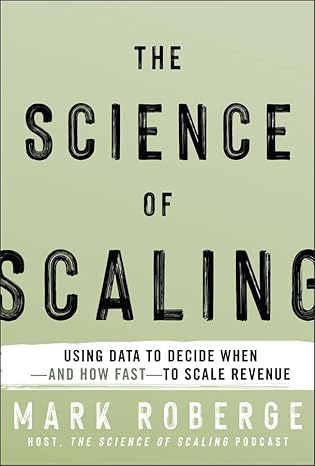
Scaling sales
Are We Ready to Scale? How Fast?
Great businesses with noble missions fail because of inadequate answers to the following two critical questions: Are we ready to scale? If so, how fast?
The following five issues to be the most common diagnoses for missed revenue targets and ultimate failure among seed-funded businesses:
- Premature focus on top-line revenue generation at the expense of consistent customer value creation.
- Inadequate, non-data-driven definition of product-market fit.
- Misunderstanding of the go-to-market capabilities required to scale the revenue team.
- Front-loading sales hires at the beginning of the year rather than pacing throughout the year.
- Confusing temporary competitive advantage with sustainable competitive advantage.
The Science of Scaling framework has three sequential stages:
- Product-Market Fit, defined as generating customer success consistently.
- Go-to-Market Fit, defined as generating customer success and revenue consistently and profitably.
- Growth and Moat, defined as scaling revenue predictably while simultaneously building a sustainable moat around the business.
The Science of Scaling Framework: Calculating Whether We Are Ready to Scale and How Fast
PHASE 1: Product-Market Fit
“That’s go-to-market efficiency. Revenue tells you how good your sales team is. Not whether your product delivers real value. At best, that’s market-message fit.”
“Product-market fit is when your product satisfies the majority of potential customers in a good market.”
“We use ‘product-market fit’ to make critical decisions, such as when to scale, but we lack a scientific, data-driven definition of the term.”
Product-market fit occurs when our customers continuously realize the value they were promised when they purchased our product.
We can assert that companies achieve product-market fit when their annual customer retention exceeds 90 %.
“Customer retention is the best statistical representation of product-market fit. However, customer retention is a lagging indicator. We need to define a leading indicator of retention to foster the required speed of learning and align the organization with this goal.”
There is no universal leading indicator of retention (LIR) applicable to all company contexts.
[Product-market fit] is “True” if P % of customers achieve E event every T time. The following are the best practices for defining the Percentage (P), Event (E), and Timing (T) variables for our business.
- P is the minimum required percentage of customers achieving the leading indicator of retention. If P is surpassed, we have product-market fit. Considering all factors, I often observe P set between 60 % and 80 %.
- E is the actual event or set of events that represents the leading indicator. Events around product setup, usage, and results are commonly used. Objective: E must be factual and binary. Instrumentable: We must be able to automate the measurement of E. Aligned with customer success and value creation. Correlated to the company’s unique value proposition. Event combinations are acceptable, but simplicity is key. Consider starting E with “setup,” evolving to “engagement,” and ending with “ROI”.
- T is the time frequency used to evaluate the leading indicator event.
A common obstacle to successful scaling is a lack of discipline regarding our ideal customer profile (ICP). A challenging strategic decision involves determining how broadly to define the ICP. The ICP should align with customer success, retention, and lifetime value (LTV), not minimum customer acquisition cost (CAC).
As we acquire customers in different segments and track their success with our product as measured by LIR, we will refine the ICP.
“Organizing our customers into acquisition cohorts and measuring each cohort’s LIR progress enables early identification of product-market fit.”
PHASE 2: Go-to-Market Fit
During the product-market fit phase, we acquired customers through unscalable methods. We relied on founder selling. We networked our way to the key meetings. We offered discounts in exchange for the customer’s feedback and patience. We can’t scale yet, because we don’t have the system components to scale.
Go-to-market fit is the ability to acquire and retain customers consistently and profitably.
The software industry currently rallies around these three-unit economic goals:
- [Lifetime Value (LTV)] / [Customer Acquisition Cost (CAC)] > 3
- Payback period < 12 months
- Magic Number > 1.01
“Unit economics are the best measure of revenue acquisition efficiency and, in turn, go-to-market fit. However, like customer retention, unit economics are lagging indicators. We need to extract the long-term unit economics target into short-term go-to-market goals, or LIUEs.”
We need go-to-market fit to be ready to scale.
Unit economics are the best measure of profitability and, in turn, go-to-market fit.
We need to extract the long-term unit economics target into short-term go-to-market goals, or leading indicators of unit economics (LIUEs).
Lars Leckie, “SaaS Metrics 2.0 — How to Calculate the Magic Number,” Scale Venture Partners, 2012. Leckie introduced the “Magic Number” as a measure of SaaS sales and marketing efficiency, defining it as the ratio of new annualized recurring revenue (ARR) generated in a quarter to the previous quarter’s sales and marketing spend, with a value above 1.0 indicating strong efficiency and readiness to scale.
Growth and Moat
We are prepared to scale once we achieve product-market fit and go-to-market fit. These phases must be addressed in sequence.
Most venture capitalists operate under a power law dynamic, where they expect 80 – 90 % of their startups to yield little or no returns, while 10 – 20 % are anticipated to perform exceptionally, compensating for losses many times over, resulting in a fund outcome that exceeds all other asset classes.
I have never really seen a lump-sum hiring approach work. I am sure successes are out there. I just haven’t seen them.
We should add salespeople as fast as possible without losing product-market fit and go-to-market fit. We have a precise measurement of product-market and go-to-market fit.
“THE LIR and LIUEs become our speedometer, enabling us to evaluate product-market fit and go-to-market fit 6 to 12 months ahead of our peers and adjust our scale pace in real time.”
As long as the sales capacity and demand generation capacity produce similar figures, the plan works. If the sales capacity is much higher than the demand generation capacity, there will not be enough meetings for the salespeople. If the demand generation capacity significantly exceeds the sales capacity, we are paying to generate demand that our sales team does not have time to work on.
Scaling is expensive. It becomes even more costly when done in a haphazard, irresponsible way, often leading to the demise of what could have been a great company.
Aligning the Go-to-Market System with Product-Market Fit
Defining the Go-to-Market System
Sales is not magic; it is a science like finance, engineering, and marketing. Yes, there are some creative aspects to sales, just as there are creative aspects to these peer functions.
The foundation of the go-to-market system is the ideal customer profile (ICP).
The go-to-market process sits on top of the ICP. The go-to-market (GTM) process illustrates how buyers evaluate and purchase our products, as well as how we support them throughout this process.
The system has two inputs: Demand Generation and go-to-market Hires. The Demand Generation component creates a flow of prospective buyers into the system, while the go-to-market Hires component supplies the human capital required to convert those prospective buyers into successful customers.
Two internal components drive the ongoing flywheel of the system. The Pricing and Packaging component determines how customers pay our company. The go-to-market Compensation component outlines how our company compensates its human resources as the system functions.
The go-to-market system generates three outputs in sequence: Go-to-market Activities, which lead to Revenue Forecast, which in turn results in Revenue.
The Optimal Design of the Go-to-Market System Is Contextual
The “inappropriate cut and paste” is the answer to many post-mortems on a failed scale-up attempt.
“There is no one-size-fits-all go-to-market system. The components of the system depend on the business context, which is shaped by the product, buyer, and company. Optimal system design evolves as we navigate the phases of the Science of Scaling.”
Aligning ICP with the Pursuit of Product-Market Fit: Early Adopters Fostering Rapid Learning
Founders often underestimate the capital, time, and effort required to acquire and onboard large companies. Sales cycles tend to be longer than anticipated.
Even worse, founders often overestimate the market pull that will be generated by a large brand customer reference.
Customer size is just one aspect of the ideal customer profile (ICP) definition. We must also consider sectors, locations, end users, and other factors.
During the pursuit of product-market fit, the ICP needs to achieve two objectives: Foster rapid learning Include a sufficiently large customer base to support the revenue growth expectations for the first three years.
Regarding customer size, outline the range of sizes we intend to target throughout our business lifecycle. Define our initial ICP around the smallest customers in this range.
An important aspect at this stage is deciphering between early adopters and laggards. We need “early adopters,” not “laggard followers.”
Often, an “early adopter” is more about the individual buyer within the organization than the organization itself.
Aligning the Go-to-Market Process with the Pursuit of Product-Market Fit: Founder-Led, Learning-Oriented
In the world of early-stage startups, few traps are as deceptive as false hope. And no illusion is more dangerous than the compliment disguised as “not now.”
“Founders often confuse their product pitch deck with the sales process.”
Telling buyers about our product provides minimal learning. Asking buyers about their approach to the problem we solve maximizes it.
Follow these best practice principles:
- Don’t pitch your idea.
- Ask about past behavior, not opinions or hypotheticals.
- Avoid leading questions.
- Listen more, talk less.
- Dig for specifics.
A “true negative” is much better than a “false positive.”
Aligning GTM Hires with the Pursuit of Product-Market Fit: Half Product Manager, Half Account Executive
Most startups never achieve product-market fit. As a founder, we must stay close to, if not own, this high-value work at this stage.
Focus on these attributes when evaluating candidates:
- Ability to delve into customer needs through thorough discovery skills.
- Strong collaboration skills.
- Comfortable in ambiguous and rapidly changing environments.
- Motivated more by innovation than by making money.
- Athlete who can handle the full cycle of the go-to-market process.
Discovery-Oriented Sales Approach. Naturally asks inquisitive questions about the prospective customer’s problems and opportunities. Listens and drills in with strong follow-up questions. Sounds genuine in delivery and interest in the responses.
Cross-Functional Team Collaboration. Strong collaboration skills for working in cross-functional teams, primarily with product and engineering.
Securing one or two dozen customers significantly enhances our ability to evaluate LIR and, consequently, product-market fit. Our objective is to acquire approximately 20 customers as quickly as possible.
Aligning Demand Generation with the Pursuit of Product-Market Fit: Rely on Personal Network and Referrals
Typically, the most effective channel is referrals through our personal and professional networks.
There are a few best practices around these referrals. It is advisable to avoid imposing additional work on the referrer.
Rather than inquiring if they know anyone, conduct the necessary research to identify the individual to whom you seek an introduction.
When crafting the introduction request, focus our intent on research versus product demonstration.
Aligning Pricing with the Pursuit of Product-Market Fit: Price for Commitment, Not Profits
At this stage, our priority is learning, not profit maximization. Unless pricing is the primary innovation in our business model — an uncommon scenario — we should refrain from optimizing prices at this time.
Aligning GTM Compensation with the Pursuit of Product-Market Fit: Equity Instead of Variable Commission
Despite the common use of variable commission plans in sales compensation, avoid them at this stage. If we have a salesperson on the product-market fit (PMF) pursuit team, tying part of their pay to revenue or customer acquisition can create an unnecessary misalignment between their incentives and our priorities during this phase.
“Operate with a ‘do unscalable things early’ mentality by leveraging personal networks for demand generation, pricing for commitment not profits, and opting for equity-based compensation over a standard variable commission model.”
Include equity in the company as part of the initial compensation for the first seller, just like we do with our early product, engineering, design, and other team members.
Aligning Go-to-Market System Outputs with the Pursuit of Product-Market Fit: LIR Achievement
As we report on the progress of our startup, let’s consider two reports. The first report represents a typical accounting balance sheet that includes Assets, Liabilities, and Equity. The second report shows the percentage of customers achieving our leading indicator of retention (LIR).
The LIR is our north star metric.
Aligning the Go-to-Market System with the Pursuit of Go-to-Market Fit
Aligning ICP with the Pursuit of Go-to-Market Fit: Expand from Early Adopter to Early Majority
Go-to-market fit refers to the company’s ability to acquire and retain customers consistently and profitably, with profitability assessed through unit economics. Our operational philosophy shifts from “do unscalable things early” to “prepare for scale.” Pricing and sales compensation emerge as crucial components of our unit economics formula. Learning motions shift to codification motions.
The market in which we do business is dictated by the customers our go-to-market team targets and acquires.
We now need to demonstrate that we can build a profitable business within our proven ICP. The key at this stage is avoiding premature ICP scope creep. Selling to companies outside our ICP is likely to lead to customer retention problems in the future.
The only evolution of the ICP as we transition to the go-to-market fit phase is to expand from early adopters to the early majority.
Aligning the Go-to-Market Process with the Pursuit of Go-to-Market Fit: Codified and Repeatable
The key to the first meeting, and, in fact, the entire sales process, is not to educate the buyer about our product. Instead, the key is to understand how the buyer perceives the problem that our product solves, determine whether we can assist them, and explain how we can help them within their perceived context.
From a behavioral psychology perspective, people desire to be understood. They want to be heard.
As the seller, we can determine which buyers are likely to make a purchase, spend more time engaging with them, and identify which buyers to qualify out, so we do not waste our time on them.
These principles are fundamental sales concepts.
“How much is your sales training focused on teaching your salespeople about your product versus your buyer?”
I label this flawed approach to go-to-market process design as “inside-out,” or starting with the product. Instead, we need to adopt an “outside-in” approach by beginning with our buyer.
A go-to-market process framework that positions the buying journey as the foundation for all other components.
The framework identifies four components of the go-to-market process:
- Buyer Journey
- Discovery Guide
- Presentation Guide
- Customer Success Guide
Buyer goes through as they define their challenges and goals, identify potential solution categories, choose and purchase the offering that best meets their objectives, and integrate the offering into their business to realize the intended value.
As our business scales and we expand to additional customer segments, we will develop a buyer journey for each segment. However, at this stage, it is best to simplify the go-to-market system to a single buyer journey definition, if possible.
The Discovery Guide sets the stage for the initial conversation between the salesperson and the buyer. We must “discover” the buyer’s needs and “qualify” their fit for our product.
There are three parts to the Discovery Guide.
- The first part is a Sales Qualifying Matrix.
- The second, lesser-known aspect of the go-to-market process is the Customer Success Qualifying Matrix. The definition of the leading indicator of retention discussed in Part I can be instructive to the attributes of the Customer Success Qualifying Matrix. The terms marketing qualified lead (MQL) and sales qualified lead (SQL) are industry terms that can help us frame this distinction. An MQL is a booked first meeting with a potential buyer who fits our ICP. If, after the discovery meeting, we find the prospective buyer meets our sales and customer success qualifications, we can now move this buyer from an MQL to an SQL.
- The third and final part is the Discovery Meeting Guide. The goal of the meeting is to “discover” where the buyer is on the predefined Buying Journey and “qualify” the buyer against the Sales Qualifying Matrix and Customer Success Qualifying Matrix. The seller begins the discussion by building rapport. The first section of the Discovery Guide offers suggestions on how to do that. Next, the seller sets an agenda. Some sales methodologies refer to this as an up-front contract. Next, the seller begins with as open-ended a question as possible to avoid leading the buyer. Some methodologies refer to this opening as exploring the “situation.” An effective question is “Why did you take this meeting?” Sellers who can defer discussions about features, price, packaging, and other product details until after this part of the discovery process tend to be more successful. At this point, the seller can provide brief information about the product, tailored to the buyer’s needs, with the goal of scheduling a follow-up meeting and encouraging the buyer to attend. The seller ends the meeting with a clear next step, including date and time.
If the buyer’s perception of their needs aligns with our product offering, we move forward with qualifying the buyer and, if qualified, tailoring the presentation of our product to their needs. Trying to sell to a buyer who isn’t prioritizing our product’s problem set, and you agree this is correct, won’t end well. However, if we disagree with the buyer’s perception of their needs and believe they should focus on the problem we address, then try to reframe their view. Reframing is an advanced sales technique.
With our discovery and qualifying complete, we can now present the product to the buyer. The most common mistake founders and sellers make at this stage is failing to leverage the information gathered about the buyer’s context when explaining our offering.
Great salespeople do not lie; they help buyers connect their unique needs to the most relevant aspects of the product.
A framework for the Presentation Guide:
- Agenda. Agree on goal of the call and moving to next steps.
- Discovery Recap. Recap challenges — how we can help, why we should help, and why now. Gather any info missed.
- Summary. Summarize our company’s mission and how we are going to solve their challenge.
- Feature 1. Tie the feature to the benefit, confirm agreement on improvement.
- Feature 2 & 3.
- Case Study. Present a customer success story. Choose a customer that has a similar context (Industry, Size, Problem Statement, etc.).
- Recap & Next Step. Confirm buy in and agree on next steps.
The buyer will set an agenda or up-front contract. The seller will outline the goal for the meeting, the proposed next step if there continues to be a fit, and the proposed next step if there is not a fit.
Many founders begin with a slide about their company, customers, funding, mission statement, etc. Remember, this isn’t about us. It’s about the buyer. Therefore, the best next step is to review the buyer’s context. This review allows us to show how well we understand their business and gives new participants a chance to share their perspectives.
With the context recap and additional qualification questions behind us, we are now ready to present our company and our product. Tailoring our company and product description helps the buyer connect our offering with their specific issue, maximizing the likelihood that we will have an opportunity to help them.
The order in which we present the features or usage flow of the product is another opportunity to tailor the presentation to the buyer’s context. Describe the high-level business purpose of the feature or module and how it connects to the buyer’s context. Demonstrate how the feature works. Verify the buyer understands the purpose of the feature. Ensure the buyer agrees that the module addresses their need.
After presenting the target features, sellers can show one or two case studies to the buyer. Next, the seller presents the price and package to the buyer. A common mistake is to share the entire price book, which can overwhelm them. Customize the price and package to their needs.
Our go-to-market process doesn’t end with the sale but with customer value realization. We need a codified process to transform customers into successful ones. A critical mistake is replacing a tailored pre-sale experience with a generic post – sale onboarding.
With the components of the go-to-market process in place, we can now summarize the process into a navigation system. The go-to-market navigation system outlines the steps the buyer takes to better define their problem, evaluate solution options, make a decision, and set up the solution to achieve the intended value. It also illustrates the corresponding actions we are taking to support the buyer throughout this process.
A common mistake when developing the go-to-market navigation system is defining the exit criteria for each stage based on seller actions versus buyer actions.
Aligning GTM Hires with the Pursuit of Go-to-Market Fit: Process Builder
During the product-market-fit phase, our first go-to-market hire possessed two skill attributes: part product manager and part account executive.
The following are the most important hiring attributes to focus on and ideas for assessing candidates for these qualities.
- Go-to-Market Process Development. Definition – Codifies, tests, and implements a repeatable process to set meetings, execute discovery calls, deliver product presentations, handle objections, close customers, onboard customers, and convert customers into successful customers.
- Thrives in Rapid Change Environment. Definition – This candidate demonstrates exceptional agility and adaptability in high-velocity, ambiguous settings. They maintain mental clarity when priorities shift, strategies evolve, and data signals contradict intuition.
- Sales Process Execution. Definition – Ability to consistently execute a consultative sales process that is still being developed — running it with discipline, tracking the outcomes, and adapting as learnings emerge.
Aligning Demand Generation with the Pursuit of Go-to-Market Fit: At Least One Scalable, Measurable Medium
Hiring salespeople without a scalable demand generation channel in place is another top 10 reasons for startup failure.
Outbound. Definition – Cold outreach to prospective customers via calls, emails, social messages, direct mailings, or other mediums.
Product Contexts. Favorable for Outbound.
- Potential for high ACV and LTV to support high CAC: Outbound is expensive.
- Complex value propositions: It is difficult to explain complex value propositions through low-touch channels.
- Complex buying and adoption requirements: Sometimes products are simple to understand but difficult to drive to a purchase decision and adoption.
Market/Buyer Contexts. Favorable for Outbound. Unique targeted buyer within organization: Fortune 1000 CxOs. Sales Execs. Low-Tech Buyers.
Account-Based Marketing (ABM)/Account-Based Selling (ABS). Definition – A joint effort between marketing and sales to drive awareness and interest in an account across many contacts and using multiple channels (paid, outbound emails, outbound calls, etc.).
Product Contexts Favorable for ABM/ABS: Same as outbound, plus the following items:
- Multiple constituents to make product adoption successful.
- Cross-organization value propositions.
Market/Buyer Contexts Favorable for ABM/ABS Same as outbound, plus the following items. Many constituents in the DMU.
Inbound. Definition – Creation of content (i.e., blogs, podcasts, eBooks, webinars, social posts) that attracts prospective customers to your website and business.
Product Contexts Favorable for Inbound Lower ACV or LTV constrain:
- Categories with less online content saturation.
- Products requiring evangelism or business process transformation.
Market/Buyer Contexts Favorable for Inbound SMBs or mid-market: Many potential buyers/Large TAM. Conducts research online. Leaders in product, engineering, marketing. Initially takes time to see results but then operates like an annuity or flywheel.
Paid Digital. Definition – Use of paid ads in search engines or social media platforms or compensation to influencers or affiliates to generate leads.
Product Contexts Favorable for Paid Digital Simple to message value proposition:
- New categories with low-paid competition.
- Low cost or high-price competitor in the market.
Market/Buyer Contexts Favorable for Paid Digital Tight, targeted buyer segments: Active in search and social. Good for initial testing of messaging and ICP but difficult to scale efficiently. Easy for competition to outbid overnight.
Product-Led Growth (PLG). Definition – Allowing prospective customers to experience value from the product without paying or interacting with a human.
Product Contexts Favorable for PLG Low time and effort to retainable value:
- A value proposition that has current demand versus one that needs to be evangelized.
- Potential for virality.
Market/Buyer Contexts Favorable for PLG Large, horizontal market: Tech-savvy user. Value primarily for the end user.
The hidden power of PLG: Sustainable moat development. Early focus on PLG increases the likelihood of product-market fit. PLG is very difficult to implement after scale.
Partners. Definition – Selling products through another company, often referred to as a channel partner. The channel partner can generate demand, sell the demand, and/or service the customer post-sale.
Product Contexts Favorable for Partners Easily bundled with other products:
- Significant customization work required.
Market/Buyer Contexts Favorable for Partners Already buying through partners: High strategic value for the channel partner in addition to the end customer.
Most founders underestimate the time and cost to enable a partner. Often requires a tested direct playbook before attempting to enable partners. Offers scale leverage.
Aligning Pricing with the Pursuit of Go-to-Market Fit: The Intersection of Customer ROI, Scalable Unit Economics, and Substitute Options
During the product-market fit phase, we priced for commitment rather than profits, minimizing friction that prevents buyers from trying and succeeding with our product.
We analyze early-stage pricing decisions through three lenses:
- The first lens is the return on investment (ROI) our product delivers to the buyer. By quantifying the ROI our solution offers, we can anchor our price on a portion of that value.
- The second lens is our company’s unit economics. Regardless of which specific unit economic metric we select, the goal is to ensure we have an attractive business to scale before moving on to the Growth and Moat phase. This means that the revenue generated from each customer significantly exceeds the cost to acquire that customer.
- Our customer is inevitably comparing the value and cost of our solution to other methods of solving the same problem. We need to consider the cost-benefit of these alternatives when setting our price.
Aligning Go-to-Market Compensation with the Pursuit of Go-to-Market Fit: Balancing Customer Retention and Profitable Growth
During the product-market fit phase, we deliberately downplayed sales compensation design.
However, as we enter the pursuit of go-to-market fit, the equation changes. Sales compensation transforms from a tactical decision to a strategic lever, directly impacting customer acquisition cost (CAC) and, in turn, our unit economics.
A compensation plan is an extension of company strategy. Effective variable commission plans reward or penalize payouts as close to the moment of the behavior driving the outcome.
A more effective approach — and one that aligns beautifully with our leading indicator framework — is to split the variable commission payment: 50 % at contract signature, and 50 % upon achievement of the leading indicator of retention (LIR).
“Align the sales compensation plan with customer success, not just customer acquisition.”
Aligning Go-to-Market System Outputs with the Pursuit of Go-to-Market Fit: Leading Indicator of Unit Economic Achievement
With our focus on acquiring successful customers profitably, as represented by strong unit economics, the primary chart by which we measure success should come as no surprise. There are several unit economic metrics to choose from.
We are focusing on a payback period of less than 12 months, measured monthly.
The key inputs to the payback period, average annual contract value (ACV), average customer acquisition cost (CAC), and the gross margin (GM %) for the customers acquired each month.
Often, unit economic performance varies significantly by demand generation channel. We do not need to validate go-to-market fit across multiple demand channels to move into the growth phase. We need to prove only one demand generation channel. Therefore, segmenting unit economics by demand generation channel is essential at this stage.
Boards of directors and executive teams rarely analyze individual AE performance at their level. However, having one AE consistently achieve the goal is a critical data point for proper funnel diagnosis.
Aligning the Go-to-Market System with the Pursuit of Growth and Moat
Aligning ICP with Growth and Moat: Scale vs. Experiment vs. Ignore Segments
Having achieved product-market fit and go-to-market fit, we are now ready to scale.
Now we are shifting the go-to-market system to process execution, addressable market expansion, and moat development.
In the first year of a startup, most founders understand the importance of not committing to a revenue goal too early.
However, for some reason, when a startup grows to $ 5M and then $ 10M, and the company launches a new product or enters a new market, they become overconfident that everything they learned in the current product and market will automatically transfer.
When we launch a new product or enter a new market, we need to restart the product-market fit and go-to-market fit process from scratch.
“Scaling involves exploiting the known ICP for short-term growth targets and exploring ICP expansions to support long-term growth aspirations. The product-market-fit and go-to-market fit stages provide structure to the exploration motion. ”
Aligning the GTM Process with Growth and Moat: Reinforced
Teams that coach their salespeople for more than three hours per month consistently outperform their goals by 7 %, while teams that coach for less than two hours per month fall short by 10 %.
“Effective sales coaching drives revenue performance. Yet, sales coaching ranks amongst the lowest capabilities of the average go-to-market system. We need to hold the organization accountable to a data-driven sales coaching culture.”
Aligning GTM Hires with Growth and Moat: Process Executors
During the Go-to-Market Fit phase, we focused our sales resources on codifying the go-to-market (GTM ) process . As we transition to the Growth and Moat phase , we are now ready to bring on more traditional salespeople , shifting our resources from process builders to process executors .
The two attributes that strongly correlate with success in nearly every hiring process, especially in high-growth startups, are coachability and curiosity.
Aligning Demand Generation with Growth and Moat: Multiple Mediums Tightly Aligned with Sales
Demand generation channels often face limits in how quickly they can be scaled and the total demand they can produce annually.
“Develop a sales and marketing SLA to evolve from the subjective blaming between sales and marketing on underperformance to a cohesive system with quantified accountability and shared outcomes.”
The following steps are used to establish the sales and marketing SLA:
- Define “marketing-qualified lead” (MQL) criteria.
- Set quantitative pipeline contribution targets.
- Specify sales follow-up obligations.
- Measure and report on both sides.
Align Pricing with Growth and Moat: Establish Moat and Raise Price
The Illusion of Pricing Power. They called it “the golden summer.”
We, as entrepreneurs, often confuse sustainable differentiation with temporary differentiation.
Here are a few categories of sustainable differentiation with examples in today’s software market:
- Network effects.
- Brand / category.
- Viral distribution.
- Switching costs.
- Learning algorithms.
As we enter the Growth and Moat phase, we need to establish pathways for our best people to develop. Three common paths are promotion to manager, promotion to a new individual contributor role, or advancement within the current individual contributor role.
Align GTM Compensation with Growth and Moat: Add Promotion Paths
We need to create a multistep sales management development program.
The steps are as follows:
- Phase 1 — Demonstrate adequate skills at each stage of the sales process.
- Phase 2 — Develop leadership skills.
- Phase 3 — Practice hiring and coaching skills with one salesperson.
- Phase 4 — Promotion.
Some organizations try a player-coach model. However, industry data and observations indicate that this model often fails. It is challenging for a manager to switch between individual quota duties and team development tasks.
The Potential Impact of AI on the Science of Scaling Framework
The Arc of Abstraction
Abstraction framework to go-to-market.
- Phase I: AI Handles Nonselling Tasks.
- Phase II: AI Sells to Humans.
- Phase III: AI Buys from AI.
- Phase IV: Functional Walls Blur.
Phase I: AI Handles Nonselling Tasks. Humans Sell
Phase I:
- The ICP AI Agent
- The Demand Gen AI Agent
- The Sales Process AI Agent
- The Forecast AI Agent
- The GTM Hiring AI Agent


