

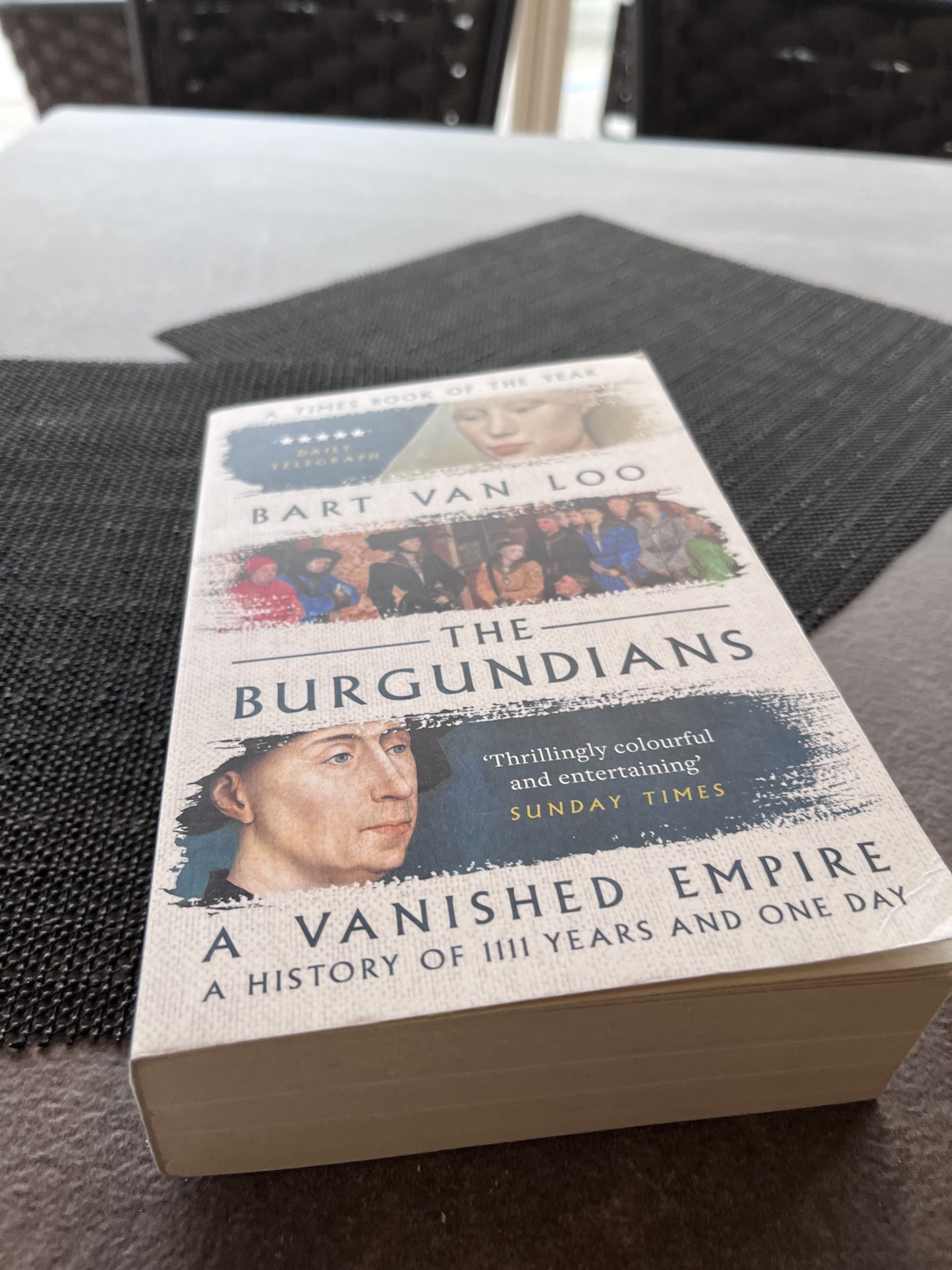
The Burgundians: A Vanished Empire, A History of 1111 Years and One Day
Our historiography is full of book length works explaining how the Low Countries broke up at the end of the sixteenth century, dividing the Northern Netherlands from the Southern Netherlands (and ultimately the Netherlands of today from Belgium).
The Low Countries are a Burgundian invention. The Burgundian Philip the Bold, John the Fearless, Philip the Good and Charles the Bold emerged as founding fathers of the united Netherlands.
The Forgotten Millenium 406-1369
From Kingdom to Duchy
The Burgundians are the Romanized German tribes.
In the last month of the year 406 temperatures dropped to well below freezing. The seemingly untraversable river turned into a big and inviting bridge. Vandals, Suebi and Alans wasted no time and soon overran Gaul. Thus the Salian Franks fanned out between the Meuse and the Scheldt, and held sway in large parts of what today are the Netherlands and Flanders.
German tribes were pushed west by Huns.
Burgundians first home was the small island of Bornholm, that lies in the Baltic Sea between Poland and Sweden. Norwegian called the island Burgundarhomr.
In 406-7 King Gundahar led approximately 80.0000 Burgundians to the region around Worms. In 435 he moved westward to Gallia Belgica, the area between the Rhineland and the Seine that would later lend its name to Belgium.
In 436, with a mercenary army consisting of Huns under the command of a certain Attila, the Roman supreme commander Flavius Aetius crushed the Burgundians in a bloody battle. Only his son Gundioc managed to escape. Epic poem the Nibelungenlied, was inspired by the events. In it, Gundahar appears as Gunther.
In 447 Attila broke with Romans and plunder through Gallia Belgica.
On 20 June 451 at Catalaunian Plains near Troyes two army met. On one side were Huns on the other bloc that Romans had formed with Gallic and Germanic forces. With Huns there were Ostrogoths, Gepids, Thuringii and Rugii. With Romans were Burgundians, Visigoths, Alans and Salian Francs.
Theodoric, the King of the Visigoths, was killed.
In 475, the successful politician Orestes maneuvered his young son onto the Roman throne. He was deposed by Odoacer in 476.
King Gundobad, son of Gundioc, profited from the disintegration of the Western Roman Empire. Around 500 he was thunder pressure by both Visigoths and Franks.
On 25 December 506 Clovis, a forty-year-old Frankish king, was baptized. Burgundian princess Clotilde had a lot of influence on his decision to do that.
Clovis marched on Dijon in Burgundy against King Gundobad and his brother Godegisel, who later betrayed Gundobad. Gundobad fled to Avignon. But Gundobad managed to kill Godegisel and he married his niece Clotilde to Clovis.
Church in the early times dealed with heretics. One of the most important of these was Arianism, the teaching of Arius, a third-century Egyptian priest. Gundobad was Arian. Bishop Wulfila converted Goths to Arianism.
Bishop Avitus of Vienne convinced Gundobad’s son Sigismund to convert only a few months before Clovis.
Not far from Poitiers the Burgundian-Frankish forces stumbled upon the Visigoth king Alaric II. Clovis killed him. Visigoth moved to Iberian peninsula.
In 516 Gundobad died.
Sigismund took over and when his first wife died (Ostrogotho, a daughter of Ostrogoth king Theodoric the Great) he remarried. His son Sigeric was opposing his new wife and Sigismund killed him. Sigismund was broken and he went to monastery.
In 523 the army of the Franks crushed demoralized Burgundians. Chlodomer killed him. Sigismund’s brother Gundomar was crowned. In 534 the Merovingians crushed the Burgundians once and for all.
The Merovingian kingdom soon split into three large sections: Austrasia (whose capital was Reims, then Metz), Neustria (whose capital was Soissons) and Burgundy (whose capital was Chalon-sur-Saone).
In 711 Moors moved to Spain, destroyed Visigoths, their leader was Abd al-Rahman.
In October 731 Carel Martel marched with his army to the valley of the Clain, north of today’s Poitiers.
Only after the division of Charlemagne’s empire in the Treaty of Verdun in 843 did the term Burgundia reappear in the writings of the chronicles.
When Vikings attacked Burgundy in the ninth century, it was Count of Autun, named Richard, that defended it.
From Burgundy to Flanders
The Hundred Years War were responsible for linking Flanders with Burgundy after 1369.
When Louis the Do-Nothing suffered a fatal fall from his horse in 987, he would go down in history as the last Carolingian.
Hugo Capet was next in line. The Capetians would systematically enlarge their domain and occupy the French throne for 800 years.
Duke Robert was the founding father of the Burgundian Capetians.
Over the course of the eleventh century the Catholic Church was being governed from Burgundy as amuch as it was from Rome. The Benedicts from Cluny and the Cistercians from Citeaux were strong forces in catholic church. Bernard of Clairvaux was at the head of Cistercians. Abbot Hugo was important for Benedicts.
Oto I of Burgundy went to Jerusalem on the First Crusade in 1095.
Burgundian history in the Low Countries began in 435, whit King Gundahar’s failed invasion of Gallia Belgica.
The Burgundian Century 1369-1467
Rising from the mud
Philip the Bold, John the Fearless and Philip the Good created a new dynasty.
Flauma. It was with this Germanic world that Flanders crawled up onto land. Flaum means flood. The first people were called Flaumung, a name that mutated into Flaming.
After the division of Charlemagne’s lands the Flemish coastal region ended up in the hands of what would be called France. The Carolingians referred to the lands the pagus Flandrensis, which Charles the Bald, very much against his will granted to Baldwin Iron Arm in 863.
After the final defeat of Rollo at Chartres in 911, the Viking leader was first offered Flanders, but he could not bear the thought of wasting away in a bog for the rest of his life.
William the Bastard also called the Conqueror, married Matilda of Flanders. She was the daughter of Count Baldwin VI.
Flanders would remain stuck between a rock and a hard place. Depended on England for the wool and to France by the principle of feudal loyalty.
An ancient Flanders without water is as inconceivable as a Belgian cafe without beer.
As more and more Flemings moved to the cities, the cities became more and more powerful. By the eleventh century, defensive walls had already been erected around Ghent and Bruges. Arras, Douai, Lille, Saint-Omer, Bruges, Ypres and Ghent grew into textile centres.
‘All the nations of the world are kept warm by the wool of England woven into cloth by the men of Flanders’.
The inn that was run by the Van der Beurze family, built in around 1285, became the most important place for brokers to purchase securities and sell them at a later date. The name beurs also migrated to other countries., the words we translate as stock market in English.
John the Fearless preferred the sword and not the word as his father. He was quick to grasp the internal disputes (city versus count) and external tensions (Flemish versus French king).
At the end of the thirteenth century, the tension between the count and his cities became more complex when major conflicts also arose within those cities between the rich French-speaking patricians (The Leliaards or the Lilies) and the plebs who toiled for subsistence wages and spoke Middle Dutch (the Klauwaards, or the Claws).
On 18 May 1302, a group of dissatisfied Bruges locals slit the throats of the French soldiers. About 120 men lost their lives that night, which would come to be known as the Matins of Bruges. Philip the Fair sent an army. But on 11 July 1302 the peasant warriors cut the king’s army to ribbons at Kortrijk. The Battle of the Golden Spurs was the elevated to celebration of the Flemish community.
In Ghent it was Jacob van Artevelde that was the prominent figure that was head of some kind of republic. He was supporting Edward III, the English king.
Louis of Male came to power in Flanders in 1346.
Ghent the Fearless
During the two popes time, Burgundy like France had chosen Avignon, and Flanders had chosen Rome.
Charles V died in 1380, Charles VI was still adolescent and so was King Richard II of England. The Hundred Years War was now in the hands of two youngsters that could be easily manipulated.
Philip the Bold, John’s father, who was gearing up to take control of Flanders was the strong man in Paris from the start.
Louis of Male was trying to break the revolt from Ghent led by Philip van Artevelde, the son of legendary Jacob. On 5 May 1382 the starving Ghentenars ambushed and killed the count’s troops. Louis asked Philip the Bold for help. Philip received help from the French kingdom.
1789 Avant la Lettre
The Battle of Westrozebeke was fought on 27 November 1382 between the French forces with their legendary Oriflamme and Van Artevelde with his black flag bearing a silver lion, the great city banner of Ghent.
The battle was quick, Van Artevelde killed and the French went on to plunder Kortrijk. They removed bell tower and also five hundred golden spurs.
The Duke of Burgundy would now determine how the hours passed in Flanders.
If the battle would have different result, maybe it would led to similar development as there was after the Battle of Valmy in 1792. Desmoulins, Robespierre and Danton sat on the shoulders of figures such as Etienne Marcel and the two Van Arteveldes.
In a sense, the fifty-three year-old Louis was the last Count of Flanders. From then on, foreign rulers would decide the fate of the country, beginning with his son-in-law Philip the Bold, uncle of the King of France, Duke of Burgundy and Count of Artois, Nevers, the Franche-Comte, Rethel and now Flanders itself.
Low Countries in the Making
Philip the Bold wanted to use his influence in the French court to marry his children properly. Albert of Wittelsbach was Duke of Bavaria and Count of Hainaut, Holland and Zeeland, all three territories feudally tied to the Holly Roman Empire.
According to Philip, the ten-year-old Margaret of Burgundia was the ideal partner for the nineteen-year-old William of Bavaria. Albert wanted double marriage. John the Fearless would marry Margaret of Bavaria. Philip also wanted Brabant, that was led by Joanna of Brabant, she was the aunt of Margaret of Flanders. Brabant included cities like Brussels, Leuven and ‘s-Hertogenbosch.
The double wedding was held in Cambrai on 12 April 1385. It was the display of Burgundian luxury in celebrations.
France as the Draught Horse of Burgundy
In 1388, the puppet Charles VI finally cut himself loose from the powerful Burgundian hand that had been pulling the strings for so many years.
Thanks to the Burgundian embrace of Flanders, Brabant, Hainaut, Holland, Zeeland and Limburg, the blueprint of the Low Countries was gradually taking shape.
Beauty and Madness
On 28 June 1389 Murad I was killed by Lazar Hrebeljanovič in the battle at Kosovo polje. He was replaced by his son Bayezid. He was the great-grandson of Osman I.
In 1377 the God-fearing-duke had purchased a land to build a monastery in Champmol as the mausoleum for the whole family.
In the summer of 1392, an irritable Charles VI left Paris with an army to teach the Duke of Brittany a lesson. John of Burgundy and his father, Philip, were part of the royal forces. On this campaign Charles VI was possessed by evil spirit. He has gone mad. Until his death in 1422, the French king would vacillate between lucidity and insanity.
In March 1393 Philip the Bold acquired the sword of the legendary crusader Godfrey of Bouillon. He wanted to go on a crusade against the Ottomans that the Hungarian King Sigismund called for. He send his son John instead. John’s army set off on 30 April 1396 from Dijon.
Ostentation and Propaganda
In 1394 Clement VII drew his last breath. The pope who had torn the church in two in 1378 was no more.
Richard II of England was born in Bordeaux. He was fighting with internal enemies like the Duke of Gloucester and he was willing to do some concessions to France if they would help him.
On 9 May 1396 John of Burgundy went on the crusade, he went all the way to Buda to meet King Sigismund and they went to Nicopolis. Bayezid captured John there. The ransom was 710 kg of gold. Bayezid was crushed in 1402 by the Mongol-Turkish of Timur the Great.
On 27 April 1404 a Burgundian officer knocked on the door of monastery of Herne in Hainaut. Philip the Bold succumbed to the flu. He was here for the Branbant transfer of power from Duchess Johana to Anthony – second son of Philip.
Philip died in 1404 and so was Albert of Bavaria. His son William became count of Hainaut, Holland and Zeeland. William’s wife was Margaret of Burgundy. Their daughter was Jacqueline.
Murder and the Language Wars
Louis, duke of Orleans and John the Fearless were not the best friends. All that escalated to a point that duke of Orleans was murdered and John pled the French capital.
John managed to gain the support of the Flemish cities. He tried to speak with them in their language, in Flemish.
Arranged Marriages, Uncontrollable Tumult
Jacueline, daughter of William from Bavaria and Margaret of Burgundy, married the second youngest son of King Charles VI of France. She remarried four times. William supported Hooks, but his father Albert supported Cods in Holand.
John and William helped John’s brother-in-law John of Bavaria to fight the rebellion in Liege. They won at Othee on 23 September 1408.
Charles of Orleans went into civil war against John the Fearless. He still didn’t forget what John did to his father.
John installed his fifteen-year-old son Philip as his permanent representative in Flanders.
At the Council of Constance (1414-18) the Western Schism was finally over.
King Henry V of England wanted to conquer France in 1415. Charles died at the battle of Agincourt on 25 October 1415.
Count William died suddenly of dog bite. His wife Margaret of Burgundy was now a widow. John the Fearless wanted to keep the influence in the country, so he married Jacqueline with John IV of Brabant.
In 1418 John the Fearless was again before Paris with his troops.
Severed Hand, Cleft Skull
On 12 June 1418 John seized the Count of Armagnac and skinned him alive. Dauphine Charles was talking with John to jointly attack the English. But it was all the game. John was murdered by him.
The twenty-two-year old Philip of Charola became the new Duke of Burgundy on 10 September 1418 and the latest Count of Flanders. His wife was a sister of the murderer of his father.
Philip of Charloa was now known as Philip the Good.
Philip managed to convince poor Charles VI to marry his daughter Cathraine to Henry V. English King was to occupied the French throne after Charles’s death. After Henry V died in 1422, his son Henry VI took over the French crown.
Three Counties, One Duke
Philip the Good was preparing for a duel with Humprey of Gloucester, Lord Protector of England. He was married to Jacqueline of Bavaria, Philip’s cousin, even thought she was still wedded to John IV of Brabant (she was now married to two men). The duel would take place on 23 April 1425. But it was canceled. Humprey stayed in England – also being entangled with his mistress Elenora Cobham.
Philip would become known as the actual founding father of the Low Countries.
Philip started his expansion to north. He went for Hainaut, Holland and Zeeland. He then capture Jacqueline, that didn’t get support from England.
The Battle for Holland and Zeeland
Jacqueline escaped.
By the end of the fifteenth century, the Low Countries numbered at least 2.5 million inhabitants. At the end of the fifteenth century, Utrecht was perhaps the largest city in the north with close to 20.000 souls.
English army together with Hooks was beaten by Philip and Jacqueline joined with peasant army to fight Philip. In the end she was defeated.
As Woman or as a Man?
During almost two-thirds of the thirteenth century, women ran the show in Flanders. From 1214 to 1278, the power lay in the hands of two sisters, Joanna and Margaret of Constantinople.
Joan of Arc, was the girl that heard the voices and lead the French to some victories in the war against England. The France was divided during the Hundred Year War. In this moment Charles VII was in the south, Philip the Good in the centre and Acquitaine and Normandy were part of king Henry VI and his regent Bedford.
In 1427 Salisbury docked in Calais. On 12 October began the siege of Orleans. The defenders were lead by Captain Baudricourt and he used Joan in February 1429.
Golden Glitter
At exactly the same spot where the pagan Clovis converted to Christianity 923 years earlies, Charles VII had himself crowned King of France.
Joan wrote to Philip the Good to get some help from him. But he didn’t reply.
Duchess Isabella was the daughter of John of Portugal and the sister of Henry the Navigator. Her mother was Philipa of Lancaster, a granddaughter of Edward III.
Philip revealed himself in Bruges on 10 January 1430 as a sovereign prince who would not be lectured in humility by anyone.
The Burial Pit and the Stake
Golden Fleece was a society of knights that Philip used as loyalty network.
On 23 May 1430 Philip and Joana met for the first time. Philip sold her to English. He used her as bargaining chip in his international relations. She was burned by English in May 1431.
Philip went after Brabant and also Namur.
Beauty and Peace
John the Fearless had less and less time to concern himself with art. His son, Philip the Good, would breathe new life into Burgundian patronage.
Two sons of Philip died young. The new hope was Charles born in 1433. He was the last child Philip had with Isabella.
Philip played both sides English and France and in 1435 he signed a treaty with France. But he also married his son Charles with Catherine, the daughter of the French King.
The Burgundian Dream
Fighting with the English, Philip managed to kick the them out of France.
On 22 May Philip’s army was at the gate of Bruge. He reached the Great Market without any problems, but than the gates close and the citizens slaughter a lot of Philip’s soldier, Philip himself escaped. The event was called terrible Whitsun Wednesday.
In 1441 Philip became the governor in Luxembourg.
Philip acted as a regent to mentally ill Charles VI and had access to French treasury.
Philip the Grand Duke of the West was now the duke of Burgundy, Lower Loraine, Brabant, Limburg and Luxembourg; Count of Flanders, Artois, the Franche-Comte, Hainaut, Holland, Zeeland, Namur, Boulogne, Charolais, Guines, Ponthieu, Saint-Pol; Margave of Antwerp, Lord of West-Friesland, Mechelen and Salins.
Philip’s most important interlocutors in the Low Countries were undoubtedly the city elite. He did everything he could to encourage the mixing of the ducal and the city elite.
He refused to choose a fixed location of his court. Cities fought to host him.
Philip also issued coins as the common currency. They were named the vierlander – our four lands. They were issued in 1433. The four economies were Flanders, Brabant, Holland and Hainaut.
More than seventy years after his grandfather had shown how it was done in Westrozebeke, Philip cut the Ghentenars to ribbons on 23 July 1453 at Gavere. He also suppressed the rebellious Bruges in 1436-38.
In the days of Charles the Bold, the Burgundy finally had a permanent army at its command.
Philip wanted to go on Crusade.
Pheasant and Fox
On 17 July 1453, the French army, with more than three hundred cannon at its disposal, defeated the English troops at Castillon. It would take until 1475 for the two countries to officially acknowledge that it was the last battle of the war. Calais remained in English hands until 1558.
Charles, Philip’s son was married again after his wife Catherine death, this time to Isabella of Bourbon.
Louis son of the French king Charles VII was fighting with his father and Philip the Good took his side. They met on 15 October 1456 in Brussels.
Fathers and Son
Charles the Bold looked with suspicion at Louis’s overly familiar relationship with the members of the House of Croy. On the other hand was the family of the iron chancellor, Nicolas Rolin.
Mary of Burgundy was born on 13 February 1457. She was the link between two major eras. Her grandfather was the imposing Philip the Good, and her grandson would grow up to be one of the greatest ruler of the world in the first half of the following century.
Charles VII of France died in 1461. Louis XI became the French king.
On 9 January 1464, the States General of the Low Countries gathered for the first time in history. Representatives from Artois, Flanders, French Flanders, Brabant, Hainaut, Holland, Zeeland, Namur, Boulogne and Mechelen signed the attendance list.
Philip the Good spent the last years of his life in Coudenberg Palace.
The Fatal Decade 1467-77
Joyous Entry, Sombre Reception
Charles the Bold was the Duke after his father death in 1467. He was fighting Liege and Dinant in the beginning of his ruling.
Although the Ghentenars knew that their new duke was capable of horrific atrocities, they once again stood up for their rights. Charles did listen to some of their demands. He then also went to Antwerp, Brussels and Mechelen.
Duchess Isabella of Bourbon had died of tuberculosis, duke remarry with Margaret of York. But Charles was rarely with her. The last time they saw each other was in July 1475, just a year and a half before Charles’s death.
The Crown for the Taking
Charles and Louis XI almost fought a battle, instead they talked.
In less than two years, the duke of Burgundy had grown into the most powerful ruler in the west, but also the most brutal.
Charles bought Upper Alsace in 1469.
More than half of the Burgundian lands now lay within the Holly Roman Empire, and Charles the Bold began to dream aloud of a king’s crown. Emperor Frederick III was prepared to discuss a possible marriage between Mary of Burgundy and his son Maximilan.
On 30 September 1473, the duke finally met the Holly Roman Emperor in Trier.
Renewal and Innovation
Charles wanted to install a third entity between the two great powers, a kingdom that had just as much right to lay claim to eternal significance.
Charles the Bold deserves to be remembered as the first sovereign who made intensive efforts to bring pax et justitia to the Low Countries.
Death in the Snow
Charles the Bold failed as a commander, blundered at Neuss, lost his treasure at Grandson, his army at Murten and his life at Nancy.
Charles was trying to connect his countries in the north with the countries in the south, so that Low Countries would be connected with the Burgundy. Doing that he was fighting Swiss and also Frederick III. He signed a peace agreement with both English and French king and they also signed a peace agreement between them.
Charles the Bold managed to connect his countries. But his fight didn’t stop. He fought with armies of the Swiss, who at that time were not an united country yet. He had some win, but at Grandson, Swiss humiliated him, by taking his assets. He was broken physically and mentally. Another battle occurred on 12 June 1476 at Murten. Burgundians run away.
The last battle of Charles fought on 5 January 1477 at Nancy. He died in the battle.
A decisive year 1482
Low countries were hit with a plaque in 1481. Mary of Burgundy and her consort, Maximilian of Austria managed to escape it.
Mary needed to protect her countries against Louis XI.
Mary signed the Great Privilege in 11 February 1477. It was the first constitution for the Low Countries.
Despite all the resentment against Charles the Bold, most of the Low Countries were eager to preserve the Burgundian dynasty. It was now up to the Habsburg to rescue the Low Countries from the clutches of France. Maximilian was received with open arms.
Maximilian and Mary married in Ghent in 1477. Mary felt of the horse in 1482 but she already produced an heir. Philip was born on 22 June 1478. He would go down in history as “the Handsome” and he would be popular in the Low Countries.
The States General, the representative body for the Low Countries pushed Maximilian to sign a treaty with France. They wanted peace. The Treaty of Arras was signed on 23 December 1482.
A Memorable Day 20 October 1496
In 1493 the Emperor Frederick III had died. As King of the Romans, his son Maximilian was now the strong man of the Holy Roman Empire. With all that worry about, he decided to transfer power in the Low Countries to his fifteen-year-old heir Philip the Handsome.
Philip the Handsome gave the Low Countries the chance to develop independently by conducting a national Burgundian policy. He was more Burgundian than Habsburg. He married Joana of Aragon and Castille in 1496.
Brugge was a strong partner of Hanseatic league, but when Spain power increased it also helped Antwerp, that was its partner in this part of the world, to rise in importance. It was until 1480 that Brugge was the richest city in the Low Countries, but things changed. Center of power in Low Countries shift to Brabant entirely.
The Last Burgundian
In 1516 Maximilian went to Low Countries for the last time. His grandson Charles was with him.
Philip died in 1506. Joanna went mad, she was known as Joanna the Mad. Charles had a sister Catherine. Charles was still young, his aunt Margaret of Austria act as regent in the Low Countries.
Charles became the emperor in 1519 after the death of Maximilian. His counterpart in France was King Francis I.
Charles was known as Charles I of Spain, Charles V of the Holly Roman Empire and Charles II of Burgundy. He grew up in Mechelen and would find it difficult to thrive in the rigidity of Catholic Spain.
Burgundy may have been lost, but Charles did all he could to get the Low Countries into Habsburg hands. He completed the Seventeen Provinces.
Barely three decades later, the Low Countries would be split into two parts; the Spanish Netherlands (from 1713 on, the Austrian Netherlands) and the Republic of the United Netherlands. In the south, power would be exercised by the central authority, in the north by the urban elite.
Gradually, the words Olanda and Olandesi popped up in church documents in reference to the heretical empire in the north and its habitants.
After the temporary reunion under William I from 1815 to 1830 (when the Belgian Revolution took place), the French-speaking elite of the infant Belgium would narrow their use of the words Belgique and Belges to refer to the south alone.
There had never been a sharp distinction between north and south in the Burgundian and Habsburg Netherlands.
In 1555 Charles V abdicated. The Holy Roman Empire to his brother Ferdinand. The Spanish branch went to Philip.
William of Orange lead the Northern Netherlands in revolt.


