

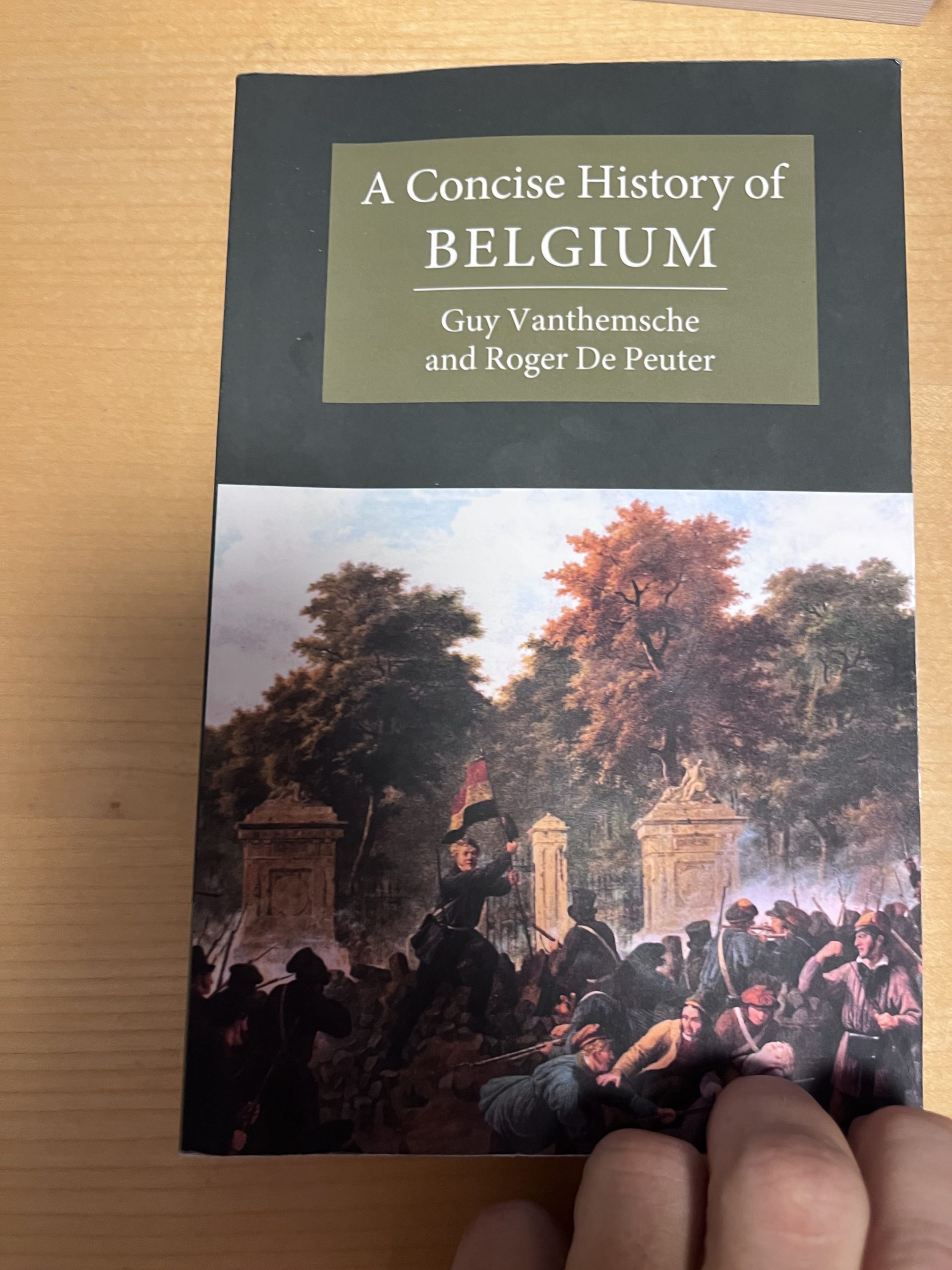
History of Belgium
The Belgian nation-state can sometimes be presented as an artificial creation of the Great Powers in 1830, bringing together two different “peoples”, the Dutch-speaking Flemings and the French-speaking Wallons.
The creation of “Belgianness” was accompanied by a specific cultural and institutional policy, namely a thorough Gallicization of public life. Only French was used in Belgian public administrative life. Language acted as a marker of social hierarchy. Elite figures spoke French.
The Flemish movement was created to support a sense of Flemish identity. The region was called Flanders.
After the WWI some German-speaking communities were transferred from Germany to Belgium.
July 21 is the Belgium’s national holiday. In 1831 the Saxe-Coburg family accepted invitation to became the dynasty of Belgium. Leopold became the first king.
The term Flanders originally refers to a small Carolingian pagus located near the North Sea coast.
One of the medieval principalities where Flemish was spoken, outside the country of Flanders, was the duchy of Brabant. In 1993, one of the Belgian state reforms split this entity into two new provinces, Vlaams-Brabant and Brabant wallon.
Etymologically, the words Wallonia and Wallon derive from the old Germanic walha or Welsch. More generally, the word also meant foreigners or strangers. Wallonia became a political reality – an official region – from 1970, after the first Belgian state reform.
Earliest Times, From Prehistory to the end of the Roman Period
The words Belgium and Belgians are dating back to Celtic times. But the words have nothing to do with 1830 realities.
Homo sapiens appeared in Belgium around 37.500 BP.
During the Iron Age (from 800 BCE) the Celts lived in this area.
At the beginning of his conquest of Gaul (58-51 BCE), Caesar had heard that the north-eastern part of the region was inhabited by Belgae. Caesar’s Belgium has nothing to do with present day Belgium.
During the four decades or so following Caesar’s victory in 51 BCE, the Roman imprint on the newly conquered north-eastern regions of Gaul was rather modest. Real organization and structural change only started under the first Roman emperor, Augustus (27 BCE-14 CE). He split the region in three large provinces: Aquitania, Gallia Lugdnensis, and Gallia Belgica. During the reign Diocletian Gallia Belgica was split into two new provinces: Belgica Prima and Belgica Secunda.
After the crushing of the Batavian revolt (70 CE). Gallia Belgica enjoyed a century of Pax Romana. This long period of quiet prosperity was interrupted in 172-174 by the bloody incursion of German tribes, especially the Chauci and the Chatti.
Around 250 CE, with new invasions from over the Rhine, especially by the Franks. New Frankish invasions followed in around 275.
The Frankish leaders step into the shoes of the Romans.
Some of the cities of the future already existed as modest Roman vici (Ghent, Antwerp, Kortrijk, Namur).
The Era of the Frankish Kingdoms (Fifth-Tenth Centuries)
The confederation of Germanic-speaking tribes known as the Franks. Almost nothing is known of their first recorded leader, Chlodio and his successor Merovech. His son Childerik (436-481) resumed expansion initiated under his grandfather. His son was Chlodowig, better known as Clovis (465-511), he defeated Romans, other Germanic populations like Visigoth and the Alamans, conquered Aquitaine, subdued the Burgundians.
Clovis converted to Christianity in Reims in 496 or more probably in 508.
After the Merovingian dynasty the Pippinids took over, later called the Carolingians. Pippin I or Pippin of Landen, Pippin II or Pippin of Herstal and Charles Martel (the Hammer), became key figures.
The Western Franks originally came from Taxandria and then settled in the surroundings of Tournai, two regions located in contemporary Belgium. But once Clovis ascended to power, the Merovingians showed no special interest in these regions.
In the territories that later became Belgium, one specific comitatus emerged as early as the second half of the ninth century. Count Baldwin I (died in 879), who had forced himself into the Carolingian family by marrying (in fact abducting) Charles the Bald’s daughter Judith, was the founder of a dynasty that ruled Flanders as a quasi-independent polity.
The rest of Belgium was part of Lothringian kingdom, that eventually disintegrated into several quasi-autonomous polities in the eleventh century (the dutchy of Brabant, the county of Hainaut and the county of Namur).
For centuries, a large zone of mixed Germanic-Latin use existed in the middle of later Belgium. Another language shift which started in the late eighteenth century: the gradual spread of French in the Dutch-speaking regions of Belgium.
Trade in the classical sense of the word, even long-distance commerce, was not unknown in the Frankish world. But the exchange links with the Mediterranean world gradually dwindled. On the other hand, commercial relations increased with the Nordic world. Viking, Saxon, and Frisian merchants took the lead in the circulation of commodities such as slaves, furs, amber.
A final heritage of the Frankish period were the cities. Liege was important as the seat of diocese already around 800. Several cities slowly emerged or re-emerged, mostly along the Scheldt and the Meuse.
The Origins of the Medieval Principalities (Tenth-Fourteenth Centuries)
The fourteenth-century Belgium consisted of three duchies (Brabant, Limburg, and Luxemburg), three counties (Flanders, Hainaut, and Namur), a prince-bishopric (Liege) and some smaller territories.
After the death of Louis the Pious (840) his empire was divided among his sons in 843 (the Treaty of Verdun).
One of the counties in the Carolingian Empire was the pagus Flandrensis located in the area of present-day Belgium. A certain Baldwin (ruled 864-879) became a prominent political figure.
Baldwin IV (980-1035) conquered Western Zeeland. This marked the beginning of the expansion in the direction of the empire. During the reign of Baldwin V “the Great” or “of Lille” (ruled 1035-1067) Flanders reached a first zenith.
Second zenith was achieved during the reign of Thiery of Alsace (ruled 1128-1168) and his son Philip of Alsace (ruled 1168-1190).
In 1087 the emperor gave the ducal title to Godfrey of Bouillon. He was one of the leaders of the first Crusade.
The prince-bishopric of Liege was the first important Lothringian principality.
The duchy of Brabant originated in the small country of Leuven.
Limburg was a rather small polity consisting of scattered territories in the north-east of the present-day Belgian province of Liege. John I of Brabant won a great victory in 1288 at the battle of Worringen, he was the successor of the childes duchess.
From a European perspective, the Low Countries, especially their Belgian part, developed into one of the most economically dynamic regions of the continent during the period 1000-1300. During that period the county of Flanders also developed into one of the most urbanized regions in Europe. 18.5 % of the population lived in big cities. In England and Wales the percentage was 3.1.
The economic significance of cities was mainly due to the development of industry, especially textiles. In the twelfth century, there was seven important cloth-producing towns in Flanders: Ghent, Bruges and Ypres in the Dutch-speaking part, and Arras, Douai, Lille, and Saint-Omer in the Roman part of the country. After 1200, the Flemish cloth industry mainly processed English wool.
Ghent and Bruges become major trading posts for export in German cities. Two worthy competitors were Antwerp and Berg-op-Zoom in Brabant.
City-dweller distinguished themselves from the rural population by their free status and citizenship. Urban identity was further expressed in squares and buildings such as the city hall, the cloth hall, and very typical for the southern Low Countries, the belfry. Belfries were built in the major and even smaller cities of present-day Belgium and northern France.
After the reunification of Flanders and Hainaut (in 1191), the position of the Baldwin family lineage as powerful vassals of the French crown was seemingly restored. In 1202, count Baldwin IX (ruled 1194-1206) took part in the Forth Crusade, but he got involved in the political rivalries in the Byzantine Empire. He became emperor of the Latin empire of Constantinople (1204), but soon died in captivity after losing a battle.
French involvement in the internal affairs of the county increased in the last decades of the thirteenth century, when Philip IV the Fair ascended the throne.
Count Guy de Dampierre (ruled 1278-1305) tried to increase his authority over the powerful Flemish towns. Ghent proved the most troublesome. Count also fight against French. Two parties were formed: the supporters of the count, Klauwaarts, and the supporters of the king, Leliaards.
In May 1302, a French army arrived in Bruges to restore order. During the famous Bruges Matins, a few hundred French soldiers were killed and the governor barely escaped.
On July 11, 1302, the Flemish army, consisting of a few hundred knights and about 8.000 to 10.000 men from the urban militia faced the royal army at Kortrijk. The battle ended in a disaster for the French. It was known as the Battle of the Golden Spurs.
In 1312-1331, the city of Liege was almost entirely in the hands of the artisan corporations.
The practice of recording agreements between ruler and subjects, the so-called system of “Brabant constitutionalism” reached its zenith in 1356.
In 1303, artisans in Brusells revolted and the patricians were forced to share power.
In 1328 last king of the direct line of the Capetian dynasty died. The English king Edward III, believed he had a right to the throne. The Hundred Years War (1337-1453) the English and French rulers tried to strengthen their influence in the Low Countries.
A revolution in Ghent in 1337 gave power to five hooftmannen. One was Jacob Van Artevelde (1290-1345). Bruges and Ypres joined the revolt. In 1340 the Flemish towns recognized Edward III as the rightful king of France and theirs.
In 1345 Van Artevelde was murdered and the political tide in the country turned. New count was Louis de Male (1330-1348). Ghent was the last city to submit to count in 1349.
From c. 1000 until the crisis of the fourteenth century, five relatively large principalities emerged in the southern Low Countries: Flanders, Liege, Brabant, Hainaut, and Luxembourg.
Unifying the Netherlands: The Burgundy-Habsburg Period (1348-1555)
In over a century and a half, about fifteen principalities and cities in the Low Countries, from Arras and Luxemburg in the south to Amsterdam and Groningen in the north were unified under one ruler. Burgundy and Franche-Comte in eastern France were also part of this new polity. The Low Countries (and thus Belgium) became part of the huge Habsburg monarchy.
After lengthy negotiations the Flemish count eventually married the daughter of Philip of Burgundy, a younger brother of the French king 1369. Philip was commonly known as “the Bold”.
After Louis’ passing, Philip the Bold (ruled 1384-1404) took charge of the Flemish government.
Philip the Bold and his son John the Fearless (ruled 1404-1419) were heavily involved in the political development in France and consequently in the Hundred Years War. The third duke was Philip the Good (ruled 1419-1467).
In 1430 Philip the Good founded the Order of the Golden Fleece. He also introduced the joint gatherings of the states of several principalities. These meetings were held exclusively in the dominion of the Low Countries. Although regional particularism remained strong, the existence of the States-General and the various councils proved tata a Burgundian state was developing in the Low Countries.
In the period of 1380-1480 Bruges was the most important trading city in north-western Europe. The first stock exchange in Europe was developed in the city. The naming of the stock exchange French (bourse), German (Burse), Dutch (beurs) and English (burse) originated int Ter Buerse, a Bruges inn where business was carried out.
Charles the Bold succeeded Philip (ruled 1467-77). He was in the constant conflict with Louix XI the French king. He was very authoritarian ruler. In 1474-75 he came into conflict with the Decapolis, an urban federation in Alsace, and their allies, the Swiss Eidengossen. He was killed in battle of Nancy in January 1477.
The new duchess was Mary of Burgundy (ruled 1477-1482). He married Maximilian of Habsburg (1459-1519). The duchess son was Philip the Fair. He was only four, so Maximilian was appointed guardian and regent. Maximilian was forced to make peace with France, he married his daughter Margaret of Austria to the French crown prince, but the marriage was later canceled. Maximilian became emperor and he could pass the governance of the restored Burgundian state to his son, Philip the Fair (ruled 1494-1506).
Philip and Margaret were married to the daughter and the eldest son of Isabella of Castille and Ferdinand of Aragon, the Catholic Spanish monarchs in 1495. Philips reign brought stability in the Low Countries.
Maximilian became the guardian of his eldest grandson, later Charles V (1500-1558), Margaret of Austria, represented him as his regent. The young Charles was educated at her court in Mechelen. In 1515 he took control of the government. Maximilian died in 1519, Charles succeeded him as Emperor. Charles represented himself as parton of the Catholic church. He was threatened by France, Ottomans and reformation.
After the regency of Margaret of Austria, Charles appointed his sister, Mary of Hungary as her successor. Charles abdicated in 1555.
Charles won against Francis I, the French king in Pavia. The treaties of Madrid (1526) and Cambrai (1529) put an end of jurisdiction of the Parliament of Paris over Flanders and Artois.
The Habsburg Low Countries became the facto a separate political unit. In 1549, Charles V decided that his successor would inherit the Habsburg Low Countries as a whole. The term “XVII Provinces” was quite significant.
Antwerp was becoming an important center of distribution (Portugal chose it as a major distribution center for spices imported from Asia) and financial center.
Art and culture was also important in Low Countries.
Desiderius Erasmus (1466-1536) was most famous for northern Humanist. He was educated in the vein of the Modern Devotion.
Lutheran teachings proved popular in the Low Countries. In the Low Countries Lutheranism was banned in 1521.
The Spanish Netherlands (1555-1700/1713)
Until 1555 the Netherlands were part of Charles V’s multinational Habsburg Empire. After 1555, the Netherlands became part of the possessions of the Spanish crown.
From the 1550s, a new protestant creed, Calvinism, gained popularity in the Netherlands.
William of Nasau (1533-1584). He was to play a crucial part in the following decades. He became sovereign prince of the southern French principality of Orange.
In 1565, over two hundred petty nobbles from different provinces formed a kind of union: the so-called League of Compromise.
Philip, the Spanish king decided that harsh measures were required against protestant (since he also apply them to Muslim and Jewish communities in Spain). Don Fernando Alvarez de Toledo, duke of Alva (1507-1582) was entrusted with the repression of the heretics.
Alva’s army was 10.000 soldier. In May 1567, they arrived in Brussels. He established an extraordinary court, the “Council of Troubles”. The persecuted called it the “Blood Council”.
William Orange run to Germany, and he prepared the military actions against Spanish army from there. In spring of 1568 signaled the beginning of what would become known as the Revolt of the Netherlands, the Dutsch Revolt and the Eighty Year’s War.
1572 was a crucial year for the insurgence. Alva replied with strong force. Spaniard violence proved counterproductive. In 1574, the king recalled Alva and replaced him with Don Luis de Requessens.
In 1575, the king announced the bankruptcy. The solider were not paid. The Pacification of Ghent (8 November 1576), settled a number of religious and political issues. But before the signature Spanish troops invaded Antwerp.
The new governor was Don Juan of Austria. He died in 1578. His successor was Alexander Farnese (1545-1592), duke of Parma.
Holland, Zeeland, and five other northern provinces and cities from Flanders and Brabant formed an alternative political union: the Union of Utrech (1579). The provision of the Union operated as the constitution of what was become the Republic of the United Netherlands, also called the Dutch Republic.
William Orange was assassinated in 1584.
In 1588 the Grand Armada failed to reach England. The same year the seven northern provinces decided to exercise sovereignty themselves. A new confederate state was born, the Republic of Seven United Netherlands. Until 1648, Philip II and his successors refused to formally recognize the sovereignty of the Dutch Republic.
In 1596 the king appointed his nephew, archduke Albert of Austria as governor of the Netherlands. He married his daughter Isabela and they ruled from 1598 to 1621. This was the time of religious, political and economical restoration after the destructive civil war and religious war.
In 1609 the so-called Twelve Years Truce was concluded. In 1621 Philip IV was the king in Spain and the fights started again. The Spanish Netherlands were dragged into a protracted conflict. Between 1621 and 1713 the country was at war for 73 years.
In January of 1648, the peace of Munster was signed. The Spanish king relinquished his sovereignty over the former northern provinces and formally recognized the independence of the Dutch Republic.
Louis XIV started the Dutch War (1672-78). The Treaty of Nijmegen ended it. Parts of Flanders, Hainaut, and Luxemburg became French.
According to the Peace of Rijswijk (1697) France was to return all the territories it had conquered since 1679.
The southern Netherland remained loyal to the Spanish-Habsburg monarchy, mainly due to the religion.
The Austrian Netherlands (c. 1700-1780)
The Austrian period in Belgian history, presented here, began in 1713 and ended in 1794.
The succession of childless Charles II posed a major problem for the European balance of power. In 1702 the War of the Spanish Succession broke out. Charles II gave his crown to Philippe of Anjou.
After the sudden death of the emperor, the Habsburg pretender for the Spanish crown became emperor Charles VI (ruled 1711-1740). In 1713 the Treaty of Utrecht was signed without Charles VI.
The Imperial and Royal East India Company was founded in 1722 and registered in Antwerp. The company’s ship would sail from and to Ostend, hence its common name Ostend Company. In 1731 the business ended.
After Charles VI death in 1740, Maria-Theresa succeeded him (ruled 1740-1780). The Peace of Aachen returned the Austrian Netherlands to Maria-Theresa.
While textile industries were mainly situated in the northern part of the country, coal and iron businesses were exclusively located in Wallonia.
The Formation of a New Nation-State (1780-1830)
Even before its independence, Belgium was taking the lead in continental industrialization.
Joseph II (1741-1790) inaugurated new policy with religious reform. The Edict of Tolerance (1781) improved the position of Protestants.
The Austrian Netherlands would be subdivided into nine Circles (Kreise) administered by intendants, civil servant appointed by the central authorities.
In 1789 Henri Van der Noot crossed the border and invaded the Southern Netherlands with a small army. On 11 January 1790, the Act of Union founding the Republique des Etats belgiques unis, was signed. The republic collapsed quickly.
In 1792 French troops invaded the Austrian Netherlands. Two decades of French rule produced profound structural changes in the annexed territories.
French troops were expelled on February 1814. But Prussians administered the eastern part of the country, while the provisional government ruled the rest of the country. The Habsburgs had made it clear that they were not interested in the country anymore.
The Sovereign Prince, William-Frederik of Orange-Nassau, returned to Netherlands and he conceived the plan of also ruling over the Belgium regions. On June 21, 1814 through Eight Articles the European powers entrusted the sovereignty over the Belgium region to the Dutch monarch.
The final step toward a full-fledged Liberal state would not be taken within the framework of the United Kingdom of the Netherlands, the Belgian revolution of 1830 would ruin William’s brainchild. The issues were religion, language (from 1819 to 1823 – there were heavy steps to increase usage of Flemish in the southern part also), south paying for the north debt.
In 1828, the Liberal and Catholic oppositions joined hands and oppose the king in the name of liberty.
On Augusta 23, 1830, the riot started at the Brussels Monnaie theatre.
The independence of Belgium was proclaimed on October 4, 1830. On December 20, 1830, the Great Powers recognized the principle of Belgian independence.
The Belgian-Dutch War of August 1831. But at that moment, Belgian independence had already been consolidated on the diplomatic and on the internal political front.
Leopold of Saxe-Coburg, a German prince who had been married to Princess Charlotte of Wales , heiress to the British throne, accepted the Belgian offer to became the king and he sworn fidelity to the Belgian constitution on July 21, 1831.
However limited and weak, Belgian political identity effectively existed in the 1820s. As we have seen earlies, it was born in the second half of the eighteenth century and reflected the consciousness that this particular region had things in common.
The Consolidation of a Bourgeois Regime (1831-1880s)
Marx was in Brussels between 1845 and 1848, where he wrote the Communist Manifesto.
Belgium became the second industrial nation of the world. Four Belgian cities were important, Antwerp, Brussels, Liege and Ghent.
The nineteenth century Belgium was a country with sharp social contrasts.
Belgium was surrounded by big forces with different interests. It was crucial for survival to maintain her independence.
Young Crown Prince Leopold was fascinated by his father’s colonial projects. This would lead, many years later, to the foundation of Belgium’s huge colony in central Africa.
Belgium in 1830s and 1840s was very liberal for its times. Free elections and very limited monarch’s authority.
Liberal and Catholics were the main political forces. Under the cover of “Unionist” governments, politicians leaning towards the Catholic camp set the tone. In 1846 the Liberal Party was established in Brussels. In 1878 a platform was established that served as Catholic Party. From 1847 to 1884, Liberal cabinets ruled Belgium for twenty-seven out of a total of thirty-seven years.
Belgium was and still is commonly defined as the meeting place par excellence.
Not until 1863 did the first MP swear his oath in Flemish.
In the second half of the 1870s, regionally based Socialist parties were created in Ghent and Brussels. In 1879 the nation-wide ambitions lead to creation of a Parti socialiste belge. It was a forerunner of the future Labour Party.
The Belgian Nation-State at Its Height (1880s-1945)
Compared to other European countries Belgium continued to be the “land of small farms”.
The colonization of the Congo in 1885 profoundly influenced the international involvement of Belgian capital.
In 1885 the Belgian Workers’ Party (BWP) was created.
King Leopold II tirelessly tried to create some kind of overseas enterprise – a commercial company, a free state – that would increase both his own fortune and Belgium’s prosperity and grandeur. In the wake of the European intrusion into the heart of Central Africa, he set up several shady private organizations from 1876 to obtain, in his word, “a piece of the cake”. In Belgium, opposition to the king’s policy also grew, particularly from Socialists, progressive Liberals and some Catholics. Protracted discussions finally led to the annexation of the Congo as a Belgian colony in 1908.
In the first world war Belgian neutrality was breached. The Schlieffen plan, draw up by the German High Commmand, provided for an attack on Paris through Belgium. During occupation the Germans implemented the Falmenpolitik, an adroit strategy that exacerbated the tensions between Flemings and Francophone.
The Versailles Peace Agreement of 1919 transferred some territory in the east of Belgium. Also Ruanda and Urundi in Africa that were controlled by the Germans were transferred under the Belgium control as mandate territories of the League of Nations.
The social, cultural, and political dominance of the French language in Belgium was increasingly challenged in the Flemish part of the country. The Flemish movement became a mass movement. On the other hand that led to the birth of the Walloon movement.
The creation of specific Flemish-National part (the Vlaamsche Front) happened after WWI, but it soon disappeared. In 1933 VNV (the Vlaamsch National Verbound) was created.
WWII again saw Germany attacking Belgium and conquered it.
The Metamorphoses of a Nation-State (from 1945 to the Present Day)
Throughout the past seven decades, the country continued to be one of the world’s top exporters in relative terms.
Flander’s share in the Belgian gross national product (GNP) grew from 51.6 percent in 1966 to 57.6 percent in 1984.
In 1944 the Social Pact agreement was concluded between the representatives of employers organizations and trade unions. In relatively short time, Belgian labor and capital well and truly developed a neo-corporatist culture of compromise that strongly contrasted with the Manchesterian attitude of nineteenth century Belgian capitalists.
But from 1980s neo-Liberal approach gained grounds.
The Belgian society was also profoundly marked by growing immigration. First there were Italians in 1940s. Then in the mid 1960s, the Moroccans and Turks. Also the people from former colonies – Congo, Ruanda and Burundi – came.
In 2005, non-Belgian represented 4.9 percent of total population in Flanders, 9 percent in Wallonia and 26.5 percent in Brussels.
All post-war Belgian governments were based on interparty compromises.
Another important division inside Belgium was the School question. Who will control it, liberals or catholic.
Political parties were additionally fragmented based on national lines – Flemish and Francophones.
Congo question developed in 1960. Patric Lumumba won the elections. But the army didn’t accept it. When he turned to Soviets for help, Western countries supported the cup and Lumumba was murdered by the men in Katanga.
Ruanda and Burundi were lost for Belgium in 1962.
In September 1964 Benelux was created.
The law of August 2, 1963 determined the linguistic status of Brussels. In November 8, 1962 the linguistic border was set. The Brussels Capital region serves as the bridge between two regions.


