Prologue
You heard Merckx. Felt him. Not a normal whirring of pedals and wheels, but a thudding through the atmosphere. “A different way of pedaling from the rest of us”, as Dino Zandegu put it.
Everyone who is anyone who rode a bike in the 60s and 70s remembers the moment they first met Merckx.
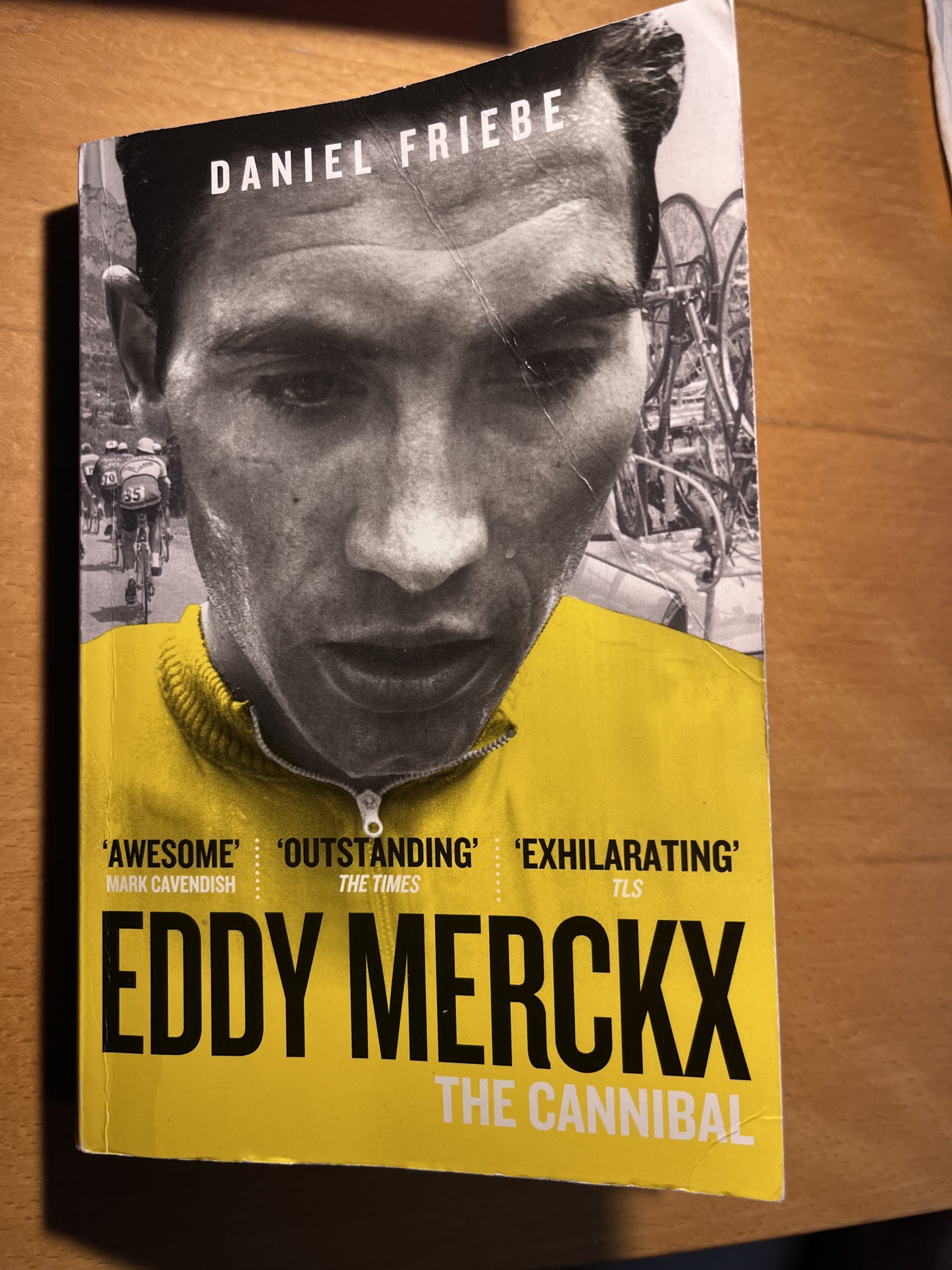
Merckx was no fool, and win often he did. Over 500 times by the end of his career in 1978. He was always trying to win. The Cannibal.
A simple sport for a complicated mind. That was cycling as seen by Merckx.
Merckx best friend in cycling was the painfully sensitive Italo Zilioli.
Folgorazione
An electrocution. Una folgorazione – literally, in Italian, what happens when two pairs of eyes meet, the air sizzles with electricity, the spine tingles and the heart gulps.
Claudine Acou married Eddy on 5 December 1967.
Vincenzo Giacotto called Nino Delfilippis and said that he has Merckx for him, Giacotto’s backer was Faema. He believed that Merckx could win Giro and Tour if he only would learn to think and race Italian.
Merckx’s problem in his first professional year would come mainly off the road. Van Looy was the king, the Emperor as they say, and Merckx was the king in waiting.
Liege-Bastogne-Liege was Merckx first professional race win. The first of 525.
Van Looy had ended the season with 37 victories, Merckx with nine. Raphael Geminiani had approached Merckx with an idea to join Jacques Anquetil in Peugeot. He signed in the autumn of 1965.
By the end of 1966 he had 20 wins.
Was Merckx a poor descenders. Maybe in the beginning.
Merckx was hardly off his bike, competing and winning on the track throughout the winter. Also his 125 kilometers he rode on average per fay, 365 days per year, were remarkable, mind boggling. His lung capacity was 5,9 liters. His resting heart rate was in the high 30s. His VO2 Max was also nothing special. But he did have a very long femur bones.
An old Merckx family maxim, “Whatever you do, do it well”, echoed permanently in his consciousness.
Something in the water
He had won Milan – San Remo and Gent-Wevelgem in the spring of 1967. He also won Fleche Wallonne.
In the early 1960s, there had been two rulers, Jacques Anquetil in major tours and Rik Van Looy in the Classics. By 1967 the pair was going but none yet gone. The new pretender was also Merckx.
He started Giro and won two stages, Blockhaus and bunch sprint in Lido degli Estensi. Gimondi won that Giro and Merckx was nine.
Merckx would end the 1967 season as the champion, nay the king of the cycling world.
Fire and ice
Merckx won the first stage in 1968 Giro. He didn’t want to give away Maglia Rosa until Napoli. He just wanted to race all the time. In spite of all the energy he seemed to be wasting, the kid was never, ever tired.
Early this year he won Giro di Sardegna, the first stage-race win of his pro career. He also won Tour of Romandie and Switzerland.
Merckx was the reigning world champion and had finished the 1967 season with 26 wins.
Merckx had some heart problems; his cardiograph showed some irregularities. It was a non-obstructive hypertrophic cardiomyopathy.
Merckx won on Tre Cime was great. Gimondi said: “I am just a cyclist – he’s a motorbike.” He won the Giro and during that Giro Gianni Motta and Felice Gimondi were positive on doping test.
Eddy, ciao
Merckx also had this great drama in his life: he couldn’t stand couldn’t tolerate losing.
New world order
Roger de Valeminck didn’t want to ride with Merckx at Faema.
Having grown up in a Dutch speaking household, in a mostly French-speaking neighborhood, and living with a Francophile wife, Merckx often just sounded confused.
Merckx disliked Guillaume Driessens instantly. But he was to be his directeur sportif.
By the end of 1968, Merckx has raised 129 times since the start of the year and won on 32 occasions.
His team was phenomenal, because he’d cherry-picked the best from other teams.
Partick Sercu told that he was not a bully … but that he was a Mafioso in one sense. Merckx want to win everything, for himself, for the public, for the organizer.
For Herman Van Springler the summer of 1968 had an air of fin d’epoque. There was only one man in Belgium, that hadn’t yet yielded to the evidence, his name was Roger DE Vlaeminck.
End of the world as we know it
Merckx had won four stages and had the ’69 Giro sewn up five days before the first real mountains. Merckx positive test was triggered by fencamfamine. The substance itself was not banned.
Eddy was ‘his dad on a bike, and his mother in everyday life’.
Eddy had done just one stage race as an amateur – the Tour of Limbourg in 1963.
Merckx hated upsetting people almost as much as he hated losing.
Benefit of the doubt?
The Giro was over for Merckx, Gimondi was now the leader. The priority now was to have the sanction lifted and Merckx’s good name restored in time for the Tour.
Merckx was in an alarming state of depression. On 14 June UCI gave Merckx the benefit of the doubt and immediately lifted the suspension of which he was currently object. Merckx was wounded but, as Walter Godefront had already noted, he was never more dangerous than when he was done.
First man on the moon
Merckx first Tour was on. He needed few stages to get it going. At the summit of the Ballon D’Alsace he maraud across the line over four minutes ahead of Gimondi, Poulidor and the rest. He than rode more carefully until he attacked again on the final Alpine stage to Digne. And again over the Tourmalet.
He won 1969 Tour. He and his Faema team-mates were received by King Baudoin and Queen Fabiola at the Royal Castle of Laeken.
Down and out?
The one arena in which Anquetil could still give Merckx a run for his money, he felt, was in the bar. So they started drinking and Merckx won. The tales of Merckx’s elephantine constitution and invincibility in eating and drinking games were apparently true.
Merckx had big accident on the track at Blois on Pierre Tessier velodrome. For a moment his cycling career was in danger.
A new Merckx
Eddy Merckx of 1970 was inferior to the Merckx of 1969. After the crash he was more in discomfort than before. His left leg was not the same. His style turned into clunking motion of equal power but nowhere near as satisfying a sensation.
His final harvest in 1969 had totaled 43 victories from 129 races.
The gypsy and the nomad
The competition between De Vlaeminck and Merckx was also emphasized by division of Belgium between Brusell and Wallonia that adopted Merckx and Flanders that was De Vlaeminck.
De Vlaeminck was called The Gypsy by Jean-Pierre Danguillaume.
De Vlaeminck won Liege-Bastogne-Liege in 1970. Merckx won Paris-Roubaix.
Merckx also won Giro but he did suffer a little in the mountains on the Passo di Crocedomini. After Blois, cycling became suffering, especially in the mountains, when previously it had just been fun.
Luis Ocana had been born a week before Merckx and into a very different milieu. He had strong BIC team. He won Vuelta that year.
Eddy used to say “Legs don’t have a brain.”
The journalist Gianpaolo Ormezzano had become as close as journalists could to Merckx.
Merckx and Ocana were suffering together on the Mont Ventoux in Tour. Merckx won that Tour.
Deplumed
Merckx was now riding for Molteni.
In 1971 Ocana was leading the Tour and Merckx fought he was finished. Ocana won the stage on the climb to Orcieres-Merlette for quite some minutes. On 10 July stage to Marseille, was one of the most impressive stages in Tour’s history. Merckx attacked from the start of 251-kilometre stage on a downhill with his team-mates. Merckx regained two minutes and 12 seconds. But Ocana was destroyed in that stage. Three back-to-back stages in Pyrenees left.
If
Ocana didn’t finish 1971 Tour. Merckx won. Ocana never reproduced his 1971 performance, only in 1973 when Merckx was absent.
Hour of need
Merckx finished 1971 with 54 victories (with win ratio of 45 %).
In 1972 he got Alex, his son.
The ’72 Giro would be by some distance De Vlaeminck’s best performance in a major tour to date – yet he was still ‘only’ seventh.
Merckx won both Giro and Tour.
The Giro and Vuelta a Espana bosses were lobbying much harder to have Merckx at their race in 1973. So he decided to skip 1973 Tour.
He hadn’t yet won (or indeed ridden) the Vuelta, Amstel Gold or Paris-Tours, but otherwise little remained except records. And ‘the hour’.
In the Agustin Melgar velodrome his result was 49,408 KM.
Sign of times
In ’73 spring he had his best Classic campaign. He won Amstel for the first time.
He started his first Vuelta. He won. And after four day he started Giro and wore the pink jersey from the start all the way to the finish.
The unbroken winning run in major tours dating from the 1968 Giro coincided with a six-year period during which Merckx’s longest lay-off due to injury had been the 12 day after his crash in Blois.
In 1974 he got chest infection in the early season. He started to lose races. Jose Manuel Fuente was one of the riders who capitalized on that.
But he still won 1974 Giro by 12 seconds from Baronchelli. And he also won Tour. He also won Worlds in 1974.
Knockout!
If Merckx had struggled in the mountains in 1974, it was partly because his team was ageing with him.
In 1975 mountain stages in Tour were close together. Thevenet was more than three years younger than Merckx.
Merckx cracked in the Dauphine on Col du Granier.
On the Puy de Dome, Thevenet crossed the line 15 seconds behind Van Impe and waited if Merckx would be able to defend his yellow jersey. He did. But that was the day of the famous punch thrown by a fan (55-year-old Nello Breton). But the next day Stage 15 Thevenet got the yellow jersey for 58 seconds.
Thevenet won that Tour.
Cannibalized
Merckx was now 30 in 1975. He was thinking of revenge for 1976.
It was hard to know whether De Vlaeminck and Maertens had won nearly 60 races between them in 1975 more because they had improved or because Merckx had decayed.
Merckx finished only eight in the Giro.
He wanted to show that he is not finished in 1977 Tour now riding for FIAT team. But Col de la Forclaz and Col du Glandon finished his dreams. He ended sixth.
FIAT didn’t offer him another contract, he signed with C&A team.
A spoonful of sugar
For the third time in his career he had tested positive for a banned substance at 1977 Fleche Wallone.
With not only his own reputation but that of cycling down the ages at stake, no one should be surprised now if Merckx neither endorses nor participates in the soul-cleansing.
Reinvention and reappraisal
Eddy had colitis and it was due to all the stress. On 18 May he announced that he will retire.
He was suffering from depression after the end. And then his old mechanics Ugo De Rosa suggested him to start the business. To start making bikes.
His company turnover is now around six million.
He was voted the best sportsman in the world three times in the early 1970s.