

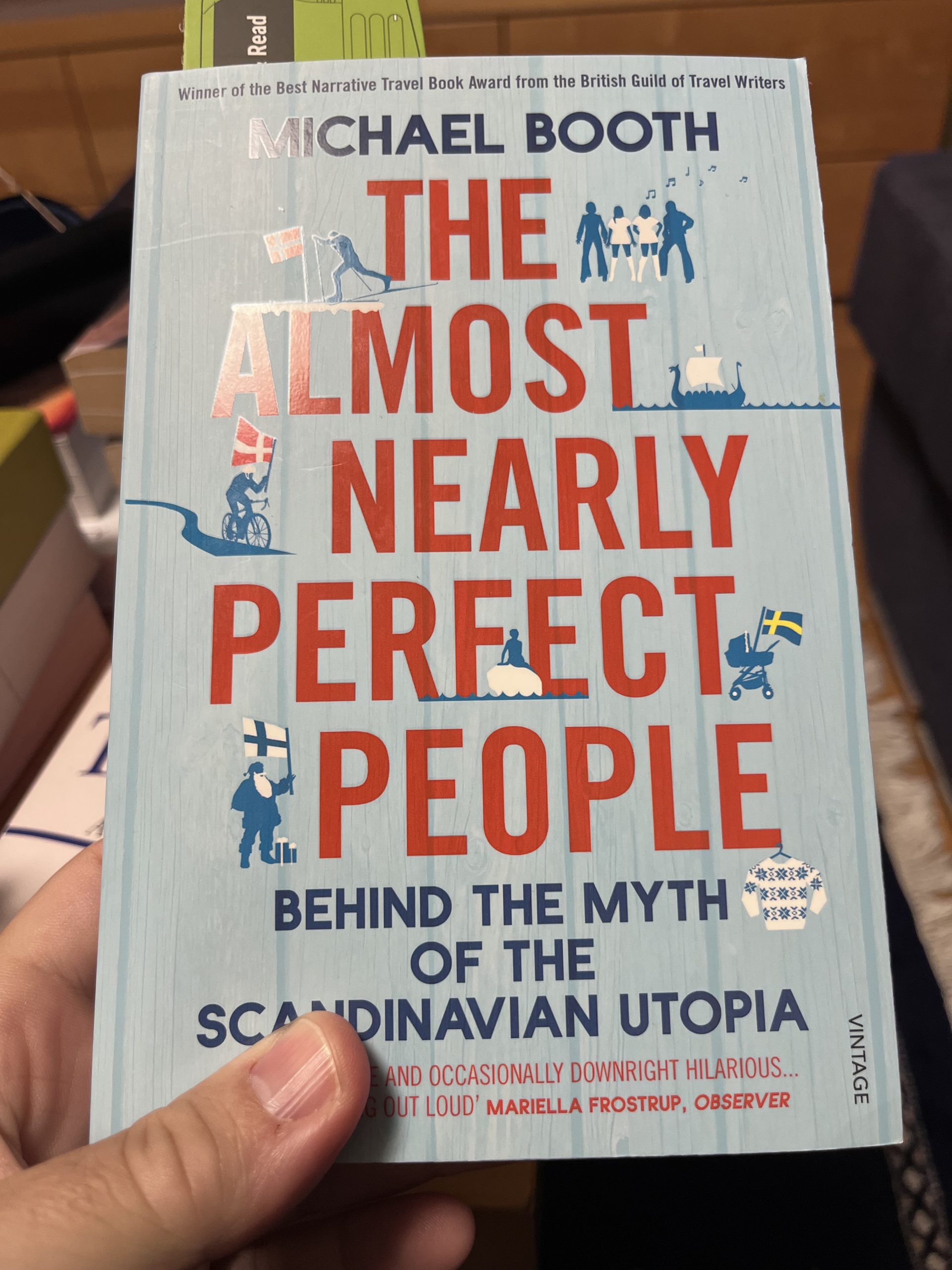
Behind the Myth of the Scandinavian Utopia
The happiest of their species. Denmark. This dark, wet, dull, flat little country, with its handful of stoic, sensible people and the highest taxes in the world. The Danes were Lutherans by nature.
Danish apoteks are run on a monopoly basis so customer service is not a priority.
We Britons are, essentially, Scandinavians. The infamous first raid on the monastery at Lindisfarne on 8 January 793. The Domesday Book is full of Scandinavian names for settlements. Wodin or Odina for Wednesday, Thor for Thursday, Freya for Friday.
At one point in the 1860s, a tenth of all immigrants arriving in the United States were from Scandinavia, many of them ending up in Minnesota.
When everyone earns the same amount of money, lives in the same kinds of homes, dresses the same, drives the same cars, eats the same food, reads the same books, has the same opinion about knitwear and beards, broadly similar religious beliefs, and goes to the same places on their holidays, things can get just a teensy bit dull.
Denmark
Happiness
Midsummer’s Eve is one of the highlight of the Scandinavian calendar. Pagan in origin but highjacked by Church and renamed in honour of Sankt Hans (St John).
The Danes take their partying very seriously. They are enthusiastic boozers, committed communal singers, and highly sociable when among friends.
The Danes work almost half the number of hours per week they did a century ago, and significantly fewer that the rest of Europe. 1539 hours a year compared with the EU average of 1.749.
Over 20 % of working population is unemployed or disability benefits. They call their system flexicurity.
One reason for the Danes’ happiness are summer houses. A homely, single-storey, L-shaped cabin.
Denmark has a much more laissez-faire attitude to booze than the rest of the region. There is no state-owned monopoly here as there is in the other four Nordic-countries.
Bacon
Once upon a time, the Danes ruled all of Scandinavia. The Kalmar Union of 1397 was a historic high point for the Danes.
There was a brief false dawn for Denmark under the reign of their great Renaissance king. Chrisitan IV – Denmark’s Henry VIII.
By the terms of the Treaty of Roskilde signed in 1658, the Danes were forced by the Swedes to relinquish their what are today the southern Swedish regions of Skane, Blekinge and Halland, as well as the Baltic island of Bornholm (the later was eventually returned and remains Danish.
When the dust settled on the Napoleonic wars Denmark discovered that it had lost Norway to Sweden in yet another of those dratted treaties, this one signed in Kiel in 1814.
Schleswig and Holstein, the Danes having been forced to abandon their thousand-year-old defences, the Danevirke, to the Prussians in 1864.
Over time, it would also lose its small colonies in India and the West Indies, and even the Faroes voted for autonomy. Adolf Hitler, when his army invaded Denmark in April 1940, it inadvertently relieved Iceland of its Danish head of state.
Danskhed – the Danishness.
The development of a Danish national consciousness really started from the constitution in 1849.
The Danes are he world’s leading pork butchers, slaughtering over 28 million pigs a year.
The aspects of contemporary Danish life that author believe make it such a wonder:
- The landscape of southern Funen (Fyn).
- Lunch of pickled herring with red onion on rye, a Tuborg and an icy schnapps.
- Flodenbolle – a chocolate-covered Italian meringue with a wafer base.
- The word overskud, meaning a kind of surplus of energy. Smack is annoying noise some people make when they eat.
- Arne Jacobsen’s petrol station of Strandvejen.
- The TV series Klovn.
- A visit to Bakken.
- Babies left sleeping outside caffes.
- The word Pyt. Let it go, it’s not worth bothering with. Pyt med det! (Pyt with that!)
- They sell wine and beer in cinemas.
Gini
The Danes do seem to have an uncommon facility to get on with each other regardless of age, class or outlook. Egality comes easily to them. It helps, of course, that Denmark is essentially one giant middle class.
According to New Statesman, 90 percent of the population of Denmark enjoy approximately identical standard of living.
The Gini Coefficient, a statistical method for analyzing the distribution of wealth in a nation. It was created by the Italian scientist Corrado Gini born in 1884. The Coefficient was introduced in 1911. It quantifies how large a percentage of the total income of a society must be redistributed in order to achieve a perfectly equal distribution of wealth.
We find there are systemic problems with subjective measures related to inequality. How people use the word happy or how they present themselves.
The Danes score notably badly in terms of their health. According to a recent report from the World Cancer Research Foundation they have the highest cancer rates in the world – 326 cases per 100.000 people.
Once a society reaches a certain level of income equality, other factors take on a greater importance in determining how happy the people are.
Boffers
The Danes are arguably the most sociable people on earth. On average, each Dane has 11.8 people in their personal network. There are 83.000 local and 3.000 national societies in Denmark – on average every Dane belongs to three.
All the Nordic nations are inclined to social cohesion. That is also connected with trust. All the Nordic countries have high levels of trust, but the Danes are the most trusting people on the planet. 88.3 % of Danes expressed high levels of trust in others. The Danes ever trust their politicians. 87 percent general elections turnout.
Chicken
Does social cohesion generate trust because it brings people together in a shared goal or interest, or is trust a precondition for people gathering together in the first place.
Vikings
Trelleborg is one of Denmark’s largest Viking sites, in western Zealand.
The Vikings are the best bet as to the source of the Danes’ remarkable egalitarianism.
The welfare state didn’t really start until 1961, but trust levels were high in Scandinavia long before that.
Vikings had kings, but, in terms of trust, it is also true that the Vikings had a strict code of honor, which you could argue finds an echo in the high levels of trust in Danish society today.
Ove Kaj Pedersen of the Copenhagen Business School is not convinced with Viking theory. He emphasizes the equality and tax rates and welfare state. That is trust: that you know that, regardless of age, sex, fortune, family background or religion, that you have the same opportunities and the same safety net. Before the welfare state Denmark had 25 per cent at the bottom and 25 per cent with highest income. Now it is 4 and 4. The split is getting worse, but it is still not that bad.
Polar opposites of Danish socio-economic extremes are the ‘Whisky Belt’ Danes and the ‘Rotten Banana’ danes. The former live on Denmark’s ‘Gold Coast’, Strandvejen (The Beach Road). It stretches twenty miles north from Hellerup. Rotten Bananas this is a great, crescent-shaped swathe of the country which is plagued by high unemployment, low wages, crumbling infrastructure, poor health care and underperforming schools. From northern Jutland south along the west coast, before curving east across the island of Funen and ending with the southern islands of Lolland and Falster.
72 per cent
If we would use only one statistic per country. In Iceland, it would probably be the size of the population. In Sweden the size of immigration. In Norway the size of its oil-revenue wealth fund. In Denmark it is its tax rate.
The Danes have the highest tax rates in the world, both direct and indirect. The total direct and indirect burden on the Danish tax payer ranges from 58-72 per cent.
Denmark has seen anti-taxation political parties come and go since the early 1970s, yet none of them has achieved any lasting success based on that manifesto.
For many Danes, their tax burden seems to be the ultimate symbol of collective sacrifice. It is a matter of pride to say: “I pay a lot of taxes.”
In the Free to Choose, Milton and Rose Friedman list a descending order of fiscal responsibility:
- You spend your money on yourself.
- You spend your money on other people.
- You spend other people’s money on yourself.
- You spend other people’s money on other people.
The Danes disagree with the Friedmans.
Over half of the Danish adult population either works in the public sector or is financially supported by it in the form of benefit payments. The Danes are also highly enthusiastic shoppers on the black market. According to one research more than 50 % buy on black market and additional 30 % would if the good offer would be given to them.
They also have the world-leading debt levels. They owe on average, 310 per cent of their annual income.
Why should you save if everything is paid for by the State? The Danes save only 1 % of their annual income compared to 5.7 average in other Western countries. They have the biggest pension funds in the world, so the pensions are guaranteed.
Hot-tub sandwiches
Ove Kaj Pedersen says that if you take Danish social skills, the way of collaborating, empathy, the ability to work in teams, Denmark comes in number one. A lot of small or medium companies with their flat hierarchies.
There are some notions that Danish health systema and education system are not as good as they could be according to the tax levels.
There is a growing concern that the schools tend to sacrifice the potential achievements of the higher performing students for the better good of the middle and lower achievers.
Surely Denmark is going to have to bite the bullet and endure the kind of far reaching and controversial reforms the Swedes were forced to implement following their banking crisis of the early nineties, and from which they emerged by far the stronger economy.
The bumblebee
Mogens Lykketoft is the grand old man of Danish politics, chief architect of Denmark’s tax policy for many years and chairman of the ruling Social Democrats.
He published a pamphlet, The Danish Model. The pamphlet seeks to explain Denmark’s so-called ‘bumblebee’ economy. Conventional economic thinking has it that this high-tax, large public-sector model ought to stifle growth, innovation and competitiveness. It should not work, bumblebee should not fly, both bee and economy remain airborne regardless.
Law productivity is also one of the problems in Denmark. Fittingly, for the home of Hamlet, it turns out that the Danes are heroic procrastinators. The Danes work less than 28 hours a week.
Denim dungarees
The Jelling stones are two stones, tenth-century memorials: the oldest erected by King Gorm the Old in memory of his wife, Thyra; the second by Gorm’s son, Harald Bluetooth.
Lutheranism was strong in Scandinavia. In the late twentieth century secularism replaced Lutheranism.
Bettina’s shoes
Aksel Nielsen was born in 1899 in Nykobing. He wrote A Fugitive Crosses His Tracks in 1933. Inside we can find the set of rules under which the residents of fictional town of Jante leave. Law of Jante (Janteloven) are a kind of Danish Ten Commandements.
Danish tycoons and captains of industry are rarely role models here.
To live at ease in Denmark and assimilate with the Danes it pays to be alert to Jante Law.
Dixieland
Alongside Jante Law, there are two other prime drivers of Danish conformism – hygge and folkelig. The former is a deceptively relaxed and informal, uniquely Danish form of coziness or conviviality.
When people hygge, they engage in a mutual sheltering of each other from the pressures of competition and social evaluation according to Heppe Trolle Linnet.
One particularly visible manifestation of folkelig is that central ornament of the folkelig or hyggelig occasion: the Danish flag, the Danneborg. The Danes genuinely believe that they have the most beautiful flag in the world.
Pendulous breasts
Denmark’s most boring town: Hordum. It has become something of an emblem for the udkantisisation of Denmark.
The happiness delusion
There are not a lot of Danes who believe that they are global happiness champion.
Could the low expectations are the secret of their contentedness. Maybe happiness is not happiness but something more valuable and durable, contentedness.
Danes are unique in their trust and social cohesion.
Scandinavia is a great place in which to be born … but only if you are average.
Iceland
Hakarl
Their country was founded by people who wanted to get away from Scandinavia. It is located halfway to Nort America and has more trade with Germany, the US and the UK than with any of the Nordic countries. There are only 319.000 of them.
Iceland is more Scandinavian than Scandinavia. It was populated by escapees from western Norway, together with the Scottish and Irish sex slaves they picked up on their journey west. They still speak a version of Old Norse.
Iceland was ruled by Denmark for 682 years.
Between 2003 and 2008, Iceland’s three main banks, Glitnir, Kaupthing and Landsbanki borrowed over 140 billion USD, a figure equal to ten times the country’s GDP. Financial crisis exposed Iceland’s debt. Iceland needed IMF loan to survive.
In January 2009 came the so-called ‘cutlery revolution’. The right-wing coalition led by Prime Minister Geir Haarde was finally ousted (they were in power since 1940s). A coalition led by the Social Democratic Alliance party of Johanna Sigurdadottir took over.
King Olaf of Norway convert the Icelanders to Christianity, but they were not fully committed to it.
In the early 1700s there were 50.385 people living in Iceland. A century later the number was about the same.
The US maintained a based in Iceland until 2006. They were the poorest country in Europe, but all that changed with Marshall Plan money and massive infrastructure projects.
Iceland had the highest birth rate in Europe, and has long been a model of gender equality. It was the first country in the world to have a female president, and a single mother to boot – Vigdis Finnbogadottir, elected in 1980.
Bankers
US economic commentator Michael Lewis wrote in 2009 that Iceland was a macho, patriarchal, risk-prone society.
Gisli Palsson studied Iceland’s fishing communities since the early 1980s and the quota system. Palson believed that there is connection between quotas and banking crash. The owners of those first quotas became rich overnight. They moved their profit from fifteen fishing companies to banks.
They are still Vikings in a sense. Equal to anyone.
Thor Bjorgolfsson, the richest man in Iceland. He is a poster boy for Iceland’s economic misadventure. Thor Jensen and Bjorgolfur Gudmundsson are also representatives of the wealth. The later being an owner of West Ham at one point.
The fifteen families are collectively known as The Octopus.
Government, media and business are connected in Iceland.
Denmark
For centuries Iceland’s intellectual class were almost exclusively educated in Copenhagen. The Danish language dominated the Icelandic education system for many years.
Even today they feel that the Danes look down on them. I think they look to us as one step up from Greenlanders.
They think they are more like the Norwegians and not the Danes. Or even more like the Finns. The humour, the drinking and the darkness.
Elves
Elves are still an important part of what it means to be Icelandic. In 1998 a pool revealed that 54.5 % said they believed in elves.
The willingness of Icelanders to believe in disruptive spirits sabotaging modern development indicates a deeper tussle between the old rural values of the landscape versus the modern age.
Steam
This is how it is in Iceland, one minute you are amid heather-covered mountains kissed by heavenly shafts of chiaroscuro, the next you are crossing the Gobi.
Vatnajokull is the Iceland’s largest glacier. Gullfoss is the Iceland’s largest waterfall. The Blue Lagoon is the most famous tourist attraction in Iceland.
Their first parliament the Althing is the oldest in the world, established in 930.
Their genetic disposition towards high risk and a historic lack of Protestant inhibitions created the perfect climate for a corrupt, nepotistic, anti-democratic economic free-for-all.
The Icelanders are turning to their geothermal energy. The grand vision is for Iceland to become the world’s green data hub.
Norway
Dirndls
17 May is the Norwegian Constitution Day.
King Harald V and his son Haakon are part of Norway royal family. They also dress in their regional costumes on the Constitution Day.
The Norway Constitution was first written in 1814. The real independence from Sweden came in 1905.
The Finland celebrate its independence from Russian in 1917. The Swedes celebrate on 6 June, they celebrate their break from the Kalmar Union in the sixteenth century.
Egoiste
A 32-year-old Oslo man, the racist extremist Anders Behring Breivik, single-handedly doubled Norway’s average annual homicide rate in one afternoon, killing a total of 77 people.
Prior to 22/7, as the attacks are more commonly referred to in Norway, the country had the strongest mainstream right-wing party in all of the region, and one of the strongest in Europe: the Fremskrittsparti, or Progress Party. Breivik was a highly active member of the party.
Norway has accepted far fewer immigrants than either Denmark or Sweden.
Knut Hamsun gave his Nobel Prize to Goebbels.
The new Quislings
Bruce Bawer wrote an e-book called The New Quislings: How the International Left Used the Oslo Massacre to Silence Debate About Islam.
The Progress Part runs on hybrid right-wing/welfare-state platform.
Norwegian racism is always a kind of racism that is not prepared to accept it being qualified as such, is an opinion from certain people in Norway.
Friluftsliv
Oslo is the second richest city in the world according to the Brooking Institution. An average annual income of 74.057 USD.
The Sam – Lapps is, these days, a racist term – are effectively the sixth Nordic people. They are the Europe’s only nomads, whose territory spans the borders of northern Norway, Sweden, Finland and parts of north-west Russia.
The Norwegian have the special relationship with their landscape, to their love of the friluftsliv, or open-air life.
Norway is the least densely populated country in Europe.
Norway is highly decentralized.
Bananas
In 1969 they discovered the gargantuan oil reserves in Norway’s North Sea.
They have the largest sovereign wealth fund in the world.
The story of the Norwegians’ transformation from dirndl-wearing peasants to dirndl-wearing Rockefellers has its beginnings in Holland, with the discovery of natural gas in Groningen, in 1959. This find prompted speculation that there might be more fossil fuel further north on the Norwegian continental shelf. Holland’s Philips Petroleum requested permission to explore there and the Norwegian government moved quickly to assert its sovereignty over the shelf. Norway’s claim raised eyebrows in London and Copenhagen.
In 1965 all three countries met to divide up the North Sea shelf. The deal was agreed and ratified in March. The Danish foreign minister responsible for signing the treat, Per Haekkerup, was a known alcoholic. The line is in favor of Norway and the strong oil filed Ekofisk is very close to Danish waters.
The Danes also produce big quantities of oil.
The Norway state oil company established in 1972 is called Statoil. The Danish oil field became the sole preserve of one company, A. P. Moller-Maersk.
Dutch disease
The CEO of Norwegian Bank Investment Management (NBIM) is Yngve Slyngstad. The Oil Fund is arguably Norway’s greatest single achievement. Slyngstad said that the purpose of the fund is to defend the consumption basket.
Norwegians own over 1 per cent of the world’s listed companies.
Oil and gas now make up over half the value of Norway’s export, fish and arms constituting the largest chunks of the rest.
The OECD has warned that the greatest challenge Norway faces is to maintain its population’s incentive to work, study and innovative.
An economy in which the public sector accounts for 52 cent of GDP will no longer be viable.
The fish factories on the north coast. Most is now outsourced to China – the fish is flown to China, filleted, packaged in Findus boxes and sent back – but the rest is done by Tamils and Russians.
Butter
Denmark, Sweden and Finland were all entangled in the European matters. Norwegians, they have always tended to keep themselves to themselves.
In 2011 Norway run out of butter. Supplies of domestic butter produced by Norway’s Tine Dairy monopoly ran out.
Norway has the lowest rate of imprisonment of any European country – just 3,500 of its citizens reside behind bars.
Norwegians consider theirs to be the one true, pure Scandinavian tongue.
Finland
Santa
Capital of Lapland is Rovaniemi. Close is Santa Clause Village.
According to international ranking, the Finns have the best educational system in the world.
Finns are even more obsessed with summer houses (mokki – they have 470.000 of them) than either the Danes or Swedes.
One key characteristic of Nordic Cities is the lack of people.
What set Finland from the rest of the Nordic region is language. Most Finns speak Swedish, few Swedes speak Finnish, and when Danes and Norwegians meet Finns they speak English.
Helsinki is dominated by Russian style architecture.
Military conflicts, terrible battles wreaked senseless devastation on the Finnish people over the centuries. Conflicts like War of the Hats and the Great Wrath.
There is no future tense in the Finnish language. Finnish nouns have no gender, in fact people have no gender. Finnish language works like Lego, you can put any two pieces together and they always fit somehow.
Silence
The sauna lies at the heart of Finnish social life and leisure time. There is one for every two of them in the country.
The Finnish sauna experience is characterized as much by the communal silence as it is by the heat. This may be the root of the sauna’s appeal to the Finns. They are a famously non-verbal race.
Finland has very little ethnic diversity (only 2.5 per cent of the population are immigrants).
The Finns’ obmutescence seemed especially to go hand in hand with that other famous Finnish characteristic, their drinking.
Alcohol
Jean Sibelius was renowned for his three-or-four-day drinking binges. Former prime minister Ahti Karjalainen was a noted boozer.
They had prohibition from 1919 to 1932. And now they have state run alcohol monopoly (Alko shops).
It is not so much about how much they drink, but that they are binge drinkers.
Finland’s rate of intentional homicides is more than double that of Denmark. 2.3 deaths per 100,000 in Finland.
The Ostrobothnia region in Finland is considered by many to be the country’s spiritual heartland.
The sisu is Finnish spirit of endurance, stamina and manliness. The 1939-40 Winter War against the Soviets is, for instance, often cited as Finland’s crowning sisu moment. They did lose it. And they went on fighting against the Soviets arm-in-arm with the Nazis, for three years.
Enzyme Monoamine Oxidase A should be connected with higher alcohol abuse, and Finns should have higher levels of it.
Sweden
Finland has more tango dancers than Argentina and Finns consume more ice cream per capita than any other European nation (14 litres a year).
Finns have a complex relationship with both Swedes and Russians.
The Finns have numerous grounds for resentment concerning the period of the Swedish rule:
- The 1696-7 famine.
- After 1809 Diet of Porvoo agreed the terms under which the Grand Duchy would be ruled by Russia, the Swedish remained the only official language in Finland for mora than half a century.
- There are 300.000 Swedish Finns who live in Finland and they have strong influence. They have their own assembly, the Folketinget and their own political party, the Swedish People’s Party, and their own national theatre. They even have their own flag, a yellow cross on a red background and Swedish remains an official language and is compulsory in schools.
The Finns used to have and still have inferiority complex with Swedes.
Russia
Civil war left scars in Finnish society. The fight between the Red and the Whites led by General Mannerheim was won by the White. 37.000 people died.
It was the Winter War that brought them closer together.
As punishment for siding with the Germans, Finland ended up giving Russia 10 per cent of its territory.
Mannerheim maneuvered Finland out of the grasp of the Soviet Union, but he also refused Marshal Plan. There was no US bases or NATO in Finland.
Many attributed Finland’s success at keeping Moscow at bay during the 1970s to one man: Urho Kekkonen.
For much of the Cold War, Russian tanks were lined up along the Finnish border awaiting the order to roll.
The collapse of the Iron Curtain in 1989 left Finland virtually bankrupt. The economy shrank by 13 per cent within months.
School
Finnish kids do not commence their formal education until seven years age.
The success of Finland’s performance in educational excellence is spread among all schools. Only 4 per cent difference between the best and the worst.
The teaching is prestigious career since it has an important role in the country’s emergence as the independent nation.
All Finnish teachers have a research-based approach to their training.
Another theory why they are so good at education is the simplicity of their language.
There are no private schools in Finland.
Wives
Eight adjectives Finns use to describe themselves: honest, slow, reliable, true, shy, direct, reserved and punctual.
One major advantage Finland has in terms of its labor market is that it is arguably the most gender-equal society in the world. Finnish women were the first in Europe to get the vote (1906).
Sweden
Crayfish
The traditional Swedish crayfish party – the kraftskiva – is one of the Swedes few self-sanctioned day of public disorder. Viking spirit. It is held every year in mid-August.
Sweden has done more than any other to define how the rest of the world sees Scandinavia: as modern, liberal, collectivist and more than a little dull.
It is the most populated of Scandinavian countries – 9.3 million.
Knowledge schools or Kunskapsskolan are Swedish schools with open-plan style of education, with no classrooms, where children set their own academic targets and draw up their own timetables.
In the early 1990s Sweden was in crisis, but the government moved quickly and reacted. They cut public spending and taxes, they still preserved core welfare state and they put more effort into privatization.
Sweden GDP and growth is much better than in other countries in the region.
Donald Duck
The top eight descriptions Swedes used for their compatriots are: envious, stiff, industrious, nature-loving, quiet, honest, dishonest and xenophobic.
Swedes used the world duktig for themselves. It is a specific type of Swedish cleverness. It is diligent, responsible, punctual, law-abiding, industrious clever.
They don’t like friction. Swedish companies tend to have a flat structure with little overt hierarchy. This can have problematic side effect, particularly when it comes to decision-making.
Lagon is another key Swedish watchword. It means according to law.
Erik for man and Maria for women are the most popular names. In Denmark is Sebastian and Helle.
Stockholm syndrome
The Nobel Museum is placed on the almost painfully picturesque historic city-centre island of Gamla stan.
Stockholm is exceptionally beautiful. Scandinavia’s most impressive capital, like Edinburgh crossed with Venice. At least the waterfront.
Rosengard in Malmo is known as the ghetto of Scandinavia.
Integration
Denmark most ethnically diverse quarter is Norrebro in Copenhagen.
Malmo’s Social Democratic mayor for the last decade and a half is Ilmar Reepalu. He laid the blame for Rosengard’s problems on the private landlords who own most of the large apartment blocks there. They were built as part of Sweden’s extraordinary Million Programme, between 1965 and 1974. In the early 1990s they began to be filled by immigrants from the former Yugoslavia. The most notorious group of apartment blocks is called Herregarden. Malmo’s first major riots took place there in 2000s.
Mosque was burned in Malmo in 2003 and Peter Mangs is known as Malmo sniper.
Catalonians
The Scandinavian welfare-state model was not designed with non-Western immigrants in mind. One of the proposed solutions is to have a two-tier system. Denmark has taken this path over recent years.
Somali pizza
Since the 1950s, Sweden has been one of the most internationally open countries in terms of its foreign policies and foreign aid. Sweden got this reputation as the conscience of the world.
The Danish People’s Party rhetoric on Muslims over the last ten years has made Enoch Powell’s Rivers of Blood speech sound like a nursery rhyme.
The simple fact is that trying to pretend the Sweden Democrats do not exist has not worked as far as their popular vote is concerned. In the last election they scored 5.7 per cent.
The party
The Danish newspaper editor Anne Knudsen described Sweden as a totalitarian state. In much of the twentieth century Sweden was effectively a one-party state, the party being the Social Democrats.
The modern, secular Valhalla is called Folkhemmet (the People’s Home). It was the most generous, progressive and extensive welfare state in the world.
Olaf Palme was born into an aristocratic, land-owning family but, after his visit to US, her returned to Sweden and in the late 1950s he joined the Social Democrats and he became a protégé of Tage Erlander. When he was shoot on 28 February 1986, Sweden suffered a collective nervous breakdown.
Swedes are not interested in history, they see their country as modern.
Guilt
Sweden had a far larger landless peasant population than Denmark and a far greater concentration of wealth in a small number of rich landowners. This was a good ground for an unholy trinity, the extraordinary and lasting accord between the Social Democrats, the Swedish Trade Union Confederation (LO) and the Employers Association (SAP).
The Wallenbergs are the prime among the twenty families that control Sweden’s economy. At their height the company employed almost 180.000 Swedes (almost one fifth of all private sector).
Sweden was neutral in the WWII and was in a good position to capitalize on Europe’s rapid, Marshall Plan fueled growth.
There is a theory that Sweden’s openness is a consequence of war guilt.
The state surveillance and especially the state dependance of individuals can be seen as concept of total control of the state. Some called it the statist individualism. They now have the highest rates of divorce, the highest numbers of single-person households. The idea is that one should be able to solve one’s own problems.
In Sweden, self-sufficiency and autonomy is all: debt of any kind, be it emotional, a favor, or cash, is to be avoided at all cost.
Hairnets
Women’s rights were a key elements of the Social Democratic social revolution, as well as being central to their economic plan.
They never had the courage to have woman prime minister (unlike the other Nordic peers).
Class
Scandinavian class structures tend to be far more subtle, income and status differences far less marked.
Social forces such as Jante Law and lagom, as well as the Scandinavians’ deep-rooted instinct for consensus and conformity, their democratic systems, universal free education and redistributive tax systems all ensure they can look each other in the eyes as equals, no matter where they were born or what job they do.
There is an elephant in the room in the form of the monarchy. The Danes are the most fervent royalists of them all.
The Norwegian love their king too. But he is a descendant of Carl (Hakon VII) the second son of the then Danish king Frederick VIII.
The Swedish royal family’s legitimacy is even more doubted. The current king Carl XVI Gustaf is a descended from some random French bloke.
Ball bearings
The Sweden got Scania, because the Danes give it to them, according to the Danes.
In recent years Sweden has seen the highest number of reported rapes per capita in Europe.
They do appear to be sitting on a demographic time bomb. The World Bank predicts that by 2040 a third of Swedes will be over retirement age.
Scandinavians
There is strong social mobility in Scandinavia.
They do struggle to integrate its non-Western immigrants. The Denmark is the best at doing that.
The combine 26 million people of the North could be a great force if they joined.


