

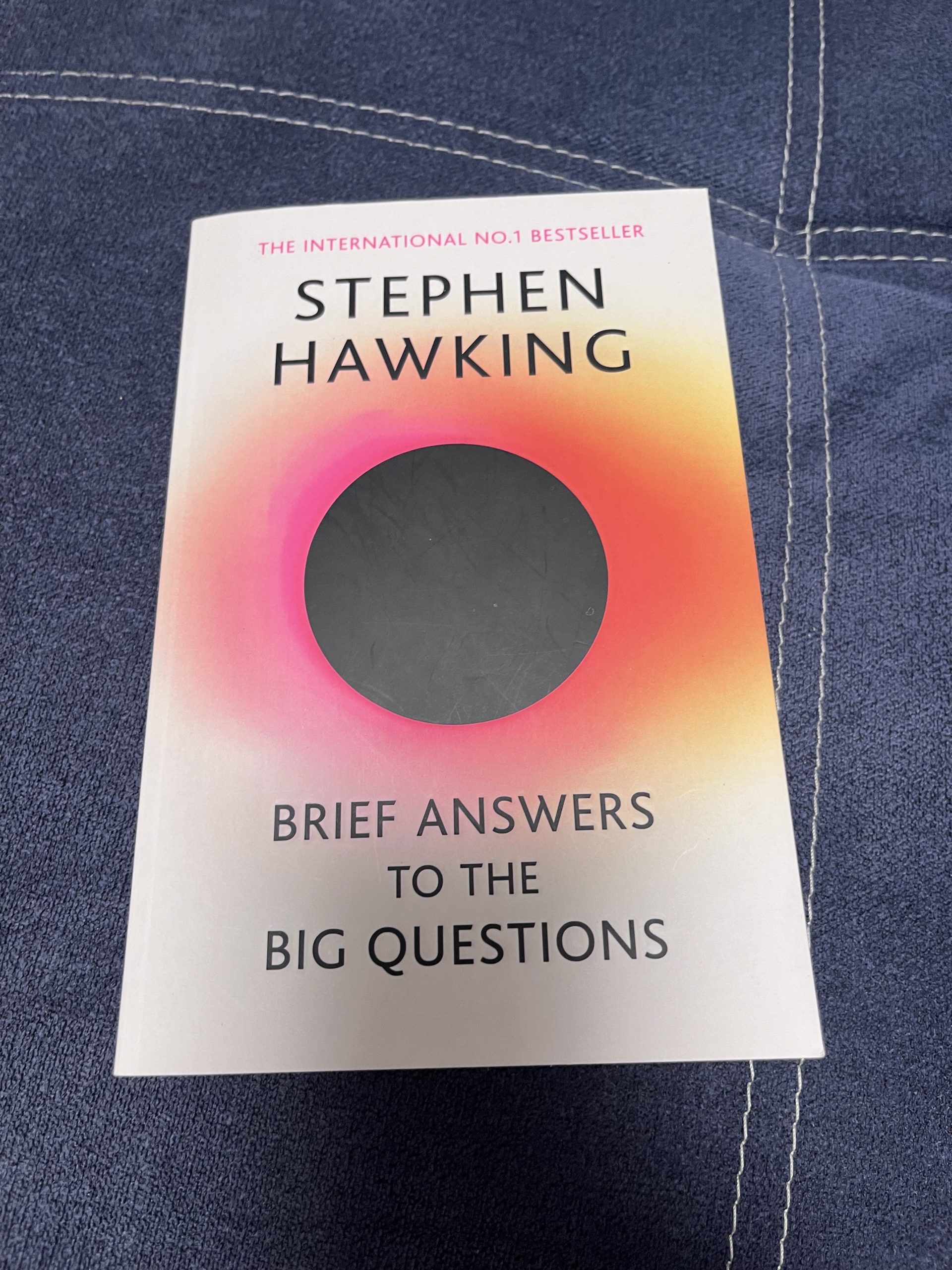
Six big questions
Gravitational waves, according to Einstein, consist of an oscillatory space warp: an oscillating stretch and squeeze of space. In 1972 my students and I began thinking about what we might learn about the universe using gravitational waves. We concluded that they are ideal tool for exploring and testing Stephen’s insights about black holes.
On 14 September 2015 the LIGO gravitational-wave detector registered their first gravitational wave.
Stephen gave a compelling, almost airtight proof that, when a black hole forms and then subsequently evaporates away completely by emitting radiation, the information that went into the black hole cannot come back out. Information is inevitably lost. Black holes violate a most fundamental quantum mechanical law. The black hole’s evaporation is governed by the combined laws of quantum mechanics and general relativity.
Six key questions:
- Is there a God?
- How did it all begin?
- Can we predict the future?
- What is inside a black hole?
- Is time travel possible?
- How do we shape the future?
Other big questions:
- Will we survive on Earth?
- Is there other intelligent life in the universe?
- Should we colonise space?
- Will artificial intelligence outsmart us?
Why we must ask the big questions
My practical abilities never matched up to my theoretical qualities. After my expectations had been reduced to zero, every new day became a bonus, and I began to appreciate everything I did have.
The big question in cosmology in the early 1960s was did the universe have a beginning.
Roger Penrose had shown that once a dying star had contracted to a certain radius, there would inevitably be a singularity, that is a point where space and time came to an end.
My work with Penrose had shown that general relativity broke down at singularities, so the obvious next step would be to combine general relativity – the theory of very large – with quantum theory – the theory of very small.
My work on black holes had given me hope that we would discover a theory of everything, and that quest for an answer drove me on.
To my colleagues, I’m just another physicist, but to the wider public I became possibly the best-known scientist in the world.
The fact that we humans, who are ourselves mere collections of fundamental particles of nature, have been able to come to an understanding of the laws governing us, and our universe, is a great triumph.
Is there a God?
Science is increasingly answering questions that used to be the province of religion.
The universe is a machine governed by principles or laws – laws that can be understood by the human mind. The laws of nature are a description of how things actually work in the past, present and future. Unlike the laws made by humans, the laws of nature cannot be broken – that’s why they are so powerful.
I use the word ‘God? in an impersonal sense, like Einstein did, for the laws of nature, so knowing the mind of God is knowing the laws of nature. My predictions is that we will know the mind of God by the end of this century.
What are the three ingredients we need to cook up a universe? The first is matter – stuff that has mass. The second thing you need is energy. The third thing we need is space. Lots of space.
Einstein realized that two of them mass and energy are basically the same thing. E=mc2. Space and energy were spontaneously invented in an event we now call the Big Bang.
The laws of physics demand the existence of something called ‘negative energy’. Space itself is a vast store of negative energy. The universe is like an enormous battery storing negative energy.
At the sub-atomic level you enter a world where conjuring something out of nothing is possible. At least for a short while.
Something very wonderful happened to time at the instant of the Big Bang. Time itself began.
Inside the black hole time itself doesn’t exist. That’s exactly what happened at the start of the universe.
You can’t get to a time before the Big Bang because there was no time before the Big Bang. For me this means that there is no possibility of a creator, because there is no time for a creator to have existed in.
How did it all begin?
Hamlet said, ‘I could be bounded in a nutshell, and count myself a king of infinites space.’
In 1915 Einstein introduced his revolutionary general theory of relativity. In this, space and time were no longer absolute, no longer a fixed background of events.
Many scientists were unhappy with the universe having a beginning. One would have to invoke an outside agency, which for convenience one can call God.
Steady-state theory, proposed by Herman Bondi, Thomas Gold and Fred Hoyle in 1948.
The reason Einstein’s general relativity breaks down near the Big Bang is that it is what is called classical theory. That is, it implicitly assumed what seems obvious from common sense, that each particle had a well-defined position and a well-defined speed.
There seems to be a certain level of randomness and uncertainty in nature. Einstein objected strongly to the idea that the universe is governed by chance.
In order to understand the origin of the universe, one therefore has to incorporate the Uncertainty Principle into Einstein’s general theory of relativity.
We can only assign a probability to particular combination of positions and speeds. This there is a certain probability to a particular future of the universe. The universe must have many possible histories, each with its own probability.
Maybe universe has no boundary in space and time. Stephen and Jim Hartle called this the no-boundary proposal.
The Anthropic Principle says that the universe has to be more or less as we see it, because if it were different there wouldn’t be anyone here to observe it.
M-theory, which is our best candidate for a complete unified theory, allows a very large number of possible histories for the universe.
There is something special about three space dimensions.
We are the product of quantum fluctuations in the very early universe. God really does play dice.
Stephen thinks that the discovery of supersymmetric partners for the known particles would revolutionize our understanding of the universe.
Is there other intelligent life in the universe?
The law says that the total amount of disorder, or entropy, in the universe always increases with time.
We can define life as an ordered system that can keep itself going against the tendency of disorder and can reproduce itself.
Our own solar system was formed about four and a half years ago.
There is fossil evidence that there was some form of life on earth about three and a half billion years ago.
No one person can be the master of more than a small corner of human knowledge. People have to specialize, in narrower and narrower fields. This is likely to be a major limitation in the future.
We have now mapped DNA, which means we have read ‘the book of life’, so we can start writing in corrections. I am sure that during this century people will discover how to modify both intelligence and instincts like aggression.
It is more likely that evolution is a random process, with intelligence as only one of a large number of of possible outcomes. It is not even clear that intelligence has any long-term survival value.
Can we predict the future?
Astronomy was the first science to be developed.
The twentieth century there were two developments that show that Laplace’s vision, of a complete prediction of the future, cannot be realized. The first was what is called quantum mechanics. This was put forward in 1900 by the German physicist Max Planck. It was not until 1927 that Werner Heisenberg pointed out that you couldn’t measure simultaneously both the position and speed of particle exactly. This is summed up in the Uncertainty Principle that Heisenberg formulated. The uncertainty in the position of a particle times the uncertainty in its speed is always greater than a quantity called Planck’s constant, divided by twice the mass of the particle.
A new theory, quantum mechanics, was put forward by Heisenberg, Erwin Schrodinger from Austra and the British physicist Paul Dirac.
Instead of being able to predict the position and speeds of particles, all we can predict is the wave function.
Do the laws governing the universe allow us to predict exactly what is going to happen to us in the future? The short answer is no, and yes. In principle, the laws allow us to predict the future. But in practice the calculations are often too difficult.
What is inside a black hole?
The first discussion of black holes was in 1783, by a Cambridge man, John Michell.
Although gravity is by far the weakest of the known forces of nature, it has two crucial advantages over other forces. First, it acts over long range. The second advantage is that gravity is always attractive, unlike electric forces which can be either attractive or repulsive.
The Einstein equation can’t be defined at a singularity. This means that at this point of infinite density one can’t predict the future.
When John Wheeler introduced the term ‘black hole’ in 1967, it replaced the earlier name of ‘frozen star’.
In quantum mechanics objects can be thought of either as wave or a particle. The lighter an object is, the longer its wavelength is and so it is more spread out. The heavier an object is, the shorter its wavelength and so it will seem more compact.
According to some theories, the universe we experienced is just a four-dimensional surface in a ten-or ekeven-dimensional space.
If one puts objects into space-time, the translations and rotational symmetries get broken. And introducing objects into a space-time is what produces gravity.
Is time travel possible?
Today’s science fiction is often tomorrow’s science fact.
One can describe the location of an event by four numbers. Three describe the position of the event. The fourth number is the time of the event.
Einstein’s paper of 1905 seemed to rule out time travel into the past.
What both the Godel universe and the fast-moving cosmic-string space-time have in common is that they start out so distorted and curved that space-time curves back on itself and travel into the was always possible. God might have created such a warped universe, but we have no reason to think that he did.
The reason quantum theory can allow the energy density to be negative is that it is based on the Uncertainty Principle.
The consistent-histories approach says that one has to find a consistent solution to equations of physics even if space-time is so warped that it is possible to travel into the past. The other possibility is what I call the alternative-histories approach.
In 2009 I held a party for time travelers in my college. No one came.
Will we survive on earth?
The Earth is under threat from so many areas. First, the Earth is becoming too small for us. The universe is a violent place. Nuclear war is still probably the greatest threat to humanity at the present time.
Clearly the present exponential growth cannot continue indefinitely.
By far the most complex systems that we have are our own bodies.
Lincoln Steffens once said: “I have seen the future and it works.”[1]
I think the present world order has a future, but it will be very different.
Should we colonise space?
We need to explore the solar system to find out where humans could live.
A new interest in space would also increase the public standing of science generally.
The zero gravity of orbit causes a number of undesirable physiological changes, including a weakening of the bones, as well as creating practical problems with liquids and so on.
Will artificial intelligence outsmart us?
Intelligence is central to what it means to be human. Everything that civilization has to offer is a product of human intelligence.
There is now a broad consensus that AI research is progressing steadily and that its impact on society is likely to increase.
The best time to stop the autonomous-weapons arms race is now.
The more we can do, the busier we become.
I believe the future of communication is brain-computer interfaces. There are two ways: electrodes on the skull and implants.
Intelligence is characterized as the ability to adapt to changes. Human intelligence is the result of generations of natural selection of those with the ability to adapt to changed circumstances. We must not fear change. We need to make it work to our advantage.
Our future is a race between the growing power of our technology and the wisdom with which we use it. Let’s make sure that wisdom wins.
How do we shape the future?
Intuition, originality, brilliance. Einstein had the ability to look beyond the surface to reveal the underlying structure. A key element for Einstein was imagination.
Some think that humanity today is the pinnacle of evolution, and that this is as good as it gets. Author disagree.
We have two options for the future of humanity as I see it: first the exploration of space for alternative planets on which to live, and second, the positive use of artificial intelligence to improve our world.
I would like to see the development of fusion power to give an unlimited supply of clean energy, anda switch to electric car.
Unleash your imagination. Shape the future.
[1] In the book on page 162


