

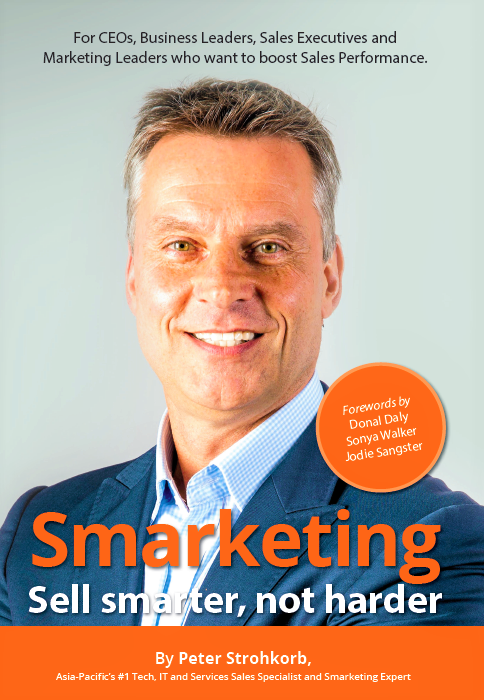
Smarketing
“Sales-people are just quick-talking, quota-driven snake oil dealers” was the cant of the marketing quarter, while the sales constituency responded, “Sales draw the picture and marketing color it in!”
On today’s playing field, successful selling, and the leading sales professional, encapsulates the best of strategic marketing, but at an individual customer level. That demands collaboration with marketing.
In a world where ‘value creation’ is a necessity, and the foundation upon which profitable customer relationships are built, discrete activities conducted separately by sales and marketing, no longer suffices.
What is Smarketing?
Marketing exists to create an environment where sales can occur. The role of Sales then is to take over these Prospects, to engage them and to guide them to transaction.
Sales + Marketing = Smarketing.
Sales helps Marketing to better understand what Sales needs to be successful. Marketing will respond by better supporting the sales objectives. The customer will have a more consistent and enjoyable buying experience. Everybody wins.
The Smarketing Philosophy
Smarketing is the belief that teams working together towards a common outcome is far better than individuals working independently and hoping that it will all somehow come together in the end.
The phrase “hope is not a strategy,” is attributed to former New York City Mayor Rudy Giuliani.
The challenge is that in many organizations the KPIs that apply to Sales are not aligned with the KPIs for Marketing (and vice versa). Consequently, Sales and Marketing can become inward-focused and the communication channels between them can become blocked up. It is time to end this siloed approach and find a new and better way.
The changing habits of Buyers have necessitated a change to the way that organizations manage the interactions between their Sales and Marketing resources. These two teams need to work together as one, identifying and striving together to reach a common goal.
The Smarketing Mindset
There has never been a time when organizations have needed to be more focused on their customers and on their prospects than today.
The positive inter-relation that Smarketing enables between Sales, Marketing and Customers It’s what I call “The Virtuous Circle of Collaboration”.
We need to stop looking at our organizations from the inside-out. Instead, we need to start viewing our business from our customers’ perspective, view it from the outside-in.
Here is how it works: Daily, your salespeople have direct interactions with the market. Feedback from the sales force is highly valuable to Marketing.
As far back as 2014, Bain & Company summed up the changing landscape very aptly in their report, called “Mastering The New Reality of Sales”.
The line between Sales and Marketing will disappear; an integrated function will emerge to synchronize coverage and resources with target customers. Without a deliberate effort to reverse creeping complexity and administrative burden selling costs will grow faster than revenue. Prospects will have screened you out of consideration based on your digital footprint (or its absence) even before one of your representatives has a chance to understand their needs. Your customers will spend more time analyzing your offerings than you will on analytics to understand their buying behavior. A competitor will offer your customers better, more seamless service through lower-touch, lower-cost channels, winning share and loyalty. You will be forced to either retrain or turn over more than half of your reps to keep up with competitor sellers who truly add value, rather than just communicate features, and take orders.
Smarketing = An integrated Business Strategy that boosts Sales Performance by aligning Sales and Marketing with the way that modern Customers buy.
Time to Go Smarketing
You can have the most sophisticated processes and the latest technology, but if your people are not working together, all your efforts will come to nothing.
The Many Business Benefits of Smarketing
Altify, in is 2017 “Business Performance Benchmark Study” quantifies the sales productivity benefits of closer collaboration between sales and marketing teams: “18 percent shorter sales cycles and 26 percent higher win rates.” – Altify Report
Smarketing delivers tangible business results for all your stakeholders. Here is a summary for you:
- Customer Benefits. Your organization becomes one that your customers want to do business with.
- Marketing Benefits. Better alignment and deeper collaboration with Sales.
- Sales Benefits. More effective support from Marketing help to better differentiate the organization from its competitors, to lift its brand, better engage with the right prospects and customers, and to achieve and exceed sales targets.
- C-Suite Executive Benefits. A future-proof, more agile organization.
Smarketing solves challenges in any organization in which the communication between Sales and Marketing is less than ideal.
Smarketing establishes a 360-degree continuous feedback loop between Sales and Marketing so that they can collaborate more easily and much more effectively.
The 360-Degree Collaboration loop ensures that Sales can keep Marketing informed on which marketing support really works for them, and which, in turn, allows Marketing to focus on doing more of what is working for Sales and less of what isn’t.
Back in 1992, Stephen Hindman and John Sviokla from the Harvard Business School investigated sales effectiveness. This what they found: “A company that can increase its sales-revenue-per-person productivity by just 5 percent, can increase its profit results by 20 percent.“
Small discount by a lazy sales rep looking for a quick sale can have a hugely negative impact on your profitability).
Smarketing will slightly improve the performance of the middle and bottom groups of salespeople.
Extracting your top performers’ personal sales know-how and corporate knowledge and transferring it to reps further down the chain is proven to lift the performance of lesser – performing reps and can have immense positive overall productivity benefits.
True business success means the ability to attract, train and retain the best and brightest people around. Apart from remuneration, the key to attracting and keeping top-rate talent lies in a positive culture.
Nothing much puts a potential Buyer off more than inconsistent value messaging. Smarketing ensures that the messaging between online content and personal experience remains consistent and it thus addresses the risk of disconnect at this critical juncture in the Buying Journey.
The Top 7 Smarketing Mistakes
While Smarketing can dramatically improve both sales and marketing functions in an organization, there is a right way and a wrong way to implement and facilitate true collaboration.
Mistake # 1: Doing Nothing.
In far too many companies, sales and marketing departments are working in their respective silos, largely unaware of, or ill-equipped for, the changing world that surrounds them.
Mistake # 2: Believing that Technology alone will deliver Results.
A wealth of customer research shows that, while automation may be effective in terms of providing sales leads, the qualification process, when automated, can alienate more Prospects than qualify them.
Just because software can do something does not mean that it will. In other words, you don’t need to use all the features and functions that software offers, just the ones that actually generate a business benefit and the ones that the organization can cope with from a change management perspective.
Mistake # 3: Implementing Quick Fixes and ‘Band-Aid’ Solutions.
The world is increasingly impatient, and so are we; our attention spans are getting shorter, so it is no wonder that, when challenges arise, we look for quick fixes. Simply adding more staff is rarely the solution to poor sales performance.
For those who are really struggling to meet their targets, training courses can feel like an outright punishment. Most of this training comes with little to no post-training follow up. ‘Set and forget’ does not work in sales training.
Increasing MQL volume only has a positive effect when Sales is suffering from a lack of leads and if the leads are of acceptable quality.
Mistake # 4: Having no dedicated Person or Team responsible for Smarketing.
The best way to achieve success is to have a dedicated but neutral third party in place whose job it is to ensure that the collaboration between Sales and Marketing is implemented and maintained.
Mistake # 5: Neglecting the Human Element.
When attempting to foster a cooperative relationship between Sales and Marketing, it is important to address the human dimension immediately.
Collaboration can be a deeply inter-personal matter. This is why Smarketing starts with the people dimension. Only once the people within an organization are ready, and willing, to collaborate will technology solutions land on truly fertile ground. Not apps, but people need to come first.
Mistake # 6: Trying to implement Change without Executive Buy-In.
Mistake # 7: Expecting immediate Results.
Measuring Smarketing Maturity
The digital economy and the Buying Journey have revolutionized the way that people and organizations buy, particularly when it comes to complex B2B sales.
There is a “Smarketing Maturity Spectrum”, i.e. measurably distinct levels of Smarketing effectiveness.
The lowest maturity level is characterized by what I call “The Silo Mindset”. Here, the two corporate departments co-exist, often without much interaction but with lots of prejudice.
The next maturity level is what I call “The Process Mindset”. At this point, the two departments have realized that they are better off working together in some limited way.
These mature organizations understand the importance of a united front, i.e. from the customer’s perspective, Sales and Marketing have become nearly indistinguishable from each other. They have evolved into what I call “The Collaboration Mindset” , i.e. they live and breathe Smarketing.
According to CSO Insights, “CRM tool adoption rates are less than 50 percent” and “Fewer than 15 percent of organizations achieved improved win rates from implementing sales tools.”
Since Sales and Marketing are two of any organization’s main customer-facing functions, poorly aligned Sales and Marketing can translate to unacceptable levels of reputational and brand risk to an organization if it is not consistently on message in all its customer interactions.
IDC is attributed as saying this: “Only 25 percent of sales leads and marketing collateral that Marketing creates is ever used by sales teams.”
It is baffling that marketing teams should spend good time, effort and resources creating sales collateral without knowing exactly how (or, indeed, whether) salespeople use this material. It is equally baffling why sales professionals feel the need to go into client meetings with their own self-made collateral. Yet, this is precisely what I am encountering in the field, particularly in large organizations that have segregated Marketing and Sales teams into separate areas, e.g. on different floors, in different buildings, in different states, or even in different countries (as is so often the case in multinational firms). In many poorly aligned organizations, Marketing creates collateral and, figuratively speaking, “throws it over the fence” to Sales, wipes its hands and declares: “That’s our job done. Now it’s up to Sales to sell.”
Whether they communicate face-to-face or digitally, Sales and Marketing need a new set of collaboration mechanisms that allow both departments to speak to each other in a mutually clear language. A language that allows for a constructive feedback loop that enables each department to support the other.
Marketing can find itself bending over backwards to please this extremely vocal minority, adopting collateral, and even adjusting their strategy in a misguided attempt to appease a particularly insistent set of in-house critics. If just a handful of vocal salespeople have a monopoly over what shape marketing collateral takes, marketing messages can become confused, costly market research can go under-utilized and both departments can end up falling significantly short of what is expected of them.
A Smarketing environment can dramatically affect the feelings of contentment and satisfaction within the organization. Such environments nurture existing talent and attract a whole new caliber of top candidates.
Imagine how much better off an organization would be if its new sales reps were to ramp up faster. Even speeding up the onboarding process by as little as 10 percent can make a huge financial difference to both the employer and to the employee. How do we accelerate this time-to-productivity?
Firstly, by having an efficient hiring process that attracts and on-boards the right kind of people into the organization. Secondly, by giving the new hire all the support they need to become productive as quickly as possible.
Importantly, this needs to include the corporate and what Chuck Carey, CEO of Compendian Inc, calls “tribal knowledge”, i.e. the inherent know-how of how things work in an organization.
Smarketing and the Sales Funnel
The term Sales Funnel is also often referred to as a sales process, a sales pipeline, a sales cycle, or as the buying journey. Did you know that the original concept of a sales funnel dates back to 1898?
My new, modern, 21st century Sales Funnel is far more effective, as it aligns modern Buyers with how they want to buy, not how Sellers want to sell to them. I call it The Modern, Customer-focused Sales Funnel.
The Smarketing Approach to Sales Lead Management
“Unfortunately, about 61 percent of B2B marketers still send all leads they receive directly to sales, while only 27 percent of those leads will actually be qualified.” https: //blog.hubspot.com/marketing/lead-quality
One way to make broader consensus possible is to institute solid lead scoring practices. To put a lead-scoring system in place, though, we need to bridge a sizeable definition gap first. The evidence that this gap exists is everywhere.
Marketing-Qualified Leads (MQLs) and Sales-Accepted Leads (SALs).
For a start, they often do not value the same metrics: MQLs seem to be largely focused on the number of website interactions, clicks and downloads, whereas SALs often focus on revenue potential and time-to-deal.
I am sorry to say that I have observed that even where there is agreement on a definition for MQLs and SALs, it does not automatically produce Smarketing.
Common Smarketing Implementation Roadblocks
Marketing can not be expected to advance and close sales. That is the job of salespeople. However, there are ways to bring both functions into unison.
Though it doesn’t work for all organizations, some have chosen to tie Marketing’s compensation to sales revenue. The risk around this strategy, however, is that it may well frustrate marketers as they may feel they are being measured on outcomes they have little control over. It’s easy to see how Marketers feel a little left out when they see all the financial incentives and rewards go to the sales team. Compensate Marketing for their contribution to sales results. At the same time, if Marketing is to share in the rewards, there needs to be some level of accountability to it.
It may be worthwhile to explore which market segments are producing the highest ROI. Long sales cycles that consistently end in small purchases can look like high conversion rates but conceal poor revenue outcomes. If your fastest sales are emerging out of markets that are being under-targeted, then re-allocating resources to focus on those markets can dramatically impact the top and the bottom line.
Frequency of Formal Sales and Marketing Team Meetings in Financially Successful vs Less Successful Companies is bigger.
Smarketing and The Productivity Trinity
The Productivity Trinity recognizes that effective Smarketing is built upon the combination of People, Processes and Technology.
If we want to achieve this outcome, we first need to understand that some small degree of tension between Sales and Marketing is healthy. The strategies that I cover in this book are not about eliminating this friction. Rather, they attempt to manage it to a point where it becomes constructive, highly effective, and eliminates Group Think, i.e. the tendency of a group of like-minded people to see things in the same way, killing diversity of thought. Group Think leads to bad ideas going unchallenged, whereas input from a broad range of perspectives, combined with constructive friction (e.g. in the form of questioning and even pushback) is sometimes necessary for healthy decision-making.
People, Processes, and Technology, that is the right order of priority.
The human element is not only the most crucial component of the Productivity Trinity; it is also the one most resistant to change.
The next tier in the Productivity Trinity looks at the processes and metrics, particularly where those processes and metrics are applied to the points at which the two functions most often intersect. To be effective, any collaborative strategy must fearlessly navigate this territory, enhancing processes and developing joint metrics to continually improve the pipeline quality and quantity, and ultimately the sales outcome.
Sales reps creating their own marketing collateral or modifying existing marketing collateral is a substantial waste of a salesperson’s time. By the same token, it is equally unproductive to have Marketing people prepare collateral that will never make it into the Prospects’ hands. Therefore, improving the relationship between Sales and Marketing can have demonstrable productivity-raising and revenue-boosting effects:
- Salespeople will spend more of their time selling.
- Marketing will create more content that Sales will use.
- With the right type of collateral (collaboratively created in response to feedback) Sales will accelerate its deal velocity and increase closure rates.
- Marketing will enjoy a more productive relationship with Sales, and vice versa.
- Morale will improve, which in turn attracts and retains higher-performing talent.
Technology can make information more accessible, it can facilitate dialogue and streamline well-thought-out business processes, but it should always be regarded as a tool, not as an end of its own.
Automation tools may well allow for this amplification and broadcasting of, say, an organization’s online presence, but the organizations that are finding new technology the most effective are those using the latest tools to target in sophisticated ways smaller, more focused groups of qualified and motivated Prospects. No more “spray & pray”. World-leading organizations consistently use technology like a scalpel, not like a flame thrower.
Implementing Smarketing
“Sales and Marketing alignment is hardly a new concept. But as increasingly sophisticated customer experiences elevate consumers’ expectations, standards are rising for business purchases, too. Therefore, it’s critical for all sales and marketing to march in tandem.”
Let us now look at a more granular level how you can implement Smarketing into your organization. We do this by taking our clients through a proven 5-step process. The first three steps are to gather important insights, which are then used in the Planning Step, thus giving the Implementation Step the highest possible likelihood of success.
- Step 1 is themed “The Pulse of Our Business”. It is a fast and inexpensive way to start a conversation in your business about current collaboration effectiveness and the business benefits if it were to be improved.
- Step 2 is called “The Voice of Our Teams”. This is because we unearth the true sentiments of your sales and marketing people in a neutral, safe, and unencumbered environment.
- Step 3 is called “The Voice of Our Customers” It gives you a 360-degree view of the underlying Smarketing-related issues by capturing the sentiment, perspectives and – importantly – genuine feedback from perhaps the most important set of your stakeholders: Your Customers.
- Step 4: A Co-Created Action Plan. This is where the rubber hits the road. It is extremely important that your Smarketing implementation plan is welcomed and even embraced by all involved. This is to avoid active and passive resistance and to ensure that the plan is implemented as quickly and as effectively as possible.
- Step 5: Implementation.
Ask sales reps to start rating Marketing’s output on a simple scale of 1 to 5. Optionally, they can also make suggestions as to how marketing content can be improved to better suit the specific ways in which it is being used.
No longer is direct feedback restricted to the vocal minority of head office – based sales reps or to the ones that are located physically near Marketing. Instead, every rep, regardless of rank and location, now has an equal opportunity to speak to Marketing and, perhaps more importantly, to be heard.
I feel I need to start my discussion here with an important distinction: Marketing is compelled to react to the feedback, but that does not mean they are beholden to Sales.
Creating proximity is a great way to break down barriers. Bringing Sales and Marketing together regularly and, if possible, face-to-face can make a huge difference.
Building more effective communication channels begins with the effort, not the results. As numerous studies have shown, the best way to learn is from making mistakes. As long as each mistake is only made once, is learned from, and is not repeated. I am not talking about multi-million-dollar mistakes here. I am talking about learned experiences, what some change management consultants have dubbed ‘Action Learning’ – sophisticated trial and error experiments, really.
Once feedback channels are established and nurtured, it is time to introduce joint metrics, definitions and overlapping responsibilities.
The goal is to eventually have an integrated process that centers on the Buyer’s journey all the way from the initial Buyer contact to the closing handshake. You can reasonably expect that customer experience will also improve commensurately with the improved Smarketing.
True alignment of processes definition means that not only is ‘revenue’ a term with agreed-upon parameters, so too is lead generation, nurturing and management, which can be established with the aid of lead-scoring. There are quite a number of lead scoring methods readily available, and most CRM vendors offer these techniques off the shelf.
The Method helps the teams to understand why and how they should collaborate.
Forcing people, processes or technologies into situations or places in which they don’t fit will get you nowhere, fast.
My research shows that sales force effectiveness is stronger in organizations in which both Sales and Marketing report to a single capable executive.
Be extremely diligent when assigning the task of overseeing Smarketing to anybody in-house.
Attracting and retaining today’s most desirable customers will become easier the longer you are able to maintain a virtuous circle of collaboration within your organization. When it comes to maintaining the collaborative environment and practices that typify the aligned organization, then the third element in the Trinity, i.e. Technology becomes crucial.
Prevention is Better Than Cure
The challenges surrounding poor Smarketing develop as businesses grow and as the teams become more dispersed, both geographically and organizationally.
You can now build Smarketing into the DNA of your business, if you plan for it. Those who apply Smarketing preventatively as their business is growing are bound to avoid major problems down the track, when they are much harder to rectify. So, decide to implement Smarketing and use it as your blueprint for sustainable business growth and ongoing success. You see, prevention is better than a cure.
Over to You Now, A Call to Action
Do not fall victim to the seven most dangerous words in business. They are: “We have always done it this way.”
Smarketing boils down to doing more with existing resources, providing a classical productivity boost to your two most customer-facing functions and to your sales funnel, resulting in sustainable sales revenue growth.


