

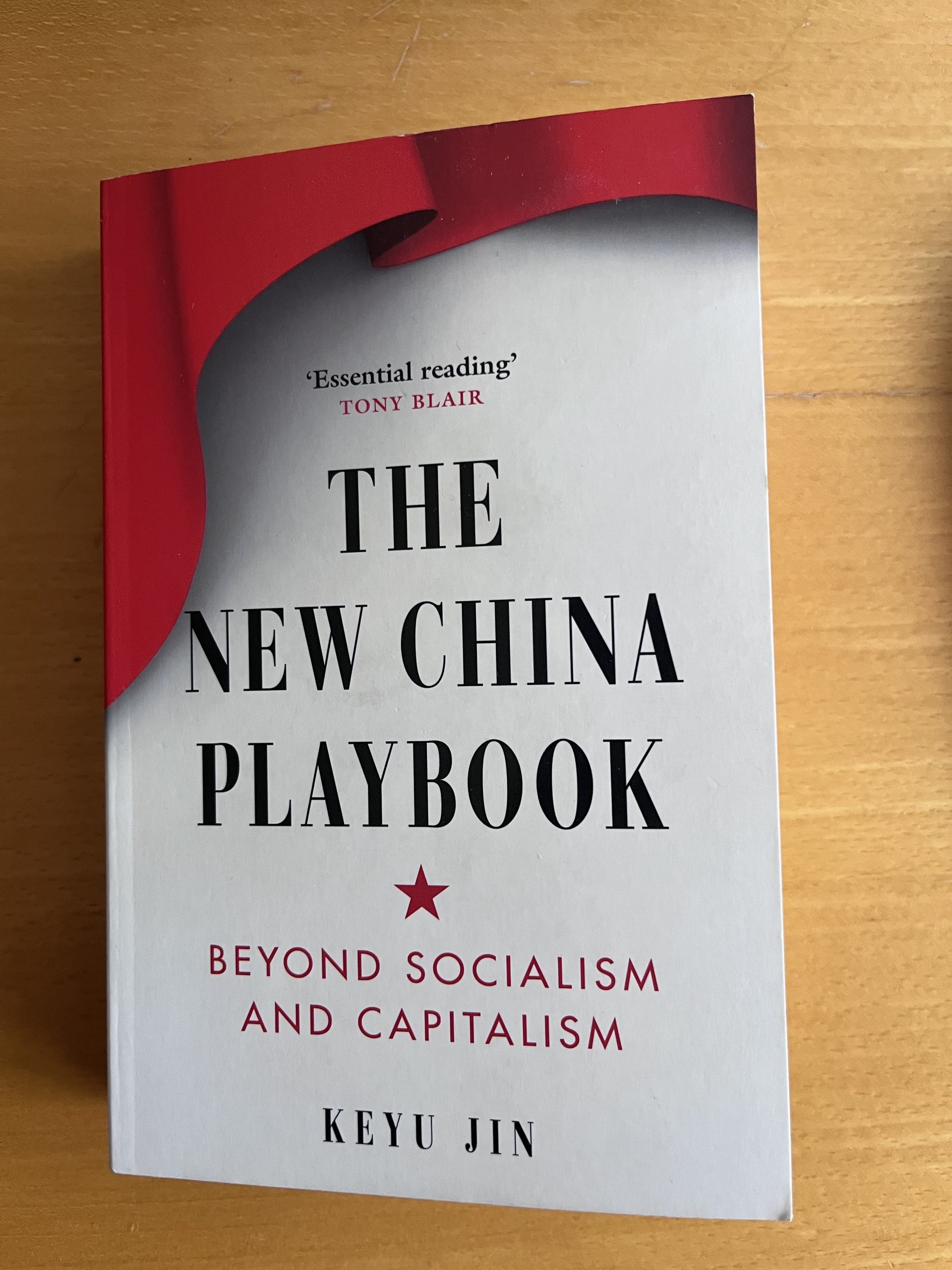
The China Puzzle
The rule of law, sound governance and intellectual property protection – all long held up as essential to long-term growth – have been weak during much of China’s economic upsurge.
China’s economic system can be called managed capitalism, the mayor economy or socialism with Chinese characteristics.
The state in China is unique in its ability to mobilize collective action in service of the nation’s goals. China’s political centralization is paired with economic decentralization.
The combination of state guidance at the macro level and market mechanisms at the micro level, what explains China’s rapid growth spurts and its technological uptake in such a short span of time.
Consumers, entrepreneurs, and the state in China none of them behaves like a conventional economic agant.
Chinese households save 30 percent of its income on average while its America counterpart save on average 7 percent.
93 percent of Chinese participants value security over freedom. They also trust government more as Americans.
The Chinese economy was in shambles in 1978 when they started to implement major reforms.
The China’s new playbook is based on innovation and technology, meant to be attained through self-reliance and mastery in an age marked by an unparalleled sense of national agency and pride.
In the new era, China will strive to move beyond socialism stained by shortages and capitalism stigmatized by inequality.
China’s economic miracle
Between 1978 and 2011, the average growth rate of China’s GDP was an astounding 10 percent.
China ranks particularly high when it comes to frugality, hard work, and educating its children.
Prominent among China’s cultural advantages were the contributions of Confucius (551-479 BC).
China, which has the world’s oldest tradition of centralized bureaucracy, introduced a meritocratic system of selection for government officials in the third century BC.
By the time of the Song dynasty (960-1279), China had become the world’s undisputed leader in science and technology and its vast economy represented a quarter of the world’s total GDP.
The culture and history laid the foundations for China’s potential level of income, but the path to get there would require a radical overhaul of the economic system.
After Mao Deng Xiaoping took over. He focused on two issues. The first was creating part consensus. The second was how to implement new economic policies.
Reform is China’s second revolution according to Deng Xiaoping. There were four major tides of reform. Underlying China’s reforms was an effort to address the fundamental limitations of a planned economy.
- First wave was in the agricultural sector. In 1980s government introduced a dual system of pricing, replacing collective farming with a ‘household responsibility’ system.
- Second wave was about creation of special economic zone (SEZ) that mimicked the effects of open, export-oriented market economies. It started in earlier to mid-1980s. Foreign investments poured into China. Foreigners brought knowledge and technology, China’s low cost working force was there. First four: Shenzen, Zhuhai, Shantou in Guangdong province and Xiamen in Fujian province.
- A third set of reforms addressed the absence of competition.
- The last wave came with China’s entrance in the WTO in 2001.
Total factor productivity (TFP) – the measure of how efficiently inputs like labor and capital are used. Productivity accounted for about half of China’s growth in output over the period of its fastest growth (30 years after 1978). When we focused on TFP, its overall annual growth rate in China between 1978 and 2007 averaged 3.92 percent and in the years between 1998 and 2007, it reached 4.58. In US and Europe, numbers are around 1 percent.
For developing countries in particular, this way of improving TFP – reducing the misallocation of resources – is far more relevant than innovation and technical progress.
Total factor productivity dropped following a large fiscal stimulus aimed at saving the economy after 2009 financial crisis, which resulted in a substantial misdirection of resources.
If China gets stuck in the middle-income trap, it may follow in the footsteps of Japan, which experienced a lost decade of no growth in the 1990s.
China needs to take care of their high debt level (275 percent of GDP) and they need to solve the issue of financial sector.
Only through innovation China has a hope of becoming the foremost economic power of the twenty-first century.
China’s consumers and the new generation
Born into a one-child policy era young Chinese are lonely, highly pressured and superbly educated young people.
China’s 1.4 billion consumers have long fired the imagination of business around the world. The single most important lens for viewing China’s consumers is the generational changing of the guard.
It was already in 1957 when My Yinchu warned about population explosion in this book New Population Theory. But the action came in 1970 with the series of restrictive policies.
Deng wanted quality over quantity when it came to his people, which led to the imposition of the one-child policy in 1978.
We estimate that if the nation implemented a two-child policy instead of a one-child policy, the saving rate would be closer to 20 percent than 30 percent. China’s household spend around 25 percent of their annual spending for children education.
Today, daughters are even better educate than sons. Today, daughters contribute financially to the care of their parents just as much as sons.
Marriageable Chinese women are in short supply.
The problem in China today and in the near future is not the labor shortage, as some would expect, but a serious skill mismatch.
The current young generation today like to spend and borrow. As the-only-child-cohort enter middle age and replace their high-saving parents as the main economic agents in the economy, they will likely turn China from a saving nation to a spending nation, and from surpluses to deficits.
The new generation has never experienced poverty and psychological hardship the way their parents did.
Paradise and jungle, the story of Chinese firms
How twenty million private firms could have sprung up within just thirty years remains one of the most fascinating questions in China’s economic landscape.
China’s corporate sector has two distinctive types of organizations: state-own enterprises (SOE) and private firms.
In 2013 XI launched a major anti-corruption drive to cut the ties between private firms and SOE.
From the outset, financial performance was not considered all important for SOEs. They were the agents to maintain stability in society and to carry out important national goals.
Their numbers have dramatically reduced, but in the eyes of the government. SOEs are still considered the backbone of the economy.
China’s first significant nonstate enterprises emerged in the countryside. At first these township and village enterprises (or TVEs) were collectively owned by local residents and often controlled, managed, and supported by local governments.
In 1981, the government decided to make it legal to set up business and create jobs, under the tight restrictions.
Private businesses had a notable advantage over SOEs: flexibility.
More than 80 percent of the state-owned firms operating in 1998 were shut down or privatized. As a consequence, the overall performance of state enterprises improved.
You may have heard the Chinese term guanxi, which means relationship. In the past, guanxi referred to that special connection and trust that formed the basis of strong business relationship. Eventually, guanxi began to characterize the interplay between private businesses and local governments.
Local governments can give out licenses, contracts, cheap, land, and direct loans from local banks to the firms they preferred.
The sprawling real estate giant that became one of the world’s largest companies, Evergrande, grew from a small operation thanks to elite political connections it cultivated early on.
After 2013 and fight against corruptions, both private and state firms, now cut off from easy financing and political favors, found new paths to prosperity – by forming conglomerates and becoming each other’s mutual owners.
Many private enterprises welcome state stakeholders. But collaboration is successful only when the state is a minority shareholder.
Such tight linkages between government and business are not unique to China, but the pervasiveness of it is. Its conglomerate model may remind us of Japan’s keiretsu network and the Korean chaebol system.
The opportunities for foreign firms were always there, but their mindset and approach determined their fate.
The new generation of entrepreneurs in China relies on persistence, innovation, and nimbleness to handle tremendous competition and navigate a much tougher regulatory environment than their predecessors faced.
The state and the mayor economy
Nearly all of China’s twenty-three provinces and four municipalities have experimental commercial development projects under way.
The best term for describing China’s development paradigm is political economy. In China the state and the economy are deeply intertwined.
The highest ranked leader in any organization at any level is invariably the part secretary.
In China the central government takes care of domestic and international politics and sets overall economic policy, which local governments tend to the economy itself.
The city of Kunshan offers a good example of how a local government single-handedly transformed an unremarkable agricultural town into an industrial and high-tech city.
Top-performing well-connected provincial leaders have gone on to become the nation’s highest ranked cadres.
No government official holding an important position is allowed to stay in any one place for too long.
China has woken up to the urgent need to shift to a new development paradigm – from maximizing output to improving quality.
Rising housing prices, horrendous traffic, and environmental degradation are all consequences of the rush to raise GDP.
In addition to addressing pollution and corruption, the state’s new agenda includes one of the most glaring problems of the day: income disparity, which invariably comes along with rapid growth.
Overall, robustness still outbalances resilience in China: its growth model is reliable but not flexible.
The financial system
The number of systemic financial crises in China is exactly zero.
China’s stock market has been one of the worst performing in the world. It is not anomaly. It is a reflection of the country’s inefficient topsy-turvy financial system.
Another problem is housing market.
China’s shadow banking system expanded at a phenomenal rate until 2017, when the government finally applied the brakes.
China’s financial system is underdeveloped. It is overly dependent on banks. The main source of financing are bank debts – 165 %. In US only 52%. Heavy reliance on banks is a common feature of financial systems in the developing world.
Historically, the Chinese financial system was an instrument of the state. Until the late 1970s the nation’s financial system was nonexistent.
In China there is no correlation between GDP growth and stock market returns. The Chinese stock market has missed out on listing many dynamic companies, since the process is approval based.
Between 2003 and 2013, the average price of housing in major Chinese cities quadrupled. Property accounts of 60 percent of Chinese households assets, as opposed to 37 percent in Japan and 25 percent in the US.
In China all land is owned by the state expect rural land, which is owned collectively by local villagers. The state can sell the right to use. Thirty years for industrial land, forty years for commercial land and seventy years for residential land.
In 1994 some changes happened. Tax collection moved from local to central government. Before 80 % was collected local and after only 50 %. But the local government got the right to collect lease for the land. Now almost 30-40 percent of the local government revenue comes from land lease.
The important factor when it comes to affordability of housing in China is what the Chinese call the “six-wallet phenomenon”. Instead of one wallet, six wallets participate in the down payment of one-child generation.
In China shadow banking refers to bank-like activities – various forms of lending and transferring funds. The players range from pawnshops to mobile payment companies, from peer-to-peer lending platforms to savings and loan associations.
In 2007, a strict loan-to-deposit ratio of 75 percent was imposed for banks.
One of the biggest players in shadow banking turned out to be local governments drawn by a pressing concerns. Local governments were not allowed to have deficits, so they use the special vehicles to take debt in their behalf. The central bank endorsed the practice at first. But the roll back the easy credit environment in 2010.
The financial sector in China is still very much a work in progress. The most alarming aspect of the Chinese financial system is pervasive debt.
But China’s extraordinary amount of national savings is more than enough to cover its domestic investment needs.
The technology race
Technology dictates geopolitical winners and losers.
The last time China led the world technologically was in the fourteenth-century. Song dynasty, when it invented compass, paper, gunpowder and printing.
There are two different types of innovations: fundamental breakthroughs and creative adaptations. China is remarkable in the second, but not yet poised to consistently make the first.
In addition to product innovation, we also have process innovations.
Chinese innovation tends to be based on new application of existing technology. They are particularly good at making existing technology better and cheaper. Also they were creative at making new business models.
For decades, it was common practice for Chinese people to copy what they liked, a practice that emanated from within society rather than from government.
China strategy was trading markets for technology. In West they call it forced technology transfer.
The expression “nine-nine-six” captures the work ethic in China: 9 a.m. to 9 p.m., six days a week.
Data is the new gold. China generates not just troves of data, but trove of useful data. China has one of the most advanced facial recognition systems in the world. People in China are monitored for irregular and bad behavior.
It is a myth that neither the Chinese government nor the Chinese people care about privacy.
More than eighty countries have adopted Chinese surveillance and public security platforms since 2008.
Of the twenty-five most valuable internet companies in 2020, eleven were American and nine Chinese. Of every ten venture capital dollars invested in AI in 2018, five went to Chinese start-ups and four to American ones.
Certainly, the ability to provide massive funding, a large pool of internationally trained scientists and engineers, and the will to give its mission a wartime sense of urgency adds wings to China’s quest to become a global leader in technology.
Behind breakthroughs in critical technologies are three key factors: markets, money and talent. China has arguably the first two of the three.
There is a saying in China that captures its state of mind: duan, ping, kuai, or short, flat, fast. It serves as popular prescription for investors: makes short term investments, keep them simple, and look for rapid returns.
China’s role in global trade
After joining the WTO in 2001, China’s share of global GDP more than doubled by 2020, rising from 7.8 percent to almost 19 percent.
Over time, China has steadily moved to the center of the global supply chain, displacing nations previously holding that position. Trade disruptions in China now had serious knock-out effects for all its trading partners – and ultimately for their consumers.
The negative impact of Chinese imports on low-wage workers in America is indelible, and irreversible for many.
Direct states subsidies in China outside SOEs are becoming fewer and farther between, but pressuring China to abandon its state capital model for the sake of trade negotiations is unrealistic and unlikely to lead anywhere.
In the future, China will strive to be a bigger but more forward looking Germany, with an unparalleled industrial capacity powered by disruptive technologies.
Within China itself, things are changing. Labor costs are rising sharply and growth is slowing down, catalyzing a flight of low-end manufacturing to its Asian neighbors.
China needs the world and the world needs China.
China’s connectedness with the world is likely to deepen, but the trend cannot be taken for granted. For China’s part, it seeks a form of global leadership in which it plays an active role in shaping international norms and rules.
With the possible exception of India, no country will ever emerge to match China’s impact on the global economy.
On the world’s financial stage
The US accounted for more than 40 percent of the all the foreign investments made between 1975 and 1980 taking the mantle of the world’s largest banker.
Today US share of the global economy is falling. But the requirements for the liquidity provider and lender is still there. China is now trying to take that spot. They are trying to popularize their currency.
China’s financial integration with the rest of the world has been slow.
To become a financial anchor, an economy must be open, which requires giving up control.
A number of countries including China, are also seeking to establish alternative payment networks, namely CIPS, in order to move international payment outside the current dollar dominated system.
The big question is whether China can rise to the occasion if necessary and complement the central role of the US. One obstacle is the global reach of China’s currency, the renminbi. The renminbi accounted for just 2.66 percent of total foreign reserves in 2021.
Bond trading volume in China is roughly 1 percent of that in the US and Europe.
The most likely scenario is that in the near future the dominant currencies will be dominant regional currencies: the renminbi in Asia, the euro in Europe and the dollar in US.
Today the world operates as a network, whether the issue is technology trade, or the flow of capital. The greatest challenges facing humanity transcend national borders.
BRI has 13.427 projects in 145 countries. China lends to Asia, Africa, Latin America and CEE.
Towards a new paradigm
For those who cling to the belief that Western-style democracy with its full embrace of capitalism is the only system that can generate widespread prosperity, China’s global rise poses a perplexity paradox. The state’s heavy-handed interventions run count the free market doctrine.
The unusual power of the Chinese state is rooted in its ancient bureaucratic structure of tiaotiao kuaikuai (lines and blocks) – an elaborate administrative system that makes it possible for authorities at the top to convey instructions all the way down to the smallest administrative unit.
The power of the state provides the system’s greatest potential and also poses its gravest inherent risk.
The top priority of China’s fatherly government is stability. In market economics volatility is the rule.
Going forward, the logic that the government knows what’s best for its people, just as parents know what’s best for their children, will be changed.
Five significant considerations will shape the course of China’s next few decades:
- A return to the social problem. Issues like the middle-income group, the consumer protectionism. The new playbook is a process to search for a new equilibrium.
- The second consideration is that China’s is shedding its status as a young nation.
- The third is two goals. The prominent economic power based on GDP. The second is to influence international rules.
- The fourth is coexistence with the US.
- The fifth is a transition to a more open society since the people will demand it.


