

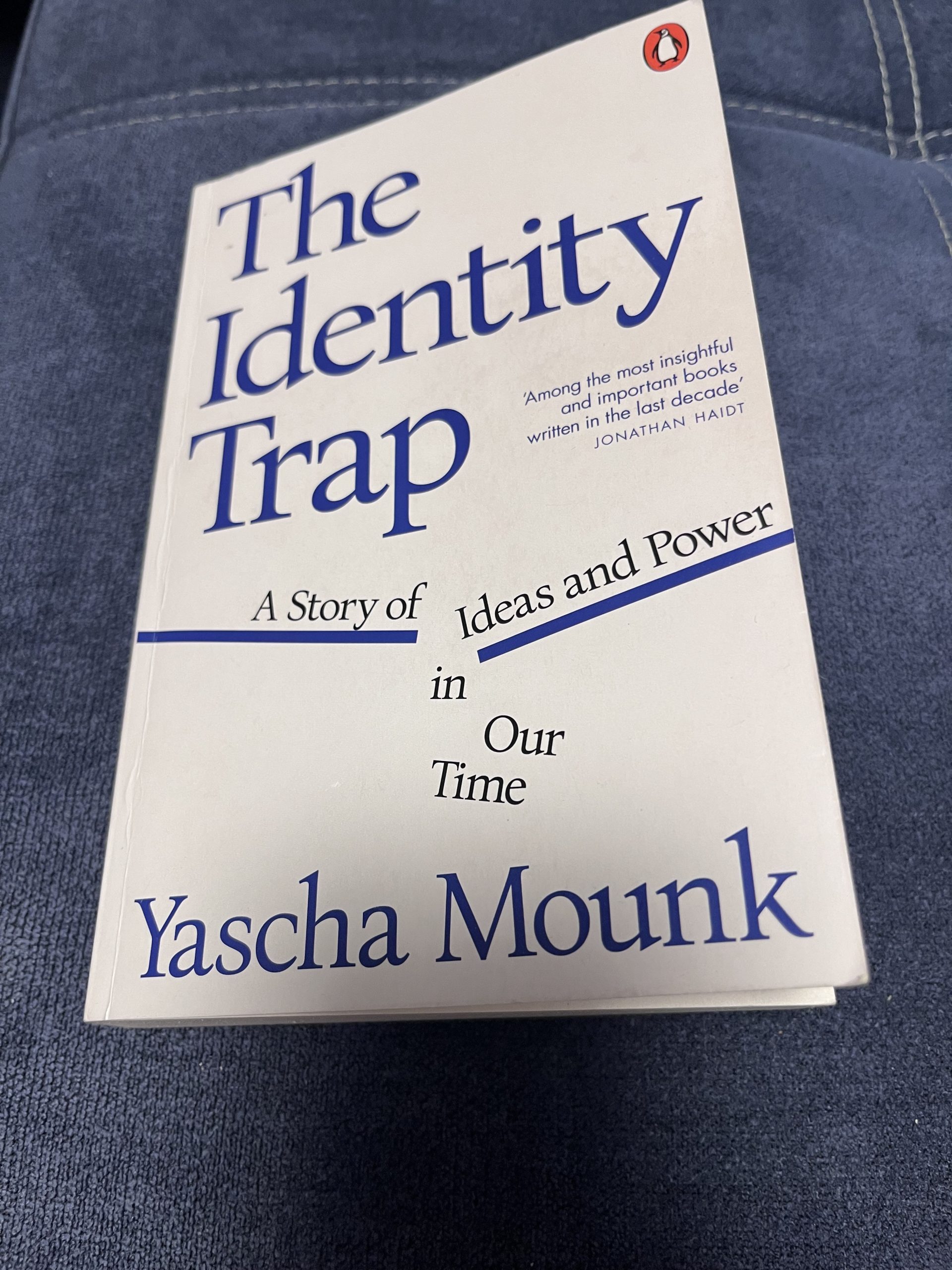
The Lure and the Trap
Concerns about the role that identity now plays in countries from the UK to the US are often ridiculed as an unhealthy obsession with culture war battles on social media.
The identity synthesis is concerned with many different kinds of groups including (but not limited to) those based on race, gender, religion, sexual orientation, and disability.
Advocates of the identity synthesis reject universal values and neutral rules like free speech and equal opportunity as mere distractions that aim to occlude and perpetuate the marginalization of minority groups. They insist on making forms of group identity much more central, both to our understanding of the world and to our sense of how to act within in.
Identity synthesis will ultimately prove counterproductive. Despite the good intentions of its proponents, it undermines progress toward genuine equality between members of different groups. Despite its allure, the identity synthesis turns out to be trap.
The identity synthesis is a political trap, making it harder to sustain diverse societies whose citizens trust and respect each other. It is also a personal trap, one that makes misleading promises about how to gain the sense of belonging and social recognition that most humans naturally seek.
A trap has three key attributes. It usually contains some kind of lure. It is usually capable of ensnaring people even if they are smart or noble. And it usually subverts the goals of those who get caught up in it, making it impossible for them to accomplish what they set out to do.
The true history of identity synthesis features the rejection of grand narratives, including both liberalism and Marxism, by postmodern thinkers such as Michael Foucalt; an embrace of the need for intellectuals to speak on behalf of oppressed groups by adopting a form of “strategic essentialism” by postcolonial thinkers such as Gayatri Chakravorty Spivak; and the rejection of the key values of the civil rights movement, including the goal of racing integration, by critical race theorists such as Derrick Bell.
The Origins of the Identity Synthesis
Postwar Paris and the Trial of Truth
Michael Focualt and Jean-Francois Lyotard set out to critique any set of ideas which assumed that there are universal truths; that some values are objectively superior to others; or that we can make genuine progress toward building a better society.
Foucault started to question conventional narratives of moral and scientific progress. He attacked areas like mental illness, criminal justice, topic of sex.
He said that the real power lies in the identity labels we use to make sense of the world and the normative assumptions enshrined in the discourses that structure my society.
Despite Foucault’s refusal to propose a better model for society, it was his rejection of universal truth, his skepticism about the possibility of progress, and his warnings about the power of oppressive discourses that ended up inspiring an ideology that has gone on to transform the left and gain unexpected influence in the mainstream: the identity synthesis.
The End of Empire and the Embrace of “Strategic Essentialism”
Edward Said was like so many other postcolonial thinkers product of Western schools and Western aspirations.
Said’s distinction between the Occident and the Orient implied a clear distribution of moral roles. There was an oppressor (the Occident) and a victim (the Orient). The goal was to change the dominant discourse in such a way as to help the oppressed resist the oppressor.
The Rejection of the Civil Right Movement and the Rise of Critical Race Theory
Nobody would mistake today’s America for the beautiful symphony of brotherhood of which Martin Luther King dared to dream. As the noble aspirations of the civil rights movement gave way to these disheartening realities, a generation of young legal scholars such as Derrick Bell and Kimberle Crenshaw set out to understand what had gone wrong.
Crenshaw played a key organizational role in the rise of critical race theory, she also contributed one of its most influential concept. She coined a term for the way in which different forms of discrimination can reinforce each other: intersectionality.
The idea became a central component of critical race theory. A neutral perspective does not, and cannot exist.
Law is subjective, neutrality is political, words are actions and racism is permanent.
The Identity Synthesis
Ever since the 1960s, the left had started to devote growing attention to questions of identity.
Inspired by postmodernism, postcolonialism, and critical race theory, a new generation of scholars succeeded in welding a diverse set of influences into one coherent ideology. This synthesis is characterized by a widespread adherence to seven fundamental propositions:
- A deep skepticism about objective truth inspired by Michael Foucault.
- The use of a form of discourse analysis for explicitly political ends inspired by Edward Said.
- An embrace of essentialist categories of identity inspired by Gayatri Chakravorty Spivak.
- A proud pessimism about the state of Western societies as well as preference for public policies that explicitly make how someone is treated depend on the group to which they belong, both inspired by Derick Bell.
- Embrace of an intersectional logic for political activism as well as a deep-seated skepticism about the ability of members of different identity groups to understand each other, both associated with Kimberle Crenshaw.
There is no objective truth, just an infinite series of viewpoints.
Effective action against one form of oppression requires effective action against all.
The Victory of the Identity Synthesis
The Identity Synthesis goes Mainstream
The internet was supposed to create a world in which distinction of group identity mattered less than ever before. Instead, it has created a world of proliferating and often competing identities.
Because social media users tend to follow or friend those who are similar to them, especially on dimensions like cultural background and sexual orientation, a large percentage of the most successful articles spoke directly to the interests and experiences of particular identity group.
The Short March through the Institutions
Rudy Dutschke argued in 1967, should try to subvert the political system by means of a “long march through the institutions”. By 1972, when the German American philosopher Herbert Marcuse picked up on these ideas.
The arrival of a new cohort of junior employees deeply steeped in the identity synthesis had such an outsized impact on some of the most important institutions in America in part because the wider technological and ideological transformation of the part decade gave their bosses good reasons to fear them.
Big corporations start to give a major platform to the popularized forms of the identity synthesis. They did it, because they were afraid of the power of social media and the power one vocal individual could have by using them.
Dissent Discouraged
Many groups are tolerant to internal dissent. They recognize the importance of open discussion, and may even reward critics who dare to speak their mind.
The pressure to conform, social psychologists have found, becomes much bigger when a group is in the middel of a conflict that involves high moral stakes.
A sense of powerlessness is a big part of the reason for the fading tolerance toward dissenters under conditions of perceived threat. This can help to explain what happened to parts of the progressive movement during Trump’s presidency. They guy down the hall may not really be the biggest enemy of society. But he often turns to be the biggest enemy over whom you have some modicum of control.
The Flaws of the Identity Synthesis
How to Understand Each Other
Five applications that are inspired by identity synthesis and are problematic:
- Standpoint theory: Citizens drawn from different groups can never truly come to understand one another.
- Cultural appropriation: Groups do (or should) enjoy a form of collective ownership over their cultural products and artifacts, from distinctive modes of dress to particular culinary dishes.
- Limits of free speech: The state should make laws that rein in misinformation and protect minority groups from being exposed to hurtful or bigoted speech.
- Progressive separation: Social and educational institutions should encourage people to identify themselves by the ethnic, racial, religious, sexual, and gender groups to which they belong. Spaces that are reserved for members of such groups can play an important role in helping people gain political consciousness and take on persistent injustices.
- Identity-sensitive public policy: To redress persistent socio-economic inequalities between different communities, the state must favor historically disadvantaged groups.
There are four interlocking claims that are particularly central to the forms of standpoint theory that now routinely influence public debate:
- There is a set of significant experiences that (virtually) all members of (particular) oppressed groups share.
- These experiences give members of the group special insight into the nature of their oppression and other socially relevant facts.
- Members of the group cannot fully or satisfactorily communicate these experiences to outsiders.
- When an oppressed groups makes political demands based on the identity its members share, outsiders should defer to them.
The standpoint theory makes for bad politics.
The Joys of Mutual Influence
Traditionally, it has been the right that opposed and the left that defended new cultural influences. But in recent years, many progressives have also started to worry about ways in which cultures might cross-pollinate.
Some groups of people should enjoy formal or informal ownership over particular cultural practices or artifacts, giving them decision-making power over who gets to partake. This raises a host of difficult questions that have not been satisfactorily answered. Two of the areas are: the problem of original ownership and the problem of group membership.
Trying to assign particular instances of culture to one group in a clean way is a foul’s errand.
A consistent application of the language of cultural appropriation pushes us to ask absurd questions and draw the wrong conclusions.
Instead of condemning cultural appropriation, we should seek to build a society in which members of every group are valued equally – and all are free to drawn inspiration from the cultures of their compatriots.
Speak Freely
According to Stanley Fish free speck is just the name we give to verbal behavior that serves the substantive agenda we wish to advance.
True beliefs can, if they are never challenged, turn into dead dogma.
The assumption that more debate will always allow the truth to win out is helplessly naïve.
Three negative consequences of abandoning free speech:
- The ideas of the powerful are going to be systematically favored over those of the powerless.
- The stakes who gets to hold power vastly increase.
- Society will lose a crucial safety value that allows the victims of bad public policies to protest the status quo.
In many European countries, the introduction of far-reaching and ill-defined hate speech laws now poses a serious
In the US, Section 230 now ensures that platforms like Twitter and Facebook are not legally liable for the content posted by their users; some other jurisdictions have adopted similar rules.
The Case for Integration
Over the course of the past few years, this universalism has fallen out of favor. Many progressives have come to believe that the traditional emphasis on our common humanity amounts to an erasure of the injustices facing oppressed groups.
In a pluralistic society, freedom of association will always lead to some amount of “homophily” the well-documented tendency of people to seek out those who resemble them.
The rise of progressive separatism is rooted in two complementary intellectual transformations: the embrace of strategic essentialism and new worries about omnipresent threats to the psychological safety of marginalized groups.
Human beings are goupish. They are primed to form strong bonds with their own group, even when its criterion for membership are trivial. The tendency to favor the in-group over the out-group helps to explain much of what is noble and most of what is vile in human history.
Four key conditions help to ensure that intergroup contract has positive effects:
- Equal status.
- Common goals.
- Intergroup cooperation.
- Support from authorities and customs.
Progressive separatism is a dead end. Its vision of the future is neither realistic nor attractive.
The Path to Equality
Even since the French Revolution, the left has touted “equality” as one of its core values. But over the past decade, many politicians, activists, and writers have instead begun to emphasize what they call “equity”. The most common interpretation of equity entails a commitment to eliminating group-level disparities, especially between different races and ethnicities.
A society that aims for equity instead of equality is unlikely to reduce the vast socioeconomic disparities between the rich and the poor.
On Structural Racism, Gender, and Meritocracy
Concept of systemic racism. Policies and practices that exist throughout a whole society or organization, and that result in and support a continued unfair advantage to some people and unfair or harmful treatment of others based on race.
Advocates of the identity synthesis are especially prone to reject the idea of meritocracy.
In Defense of Universalism
A Response to the Identity Synthesis
Advocates of the identity synthesis were especially hostile toward the liberalism. Liberalism is based on the rejection of natural hierarchy.
Three foundational claims for the case of the identity synthesis:
- The key to understanding the world is to examine it through the prism of group identities like race, gender, and sexual orientation.
- Supposedly universal values and neutral rules merely serve to obscure the ways in which privileged groups dominate those that are marginalized.
- To build a just world, we must adopt norms and laws that explicitly make the way the state treats each citizens – and how citizens treat each other – depend on the identity group to which they belong.
The Brief Case for the Liberal Alternative
The story of humanity is an annual of cruelty and injustice. Most societies in history have been deeply hierarchical, giving a small group vast powers over the rest.
The same argument that leads liberals to believe that no one ahs an inherent right to rule also creates a powerful argument for individual liberty.
The government that takes the equality of its citizens seriously will also refrain from privileging some (groups of) citizens over others.
- A commitment to collective self-determination helps to avoid the worst forms of government abuse.
- A commitment to individual freedom helps to keep the peace.
- A commitment to government neutrality helps to avert the most destructive forms of intergroup competition.
At their best, philosophical liberals believe, humans are driven by their capability to make common cause with people who have different beliefs and origins rather than their membership in specific groups.
How to Escape the Identity Trap
Over the past year or so, there have been signs that the identity trap is starting to fall out of fashion.
Here are sic pieces of advice for arguing and organizing against the identity trap in a way that is full-throated, doesn’t court unnecessary risk and has some chances of actually persuading your interlocutors.
- Claim the Moral High Ground.
- Don’t Vilify Those Who Disagree
- Remember That Today’s Adversaries Can Become Tomorrow’s Allies.
- Appeal to the Reasonable Majority.
- Make Common Cause with Other Opponents of the Identity Synthesis.
- But Don’t Become a Reactionary.
Many critics of the identity synthesis have decried it is a form of Marxism. The principal roots of the identity synthesis lie in the postmodern rejection of grand narratives, including Marxism.
The identity trap seduces complex people into seeing themselves as wholly defined by external characteristics whose combinations and permutations, however numerous, will never amount to a satisfactory depiction of their innermost selves.


