

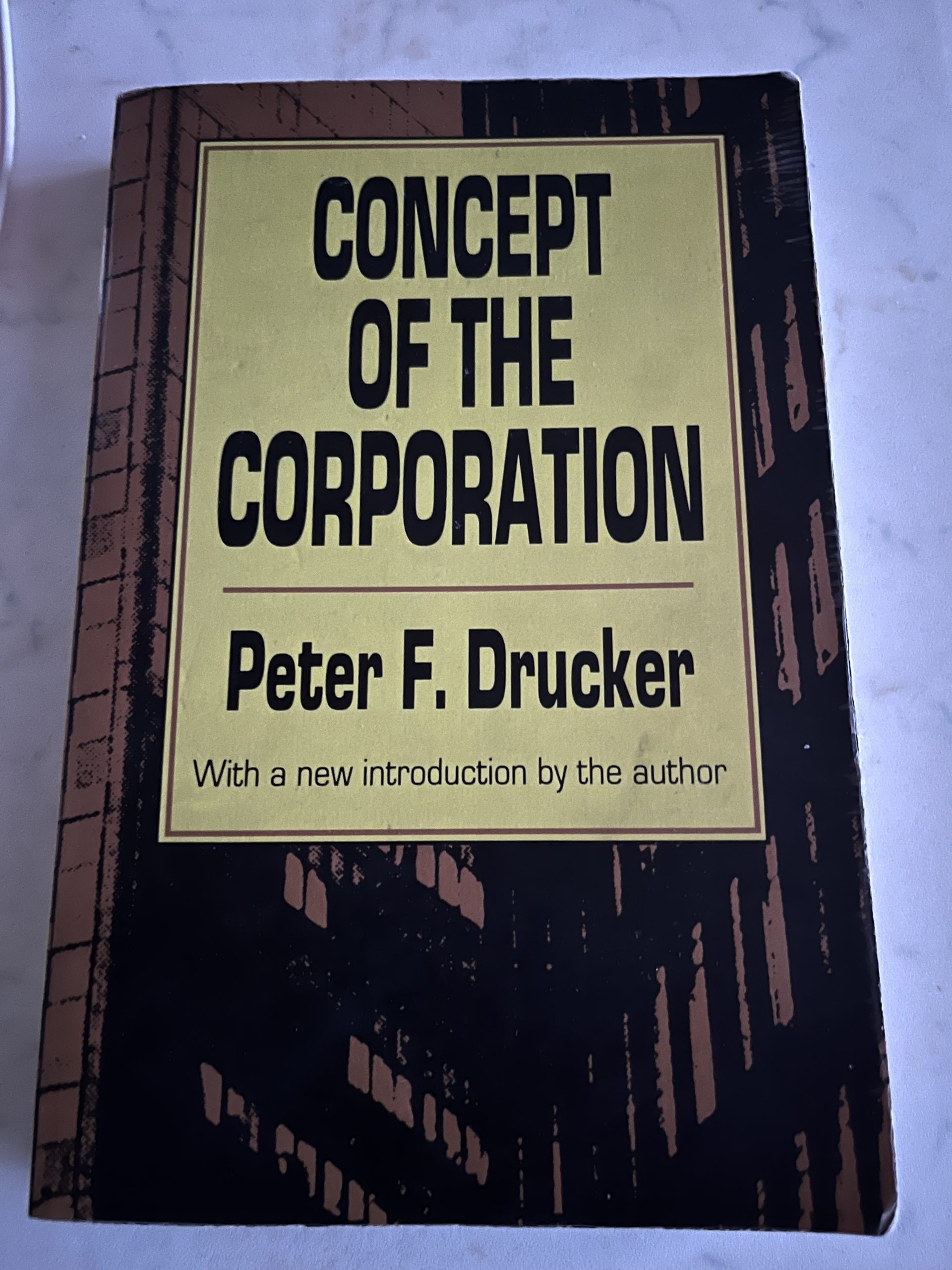
Corporation
Concept of the Corporation is not a book about “business”. It is a book about organization, management and industrial society altogether. It looks at business as an organization that is, as a social structure that brings together human beings in order to satisfy economic needs and wants of a community.
Forty years ago the term “knowledge worker” was unknown (author coined it in his book The Landmarks of Tomorrow in 1959).
Capitalism in One Country
Public enterprise is seen not as the rule but as an exception that needs special justification and special safeguards.
The popular concept implies further the acceptance of profit as motivating and controlling business actions. Finally included in the concept of free enterprise is the acceptance of the privately-owned independently-managed corporation producing for profit goods to be sold on a competitive market.
It has become obvious that no modern society can maintain its existence or independence except as an industrial society using modern industrial technology.
What determines the structure of a society is not the majority but the leaders.
The war showed that it is the large corporation which determines the limits of productivity of an economic system.
Any social and political analysis of an institution has to proceed on three levels:
- It has to look at the institution as autonomous, capable to be judged in terms of its own purposes.
- Every institution has to be analyzed in terms of the beliefs and promises of the society which it serves.
- It has to analyze the institution in its relationship to the functional requirements of the society of which the institution is a part.
The Corporation as Human Effort
Institution, it is an instrument for the organization of human effort to a common end.
The corporation is permanent, the shareholder is transitory.
The essence of the corporation, that is human, organization.
Unlike man, an institution has no natural end, no natural life span, no “retirement age”. It is always engaged in a race against time.
As with every other institution, the survival and successful functioning of the corporation depends on the solution of three interdependent problems: the problem of leadership, the problem of basic policy, and the problem of objective criteria of conduct and decision.
The difficulties inherent in its nature which the large corporation has to overcome are fourfold. There is a tendency towards one-man rule.
In every large-scale organization there is a natural tendency to discourage initiative and to put a premium on conformity.
The big-business world does not, like a small business society, have an automatic and objective yardstick for a man’s performance and achievement.
The final and perhaps the most difficult problem of leadership with which industrial society is faced, is that it does not automatically give that balance between specialist and generally educated person which is the essence of leadership.
Because the corporation is an institution it must have a basic policy. For it must subordinate individual ambitions and decisions to the needs of the corporation’s welfare and survival.
In every institution there is a latent conflict between the long-term demands of policy and the day-to-day conduct of business.
The purpose of the corporation is to be economically efficient.
The distribution of power and responsibility, the formulation of general and objective criteria of policy and action, the selection and training of leaders – these are the central questions of corporate organization.
Decentralization
Three groups of domestic manufacturing properties of GM:
- The automobile and truck group.
- Automobile accessories.
- Diesel engine producers.
Each of this divisions has its own divisional manager. Side by side with this organization according to products there is, as part of the central management, a set of functional service staffs: manufacturing, engineering, sales, research, personnel, finance public relations, law, etc., each under its own vice-president.
General Motors has become an essay in federalism. It considers decentralization a basic and universally valid concept of order.
Central management has twofold functions under a system of decentralization. It is at the same time the servant of the divisional managers and the boss of the corporation.
It is the job of the service staff to formulate future policies in closest collaboration with both divisional managers and central management.
There can be no doubt that the informality, the reliance on information and persuasion, and the absence of “edict management” reflects accurately the personality of the man who developed GM to its present position – Alfred P. Sloan.
The objective of yardstick to measure achievement of both policy-makers and production men is comprised of two sets of measurements which apply equally to divisional management and its subordinates and to central management and its policy decisions:
- Base pricing which gives an objective measure of efficiency of the Corporation and of its subdivisons as a producer.
- Competitive market standing which shows automatically and immediately the efficiency of the Corporation as a seller.
It is a necessary to analyze the consumer’s preferences as it is to analyze cost factors.
How well does it work?
The general idea that a corporation must have a policy seems to have been accepted by top management during the first WW or shortly thereafter. Decentralization and the idea of objective yardstick, date probably back to the early twenties. The corporate organization itself, the concrete organs, the concrete policies, the concrete decisions were developed gradually and in dealing with concrete situations and concrete personalities.
Even if decentralization were completely realized, it still would fail to solve two big problems and to satisfy two basic needs of the corporation as an institutions: the conversion of the specialist needed at the lover levels into the leader with a general outlook and education needed at the top and the breaking of the isolation in which the top executives of any big organization live inevitably.
The executive of a big corporation is to busy to see people except on business. Problems have to be presented to him in a form which allows him to act, that is, stripped of everything not pertaining to the business of the moment.
A corporation lives in society. Yet, the isolated executive cannot know what the effect of his action will be. The executive’s angle of vision must be narrow one for him to be effective. What can corporation do, to give its management the understanding of the outside view.
There are three fields in which GM has developed specific instruments to break the imaginative isolation of the corporation executive: customer relations, dealer relations and community relations in its plant cities.
The small business partner
The dealer’s function cover a broad range. He sells one commodity, new cars. But he also sells used cars. He also runs an agency for a finance company and one for an automobile insurance company. He also often combines it with repair shop.
The dealer is tied to the manufacturer. He has a franchise.
Good dealer is an important as a good product. And they are hard to get.
GM has realized that it has not earned its profit on the car it just sold until the last in the chain of used-car buyers has paid his last installment.
Decentralization as a model?
The difference between the free-enterprise system and state socialism or state capitalism is the dependence of the former on the market as the determinant of prices, profitability and production. The chief argument in favor of the greater economic efficiency of the free-enterprise system has always been the effect of the competitive market check.
The ability of an institution to produce leaders is more important than its ability to produce efficiently and cheaply.
The corporation as a social institution
The American beliefs
Social philosophy the US owes that character of being the same time both the most materialistic and the most idealistic society.
The strength and cohesion and ultimately the survival of every society depend on its ability to realize its basic promises and beliefs sufficiently to be acceptable to its members as meaningful and rational. But no society can ever realize its promises in full and for every one if its citizens; perfection does not pertain to the kingdom of man. On the other hand no society could survive if it failed completely to carry out what it promises.
The middle-class society of the American dream is thus really a classless society but one based on equality of rewards as is the utopia of the Marxists, but one equality of justice.
Individual dignity and fulfillment in an industrial society can only be given in and through work.
The emphasis on formal education puts a substantial premium on superior financial standing.
The modern corporation as a child of laissez-faire economics and of the market society is based on a creed whose greatest weakness is the inability to see the need for status and function of the individual in society.
It is perhaps the biggest job of the modern corporation as the representative institution of industrial society to find a synthesis between justice and dignity, between equality of opportunities and social status and function.
The monotony is inevitable. The opposite of monotony is insecurity. Any normal huma being requires a fair amount of routine to remain sane. It is not routine and monotony which produce dissatisfaction but the absence of recognition, of meaning, of relation of one’s own work to society.
Unions are in inception and basic nature negative; they are anti-bodies.
Altogether, the union, like the corporation, is a basic institution of an industrial society. It has therefore to be in such harmony with society that the achievement of its own ends furthers the realization of society’s basic beliefs and promises.
The foreman: the industrial middle class
Three main criteria of productive efficiency: output per man-hour, output per dollar of wages and output per dollar invested in machines.
Sometimes it was foreman that was a partner in managerial decisions and in policy making, today this function and authority was taken away from him.
American industry in general not only has to work out systematic policies on foreman training, it will also have to make it a general practice to bring the foreman everywhere into the councils of management.
The worker
The automobile industry stands for modern industry all over the globe. It is also the industry with about the worst relations between labor and management.
We have learned that any operation can be handled by modern mass-production methods if the volume is only large enough. Neither the difficulty of the operation nor the precision required make much difference.
It is the subordination of the individual speed and rhythm to that of a line that is responsible for most of the fatigue and nervous disturbance caused by assembly-line work.
A good many managers have realized under war-pressure that the worker who takes pride and interest in his work is better worker and a better citizen.
Wages are determined not by the policies of labor and management but by objective economic facts of productive efficiency of labor, price for the product and size of its market at a given price. In the reality today, however, the wage issue is a contentious issue.
There is only one objective basis for wage rates: the productive efficiency of the worker. Unless two contending parties of equal weight have a principle of decision in common, their bargaining is not likely to end in peace in harmony but in deadlock, frustration, mutual recrimination and bitterness.
The government will, during the next few years, impose annual-wage plans on industry without, necessarily, paying much attention to the necessities of industrial production.
Without unified management, organized under one authority and accepting one and the same criteria of success and the same focus of allegiance, industry simply could not function. Hence management must work for company and not union or government.
Economic policy in an industrial society
The “curse of bigness”
We may say that legally the corporation is a creature of the state, endowed in the interests of society with legal existence, legal rights and privileges. Or we may use the terminology of political analyst and talk of the corporation as an institution of organized society which has to fulfill basic social tasks. Or, economically, we may talk of the corporation as the unit in which our industrial resources are organized for efficient production.
Society has as much of a stake in the solution of the leadership problem of the modern corporation as the corporation itself.
Traditionally a monopoly position has been regarded as the best safeguard of the corporate survival. Yet, a monopoly, by definition,, is antisocial.
Under modern mass-production conditions maximum profitability depends on maximum efficiency.
In industrial reality economic activity extends over a very long period of time. Actually, the business cycle of seven to fifteen years is the unit of industrial activity.
There can be no doubt that size creates problems.
Society as a whole certainly has a direct interest in good relations between the big corporation and the retailers of its products.
Production for “use” and for “profit”
There is hardly any slogan that makes more sense than the one above.
Every economic transaction is by definition a gamble on the future. Profit is thus an inevitable risk premium and the basis of all economic activity, whether capitalist, socialist or cave man.
The profit margin on which the American economy operates, is definitely too low.
The reason for the frequent failure to understand this elementary proportion lies in the customary confusion of profitability which is an objective principle of social action, with the profit motive which is a subjective pricinple of individual motivation.
Essentially profit and profitability are nothing but reformulations of the law of the conservation of energy in economic terms. The profit motive on the other hand pertains to man’s actions and reactions.
In a society which accepts economic advancement and economic goals as socially efficient and as socially desirable the profit motive is socially the most efficient device.
Every society must perform somehow the functions which a free-enterprise society discharges through the market. It must allocate scarce goods.
In politics the question is not what is ideally desirable. It is which of the possible solutions is the best.
Everything in the market is commodity.
In a society like ours which believes in economic goals, we could not have a successful social policy unless we had the principle of economic rationality which the market gives in price.
Freedom is an article of faith, and not a law of physics. It is perfectly possible, therefore, not to believe in it.
The market is neither a perfect nor an all-embracing institution. But within its limits it operates in the social interest.
Is full employment possible?
It is right to see in employment a crucial test of the social efficiency of our economic system.
The risks and fluctuation of a normal labor market are perfectly bearable socially and economically.
A change from an annual basis of taxation to a cyclical one would not replace annual tax payments by a payment made once a year on the over-all profit of a cyclical period.
To prevent unemployment, business should be exempted from taxes on reserves for future contingencies set aside out of current profits. These reserves would become taxable unless they were actually used within a specified period – say ten years.
At present the union automatically demands an increase in wage rates in good years, even when living costs are not rising. Yet it also fights against any decrease of the wage rate in bad years.
In future we will have to rely to a greater extent on the capital accumulated out of current portfolio.
We shall need a higher profit margin coupled with a fiscal policy which puts positive rewards on the use of profits for future expansion.
Our present fiscal policy does its best to stifle new ventures.
There is no inherent and unavoidable conflict between the basic requirements of social stability and functioning and the basic requirements of corporate stability and functioning.
There are five pillars on which an economic policy for a free-enterprise society rests:
- It must have a working full-employment policy.
- Clear determination of those spheres in which the survival interest of society demand collective political rather than individual economic action.
- There are some important areas of economic life which should be organized on and by market price but also protected from it.
- One important task of regulation is the prevention of monopoly.
- We should center out economic policy on the conservation of our human and man-made economic assets.
Concept of the Corporation was not only even rejected by GM; it was studiously ignored by the company. The book itself was totally unacceptable to most of the executives, and above all to Alfred Sloan himself. Main reasons were: the book’s attitudes toward GM’s policies, the recommendations on employee relations and the treatment of the large corporations as affected with the public interest.
But Japanese did pay attention to the book.


