

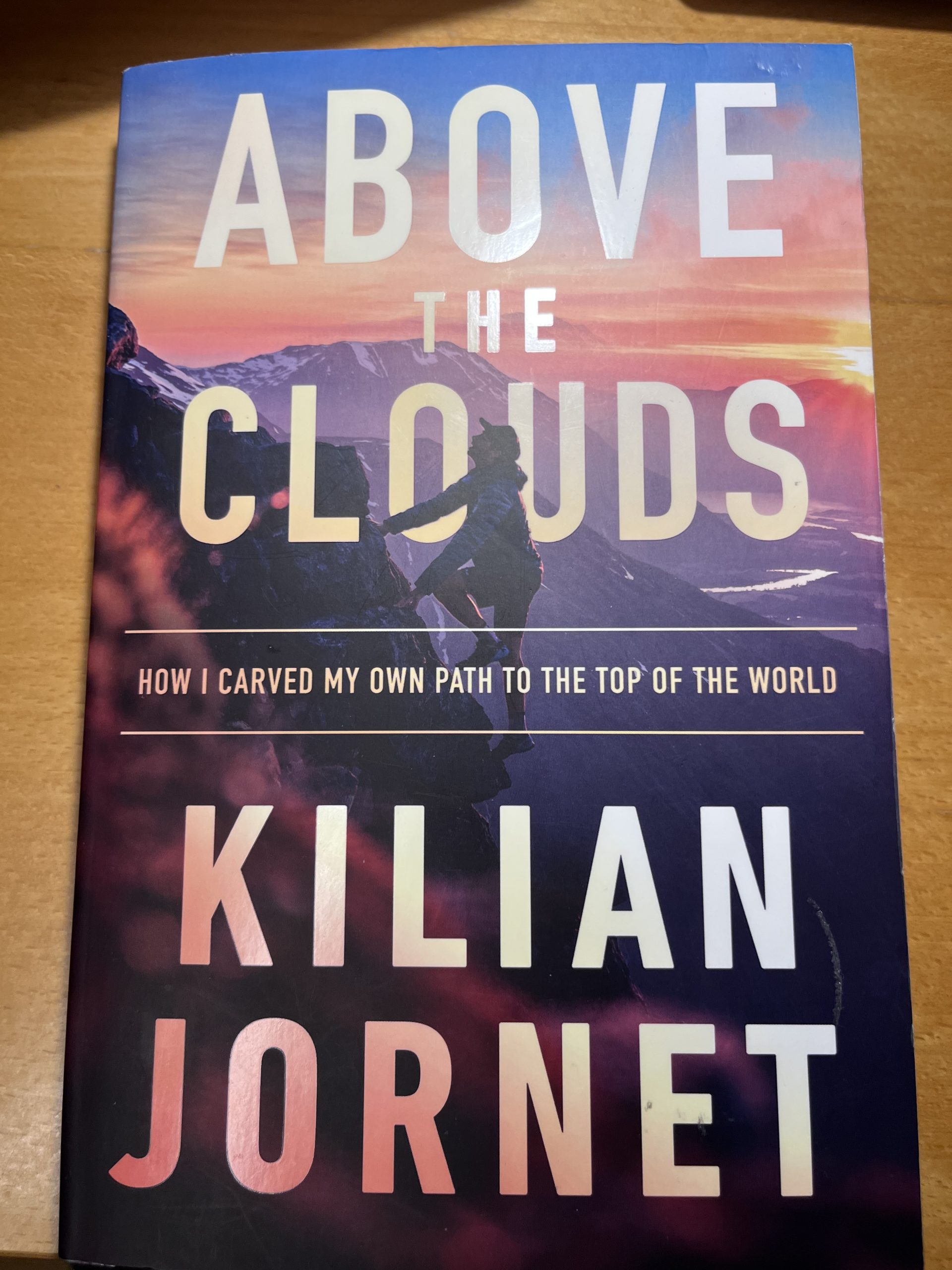
Above the clouds
I wasn’t like most kids growing up. The posters in my childhood bedroom were of Matterhorn, the Toblerone mountain in Switzerland, and a panorama called the Roof of the World, showing the range of Everest and the surrounding mountains.
I ran fast to live a slow lifestyle. I needed solitude to be myself and social interactions to make a living.
Competition in sports is about performance. The time on the clock. Mountains are (still) a space of freedom, where lawlessness reigns for the good of everyone.
Didier Delsalle has been on top of Everest, on May 14, 2005, he landed with his helicopter on the 8.848-meter summit.
When it comes to climbing mountains, the reaching should never compromise the journey to get there.
The Farewell
Tromso is a fishing port on a little island surrounded by fjords and mountains, above the Arctic Circle in northern Norway.
Before an assault on a summit, there is a moment that is impossible to quantify. If goes beyond the miles you’ve covered and the inevitable circumstances you’ve overcome. This is when you realize you have the necessary calm for the ascent.
Now I was here on Everest in the springtime, attempting to ascend and descend the mountain in the fastest time. There was no silence; I breathed deeply; the wind blew in violent gusts; snowflakes fell from the sky. It was not silent, but I felt silence.
Training
There are people who train to compete, and there are those who compete to train. I belong to the second group.
We can’t choose our genes or our build, and they’ll be with us for our whole lives.
We lived in a mountain refuge at an altitude of 2.000 meters, and the shelves were filled with books by mountaineers Kurt Diemberger, Roger Frison-Roche, and Walter Bonatti.
Despite being a good student, I was bored by the scene at school. I had zero social life, and didn’t even try to make friends. All I could think about was putting on my sneakers to go for a run. I wanted to feel exhaustion in my heart and pain in my legs again.
I have always been impatient.
My idea was to push a specific aspect of my body to the limit, such as my metabolism’s ability to work at aerobic capacity with no energy input, or the possibility to repeat anaerobic exercises at a high altitude and then recover, to mention a couple of things that preoccupied me.
In 2008 in Front-Romeu I wanted to know how many days I could spent training and running without eating anything. If we have to accept that extreme sports are unhealthy because we take our bodies to the limit and run the risk of injury, we should also be clear that we must be the ones to manage our own bodies and that they should always be under our control. On the fifth day I fainted and collapsed on the ground.
I have experimented with sleep, hydration, and several kinds of training, running at high altitudes, trying out different equipment, and practicing a hundred hours a week. Most of these experiments have ended up in disaster.
I know the way I train can be dangerous, for one reason: my method is oriented toward figuring out my limits.
You must be aware that you can’t overcome your body’s physiological limits. What you can do is build up an armor made of different pieces: mental preparation, technique, the kind of equipment you use, and your strategy. There is one more limit, a psychological one. this one is called fear.
I believe that children should be coached not to win but to train. I was lucky enough that this was the first thing Maite Hernandez and Jorda Canals taught me. They also taught me to be methodical and analytical, to note everything about my performance so I could analyze it later and identify anything that hadn’t worked out well.
These days, if you’re beginner, you have to choose between being a professional, elite runner, belonging to the glorious top five percent in the world, or being a running influencer. If you don’t compete, training becomes a professional accessory, and you have to choose your activities for their visual, communicative, or inspirational appeal as well as their potential to grab the attention of an audience, even though they may have zero athletic draw. Mind you, these are both valid and interesting life paths.
The Front-Romeu Hermitage is metaphorically my Kenyan Iten, an old monastery converted into college accommodations with simple rooms, no internet access, and limited cel phone reception, at the foot of the ski slopes.
I travel, I pollute, I use the internet; I don’t really like clothes, but we have to protect ourselves from the cold with something. I didn’t have the balls to choose the life of a hermit, and I am willing to prostitute myself to a certain extent in exchange for the money I need to keep surviving and have a good time while pursuing my passions.
Money won’t give me back the time that could make me lose.
It is hard for me to think of climbing a mountain as heroic. climbing a mountain is just putting your life in danger to try to reach the summit, and then coming down again. In fact, it’s a selfish enterprise. A dangerous and expensive leisure activity.
My Home is the Mountain
I grew up in La Cerdanya in a refuge shared by mountaineers, skiers, and tourists passing through.
Maybe home is spending time with the people you love. Home is laughter. Home is making love, feeling the comfort of solitude, and crying without worrying that anyone else can see you.
I went to live in Chamonix in 2010 because, for me, it was a mythical place.
If you climb at a high speed and for a long time, you can see much more.
I have never doubted that Emelie is smarter than me, because she prioritizes safety over her goals.
In three sports as different as running, mountaineering, and climbing, there is a common border, a shared measurement, the two-hour threshold. In running 2 hour mark for 26.2 miles is the benchmark. In mountaineering, the touchstone is the north face of the Eiger, in the Alps. Michel Darbellya was the first to take eighteen hours alone; Messner and Peter Habeler arrived in ten. Hainz, Arnold and Steck have completed the climb in less than two and a half hours. The two-hour horizon is getting closer. Alex Honnold and Tommy Caldwell managed El Capitan in Yosemite Valley bellow two hours.
In the mountains, the idea of a record is relative, since it’s impossible to compare two times even on the same peak. Performance is measure by fastest known time.
Four basic factors give rise to improvements in time. The first is personal performance. The second is the optimization of the route. The third is conditions. The fourth is the kind of ethic you want to apply.
Our ethics are the rules we impose on ourselves and apply to the actions we carry out, but they relate to the ethics of each individual; we do not impose them on others.
Ther is only one rapid ascent I can say I’m absolutely proud of, for having achieved total optimization. This is the Cervino ascent. On August 1, 2013, I took my truck and headed to Cervinia in the Aosta Valley to do Cervino-Matterhorn.
I’m too impatient. I don’t know it that’s a virtue. I believe you only live once and you have to make the most of every second.
Everest in Summer
When you prepare for an expedition, it’s important to gather the maximum amount of information before an assault on the summit.
My eyes were overwhelmed by all the beauty as I sat there with Everest at my back and the Tibetan Plateau in front of me. The silence was so perfect that my own breath seemed to insult the peace.
On the last day of August, I was back there again. At an altitude of almost 8.000 meters, in the middle of the northeast wall of Everest, I wasn’t sure we would make it out of there alive.
More Than Five Hundred Race Numbers
I’ve accumulated over five hundred race numbers. The first was pinned on me by my parents before I could walk, for the La Modina New Year’s descent. I was two month old.
Short races, those that take one to four hours to cover between 20 and 40 kilometers, demand a high level of concetration.
For a few years, I believed mistakenly that a race was what happened between the starting shot and the finish line. I was blinded by the idea that competition was a binary game between winning and losing.
After doing longer training for a couple of months, I found I could run for eight to nine hours without eating or drinking.
These races are the window where brands and runners put themselves on display. So much media attention often makes you forget the basic elements of the sport: a respect for nature and the community that lives alongside it.
The Vertical Kilometer is a race of total sincerity. At this event, it’s impossible to pretend. If you’re strong, you’ll make good time, but if you’re weak, there isn’t a single technique or tactic that will let you disguise it.
When you’re running against yourself, the winner or loser is always internal.
Some things have to change to progress, while others remain the same, and that is exactly their charm, since they transport us to a past when we believe everything was better.
Florent Troillet. Sometimes you don’t need to speak to someone to feel at ease. From the first day, each of us knew what the other wanted without them having to ask.
A good memory leaves a nice aftertaste, and our brain will try to bury anything that gets in its way.
For me, running is easy, and doing it fast is, too. Winning, on the other hand, is harder and demands many hours of training and effort.
I don’t believe that sport has no social function. Since the Roman period, it has served as entertainment. Today, despite everything, sport seems to be going back to its roots, to spectacle and to the Roman circus. Competitive sport is also overvalued, and increasingly exposes the dark side of human nature.
Maybe the best weapon against doping and cheating is to de-mythify the sport and get rid of the podium. There’s no such thing as a hero.
In many parts of the world, sport isn’t the final goal but rather a way to make a living.
I always considered myself an amateur. The word is a Gallicism that comes from the Latin amator, meaning the one who loves.
I like winning, but I also like losing. I like spending time with new runners who are more motivated than me, better trained, and have a stronger desire to reach the top.
Everest in Fall
Fall is a beautiful season in Nepal.
The life in which people recognize me freaks me out and makes me panic in a way that’s difficult to describe. I am going to be an unbearable old man.
What I love the most about going on expedition is that I can disconnect from the world, from everything and everyone.
I didn’t choose to be admired. In fact, there are moments when it disgusts me. I’ve never wanted to be a role model to anyone.
Each mountain is the shape of the person who wants to climb it; a solitary ascent isn’t one you feel with your hands on the rock, but the one that beats inside you, while on the outside your body is fighting.
Maybe that’s what old age is: a body with no room left for any more scars.
Partners in Dreams
The last challenge in the Alps, the Eiger was conquered by Heckmair, Kasparek, Vorg and Harrer in 1938. The north faces of Matterhorn and the Grand Jorases were climbed in 1928 and 1931. Gaston Reibuffat climbed all three between 1945 and 1952.
Chamonix was the departure point for the first ascent of Mont Blanc in 1786, the feat that gave birth to mountaineering.
I did Grand Jorasses with Simon Elias Barasoain, Mattehorn alone and Eiger with Ueli.
Ueli was a guy who trained for twelve hundred hours a year. A figure like those of cross-country skiing or cycling hours a year, a figure like those of cross-country skiing or cycling world champions.
Good luck is not always on your side. Stephane Brosse introduced me to the world of incline skiing. A ledge of the Aiguille d’Argentiere collapsed, taking Stephane with it. In the months after Stephane’s death, I dealt with the guilt by bingeing on alcohol and taking insane risks in the mountains. Seb Montaz and Vivian Bruchez redirected me back to the right path.
Everest in Winter
When you think of Nepal, what comes to mind are majestic mountains, tropical forests, and rustic villages scattered across silent valleys. But my first steps there were permeated with insufferable heat, dusty air , the stench of pollution.
Some mountaineers are determined not to let the sport evolve. They’re like a kind of mountains Amish who reject the technology offered by technical progress and the new equipment that lets us climb mountains more easily. Two from that cult are Jordi Tosas and Jord Corominas. Maybe going against evolution is the perfect way to evolve.
When you’re in an uncertain situation, you need to be able to control your emotions, even find a way to eliminate them, and let reason and instinct lead your actions.
The perception of risk is a personal matter. Committing to a climb is always a personal choice.
Experiences That Changed Me Forever
We live in a world of parallel realities that observe but choose not to understand each other.
Appearances end up prevailing over facts, and the issue is often reduced to finding an easy polemic to draw people into the media.
For a few years now in our society, our materialistic focus on personal image has become as important as our capitalist, materialistic focus on well-being.
We have come to believe that we are what we have.
Sports have not been immune to the shift.
I wasn’t completely immune to this.
While for a long time what I wanted and what people asked of me were one and the same, now, without my knowing very well how, the band was broken and I was a prisoner of other people’s project.
When I came from Nepal 2015 I wanted to kill Killian Jornet, to kill the personality.
Language is the vehicle for our thoughts, and if we don’t find the exact word to describe what we think, see, or feel, everything is lost to oblivion and disappears, but never existed.
My heart, I realized at the time, was telling me I wanted to return to climbing unnamed mountains, so, that I might feel again, without knowing how to describe my feelings.
Running is pure, simple, and human. The closest to it is walking, which is just what runners do when they’re tired.
With extreme fatigue, we take more risks due to laziness and exhaustion.
I know that to achieve intense enjoyment. I have to go to the limit of my comfort zone, then stick to the range of things I know how to do, stretching the limit as far as possible.
Everest in Spring
Ueli died on Nuptse. Everything clouded over. An entire value systems collapses each time one of the pillars sustaining, it dies on the mountain.
Death, for me, would be to not go at all.
The importance of failure, and of failures. We are nothing more than insignificant, fragile people, and this is something we should always keep in mind.
If there is one thing I’ve learned, it’s that if I’m feeling good, it’s better to keep going up and see what happens, because the altitude doesn’t give you too many chances.
Up there, your sense of time is strange and intuitive. It floats around you, but you can’t touch it – it’s diffuse.
The phrase “No news is good news” doesn’t apply when the person you love is on a large mountain.
The Welcome
I’ve never kept any trophy from the races I’ve won.
I’m convinced that that the best time is always now, and the best memory is always tomorrow.
What’s up? Shall we go for a run?


