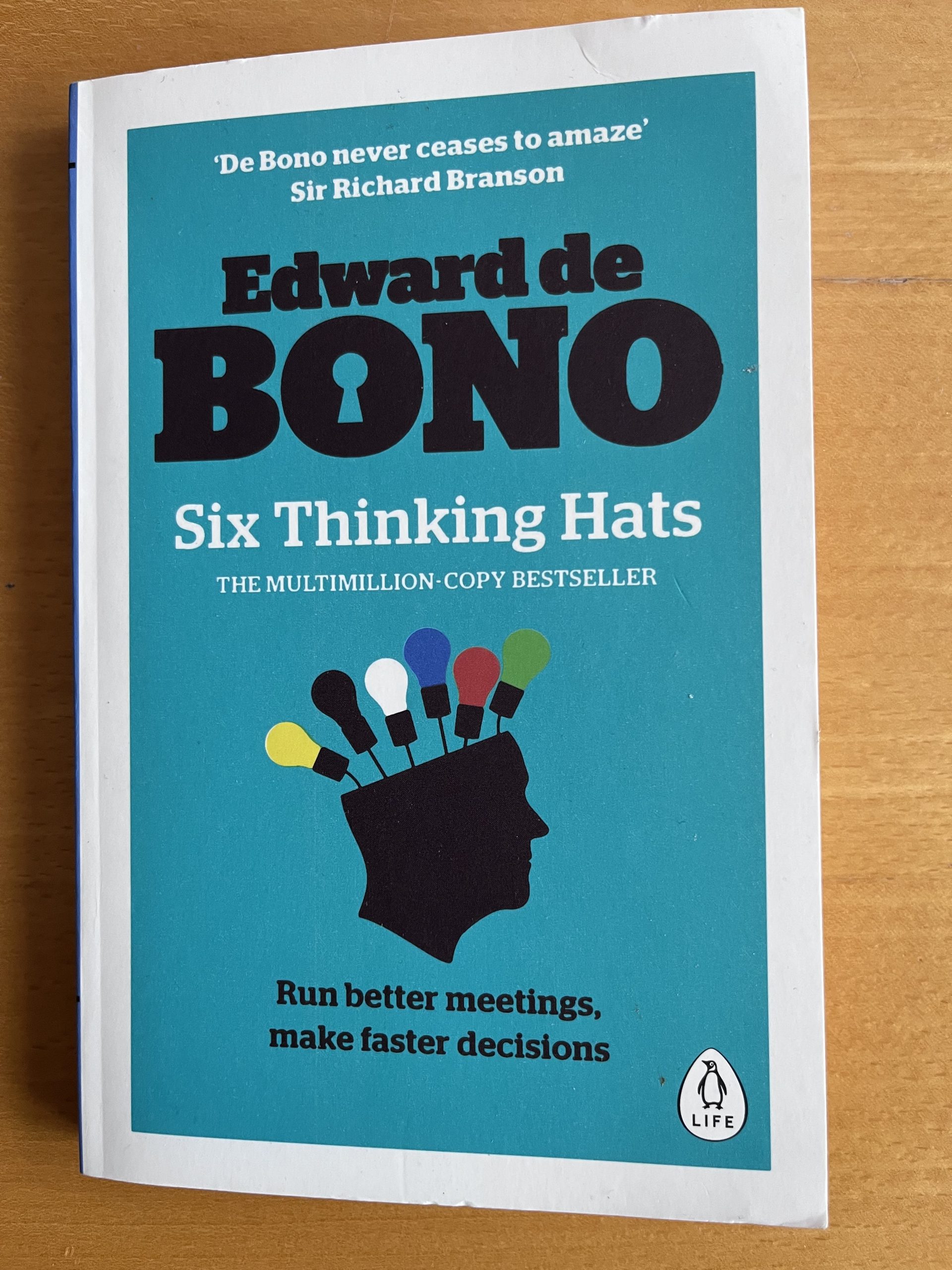
The Six Thinking Hats
Thinking is the ultimate human resource. Usually, the only people who are very satisfied with their thinking skill are those poor thinkers who believe that the purpose of thinking is to prove yourself right – to you own satisfaction.
The approach of the six thinking hats is a very simple concept which allows a thinker to do one thing at a time.
The basic idea behind Western thinking was designed by the Greek ‘Gang of Three’. Socrates put great emphasis on dialectic and argument. He saw his role as simply pointing out what was wrong. Plato believed that the ‘ultimate’ truth was hidden below appearances. Aristotle systematized inclusion/exclusion logic. From past experience we would put together ‘boxes’, definitions, categories or principles.
As a result, Western thinking is concerned with ‘what is’ which is determined by analysis, judgment and argument. But there is another whole aspect of thinking, that is concerned with ‘what can be’ which involves constructive thinking, creative thinking and ‘designing a way forward’.
Many cultures in the world, perhaps even the majority of cultures, regard argument as aggressive, personal and non-constructive.
The argument system works well in a stable world.
The essence of parallel thinking is that at any moment everyone is looking in the same direction – but the direction can be changed.
The value of the hat as a symbol is that it indicates a role. Another advantage is that a hat can be put on or taken off with ease. A has is also visible to everyone around.
It is important to note that the hats are directions and not descriptions of what has happened. The hats are not descriptions of people but modes of behavior. People might be better at one mode than another. Nevertheless, the hats are not categories of people.
The Six hat method follows the Confucian approach rather than the analytical one.
Perhaps the biggest obstacle to quick and effective thinking is the ego. Confrontational and adversarial thinking exacerbates the ego problem. Six Hats thinking removes it.
Confusion is the biggest enemy of good thinking. We try to do too many things at the same time. We look for information. We are affected by feelings. We seek new ideas and options. We have to be cautious. We want to find benefits. Those are a lot of things that need doing. With the Six Hats method, we try to do only one thing at a time.
Six Hats, Six Colors
- White Hat: White is neutral and objective. The white hat is concerned with objective facts and figures.
- Red Hat: Red suggests anger (seeing red), rage and emotions. The red hat gives the emotional view.
- Black Hat: Black is sombre and serious. The black hat is cautious and careful. It points out the weakest in an idea.
- Yellow Hat: Yellow is sunny and positive. The yellow hat is optimistic and covers hope and positive thinking.
- Green Hat: Green is grass, vegetation and abundant, fertile growth. The green hat indicates creativity and new ideas.
- Blue Hat: Blue is cool, and it is also the color of the sky, which is above everything else. The blue hat is concerned with control, the organization of the thinking process and the use of the other hats.
You may also think of the three par of hats: white and red, black and yellow and green and blue.
Using the Hats
There are two basic ways to use the hats. Singly to request a type of thinking. In a sequence to explore a subject or solve a problem.
In the sequence use, any hat can be used as often as you like. There is not need to use every hat. The sequence may be made up of two, three, four or more hats. There are two broad types of sequence: evolving and preset.
Discipline is very important. Members of the group must stay with the hat that is indicated at that moment.
How much time is allowed per hat. The author suggest one minute per person.
The White Hat
General
The White Hat is about information.
- What information do we have?
- What in do we need?
- What information is missing?
- What questions do we need to ask?
- How are we going to get the information we need?
When two offered pieces of information disagree, there is no argument on that point. Both pieces of information are put down in parallel.
Facts and Figures
Too often the facts and figures are embedded in an argument. The facts are used for some purpose rather than presented as facts.
The framing of suitable focusing questions is part of the normal process of asking for information.
Are you really trying to get the facts, or to build up a case for an idea forming in your head.
Separate what is fact and what is extrapolation of interpretation.
Whose fact is it?
Much of what passes for fact is simply a comment made in good faith or is a matter of personal belief at the moment.
Two-tiered system: believed facts and checked facts.
Your own opinion is never permissible under white hat thinking. You can report the actual opinion of someone else.
Japanese-Style Input
The Japanese participants sit down at a meeting without any preformed ideas in their heads. The purpose of the meeting is to listen. The Japanese notion is that ideas emerge as seedings and are then nurtured and allowed to grow into shape.
Facts, Truth and Philosophers
Truth is related to a word-game system known as philosophy. Facts are related to checkable experience.
White hat thinking is concerned with usable information. So the ‘by and large’ and ‘on the whole’ idioms are perfectly acceptable.
The spectrum of likelihood:
- Always true
- Usually true
- Generally true
- By and large
- More often than not
- About half the time
- Often
- Sometimes true
- Occasionally true
- Been known to happen
- Never true
- Cannot be true (contradictory)
Who Puts on the Hat?
- Put on your own hat.
- Ask someone to put on the hat.
- Ask everyone to put on the white hat.
- Choose to answer with the hat on.
Summary
When wearing the white thinking hat, the thinker should imitate the computer. The person requesting the information should use focusing questions.
The Red Hat
Under the red hat a range of feelings can be expressed. The expression of feeling may vary from culture to culture.
There is no need to explain or justify the feeling.
The red hat is always applied to a specific idea or situation. The thinker is not permitted to change the idea.
The red hat can also cover intellectual feelings.
The red hat is always done on an individual basis. Individuals should not be allowed to say ‘pass’ when they are asked for their red hat feelings.
Emotions and Feelings
Emotions, feelings, hunches and intuitions are strong and real. The red hat acknowledges this.
The Place of Emotions in Thinking
Any good decision must be emotional in the end. Emotions give relevance to our thinking and fit that thinking to our needs and the context of the moment.
There are three points at which emotion can affect thinking:
- There may be a strong background emotions such as fear, anger, hatred, suspicion, jealousy or love.
- In the second instance, the emotion is triggered by the initial perception.
- The third point at which emotions can come in is after a map of the situation has been put together.
Every decision has a value base. We react emotionally to values.
Intuition and Hunches
The word intuition is used in two ways. Both are correct. But in terms of brain function they are totally different. Intuition can be used in the sense of a sudden insight. The other use is the immediate apprehension or understanding of a situation. It is the result of a complex judgment based on experience.
Intuition, hunch and feeling are close. A hunch is a hypothesis based on intuition.
We give legitimacy to intuition and feelings with red hat thinking.
intuition can be treated as one may treat an adviser.
Opinions may be expressed under red, black or yellow hats. When the red hat is used, it is best to express an opinion as a feeling.
Moment to Moment
Normally emotions take some time to well up and even longer to die down. In a sense the red hat allows someone to switch in and out of the emotion mode in a matter of moments.
The Use of Emotions
Thinking can change emotions.
Expressed emotions can provide the constant background to the thinking or discussing.
Emotions are often used to establish bargaining positions.
Emotions are part of both the method of thinking and the matter to be thought about.
The Language of Emotions
We are brought up to apologize for emotions and feeling because they are not the stuff of logical thinking. Red hat thinking frees us from such obligations.
The exploration of emotions and a probing for their foundation. But that is not part of the red hat idiom.
Summary
Wearing the red hat allows thinker to say: “This is how I feel about the matter.”
The Black Hat
The black hat is the most used of all the hats. The black hat is perhaps the most important hat. The black hat is the hat of caution.
The black hat is the hat of survival. In order to survive we need to be cautions.
The black hat is the basis of Western civilization because the black hat is the basis of critical thinking.
Continuous and Careful
With the black hat we point out what is wrong, what does not fit, and what will not work.
Black hat thinking is always logical. There must always be a logical basis for the children.
Black hat reasons must be capable of standing on their own. They must make sense.
Black hat is not balanced.
In its ‘design role’, the black hat points out the weaknesses in and idea so that those weaknesses can be put right.
Content and Process
Point out errors and thinking. Question the strength of the evidence. Does the conclusion follow? Is it the only possible conclusion?
The Six Hats method is very different from argument, the rules of argument do not apply. Logical deduction insists on certainty. The Six Hats method deals with possibilities and likelihood. In the real world it is very difficult to be certain. Action has to be taken on likelihood.
The black hat is not permission to go back to ‘argument’.
The Past and the Future
A very important function of the black hat is risk assessment. All proposed actions are going to be carried out in the future. This is an extremely important difference between ‘academic’ thinking and ‘real world’ thinking.
In the real world there is the action element – which author sometimes call operacy.
The Problem of Overuse
It is much easier to be critical than to be constructive.
There are people whose self-importance and self-image are based on their willingness to criticize.
Overuse of the black hat is not helpful.
Summary
Black hat thinking is concerned with caution. At some stage we need to consider risks, dangers, obstacles, potential problems and the downside of a suggestion.
Black hat thinking can be abused and overused if it is the only mode of thinking.
The Yellow Hat
Think of sunshine. Think of optimism. Under the yellow hat a thinker deliberately sets out to find whatever benefit there may be in a suggestion.
The yellow hat has a high value because it forces people to spend time seeking out value.
The yellow hat should be logically based. There should be some reason given for the value put forward. The yellow hat is a judgment hat and is not based on fantasy. What are the values? For whom? Under what circumstances? How are the value derived? What other values are there?
Speculative-Positive
Being positive is a choice. We can choose to look at things in a positive way. Positive thinking has to be a mixture of curiosity, pleasure, greed and the desire to ‘make things happen’.
Although yellow hat thinking is positive, it requires just as much discipline as the white hat or the black hat.
There may be very powerful positive points that are not at all obvious at first sight. That is how entrepreneurs work. They see value that those around them have not yet spotted. Value and benefit are by no means always obvious.
The Positive Spectrum
There are Pollyanna-type people who are optimistic to the point of foolishness. At what point does optimism become foolishness and foolishness hope?
If we restrict our yellow hat thinking to what is sound and well known, there is going to be little progress. The key point is to look at the action that follows the optimism.
Reasons and Logical Support
A positive assessment may be based on experience, available information, logical deduction, hints trends, guesses and hopes.
Yellow hat thinking covers positive judgement.
The emphasis of yellow hat thinking is on exploration and positive speculation.
Constructive thinking
It is to yellow hat thinking that the constructive and generative aspect is left. It is from yellow hat thinking that ideas suggestions and proposals are to come. We shall see later that the green hat (creativity) also plays important role in designing ideas.
Proposals are made in order to make something better.
One aspect of yellow thinking is concerned with reactive thinking.
Once the yellow hat has directed the thinker’s mind towards coming up with a proposal, the proposal itself may not be hard to find.
So yellow hat thinking is concerned with the generation of proposals and also with the positive assessment of the proposals. Between these two aspects there is a third. The developing or ‘building up’ of a proposal.
Speculation
Speculation has to do with conjecture and hope.
Any speculation must have a strong sense of potential benefit. There also has to be hope.
In practice there is a big difference between objective judgement and the intention to find positive value.
People are forced to solve problems, but no one is ever forced to look for opportunities. However, everyone is free to look for opportunities – if they so wish.
If the benefits are poor with the best possible scenario, then the idea is not worth pursuing.
Part of the black was also to explore ‘if’ in the sense of risk and danger. The corresponding part of the yellow hat function is to explore the positive equivalent of risk, which we call opportunity.
The vision includes both the benefits and the feasibility of the project: it can be done and it is worth doing.
Relation to Creativity
Yellow hat thinking is not directly concerned with creativity. The creative aspect of thinking is specifically covered by the green thinking hat.
Just as black hat thinking can pinpoint a fault and leave it to green hat thinking to correct the fault, so yellow hat thinking can define an opportunity and leave it to green hat thinking to come up with some novel way of exploring that opportunity.
Summary
Yellow hat is positive and constructive. It probes and explores for value and benefits. Is constructive and generative. It can be speculative and opportunity seeking.
The Green Hat
The green hat is the energy hat. Think of vegetation. Think of growth. Think of new leaves and branches. The green hat is the creative hat.
Under the green hat we put forward new ideas.
The green hat includes both ‘the top of the head’ creativity and ‘deliberate’ creativity.
Creative Thinking
For most people the idiom of creative thinking is difficult because it is contrary to the natural habits of recognition, judgment and criticism. The brain is designed to set up patterns, to use them and to condemn anything that does not ‘fit’ these patterns.
The green hat by itself cannot make people more creative. The green hat can give thinkers the time and focus to be more creative.
With green hat thinking we cannot demand an input. We can demand an effort.
Lateral Thinking
Author invented the term lateral thinking in 1967. It needed to be invented for two reasons. The first reason is the very broad and somewhat vague meaning of the word creative. The second reason is that lateral thinking is directly based on information behavior in active self-organizing information systems. Lateral thinking is pattern switching in an asymmetric pattering system.
Movement Instead of Judgment
In normal thinking we use judgment. For most of our thinking judgment is vital.
Movement is a key idiom of lateral thinking. Movement is an active idiom. We use an idea for its movement value. There are a number of deliberate ways of getting movement from an idea, including extracting the principle and focusing on the difference.
With movement we use an idea for its forward effect.
Provocation and movement go together. Without the idiom of movement, we cannot use provocation. Unless we are able to use provocation, we remain trapped within past patterns.
The key point to remember is that in green hat thinking the movement idiom completely replaces the judgment idiom.
The Need for Provocation
A provocation can never be looked for because it has no place in current thinking. Its role is to jerk thinking out of current patterns.
We can sit around and wait for provocation, or we can set out to produce them deliberately.
Po: Beyond Yes and No. Logic of asymmetric pattering system. The Po stands for provocative operation.
One simple way of getting a provocation uses reversal. You spell out he way something usually happens and then you reverse it or turn it back to front.
Just as movement is part of the basic idiom of green hat thinking; so too is provocation.
Alternatives
Real life is very different from school sums. There is usually more than one answer.
We set out to look for alternatives. The acknowledgment that there might be alternatives and the search for these alternatives is a fundamental part of creative thinking.
The willingness to look for alternatives (or perception, of explanation, of action) is a key part of green hat thinking.
There are different levels of alternative. Whenever we look for an alternative we do so within an excepted framework, which sets the level. Usually we want to stay within that framework. Occasionally we need to challenge the framework and to move upward to a higher level.
Personality and Skill
Author does not like the idea of creativity as a special gift. He prefers to think of it as normal and necessary part of everyone’s thinking.
What Happens to the Ideas?
One of the weakest aspects of creativity is the ‘harvesting’ of ideas.
We tend to look only for the final clever solution. And ignore all else. Apart from this clever solution, there may be much else of value.
Summary
The green hat is for creative thinking. The search for alternatives is important. The movement idiom replaces the judgment idiom. Provocation is an important part. And is symbolized by the word po.
The Blue Hat
Think of the blue sky above. Think of ‘overview. The blue hat is for thinking about thinking.
The blue hat is like the conductor of the orchestra.
Using the blue hat at the beginning of a thinking session defines the situation.
The blue hat sets the thinking strategy. During the session the blue hat keeps the discipline and ensures that people keep to the relevant hat. The blue hat also announces a change of hats.
At the end of a session the blue hat asks for the outcome. This may be in the form of a summary, a conclusion, a decision, a solution and so on.
Under the final blue hat the next steps can be laid out.
Control of thinking
The blue hat is the programming hat for human thinking.
It should be said that blue hat thinking is not limited to organizing the use of the other hats. Blue hat thinking can also be used to organize other aspects of thinking such as the assessment of priorities or the listing of constraints.
Focus
The focus aspect is one of the key roles of blue hat thinking. The difference between a good thinker and a poor thinker often lies in the ability to focus.
A focus can be broad or it can be narrow. The important thing about the focus is that it should be spelled out in a definite manner.
Asking the question is the simplest way of focusing thinking.
Questions are divided into two types. There is a fishing question, which is exploratory. There is a shooting question, which is used to check out a point and which has a direct yes or no answer.
The definition of the problem is important, otherwise the solution may be irrelevant or unnecessarily cumbersome.
Instead of presuming to find the best problem definition, it is more practical to set out a range of alternative definitions.
It is also the role of the blue hat thinker to set specific thinking tasks.
Program Design
Blue hat thinking might define focus areas that need new concepts.
Where there is to be a fixed program, it is essential that it be made visible to each person taking part in the thinking.
It should be remembered that most thinking is actually a mixture of black and white hats – with unexpressed red hat emotions in the background.
Summaries and Conclusions
The blue hat thinker can make comments on what he or she observes.
The blue hat thinker makes summaries but he/she is also responsible for conclusions.
It is the business of blue hat thinking to make the final summary and prepare the report
Control and Monitoring
Normally the chairperson at any meeting has an automatic blue hat function.
The formality of the blue hat allows any thinker to be much more direct that would otherwise be the case.
Summary
The blue hat is the control hat. The blue hat thinker defines the subject towards which the thinking is to be directed.
The blue hat thinker is responsible for summaries, overviews and conclusions.
Blue hat thinking monitors the thinking and ensures that the rules of the game are observed.
Benefits of the Six Hats Method
In the end, all decisions are really ‘red hat’. We lay out the factors but the final decision is emotional.
There are two main purposes to the Six Thinking Hats concepts. The first purpose is to simplify thinking by allowing a thinker to deal with one thing at the time. The second main purpose is to allow a switch in thinking.